
Environment committee advances HB 5004 on renewable energy; rejects moratorium on battery storage
Get AI-powered insights, summaries, and transcripts
Sign Up Free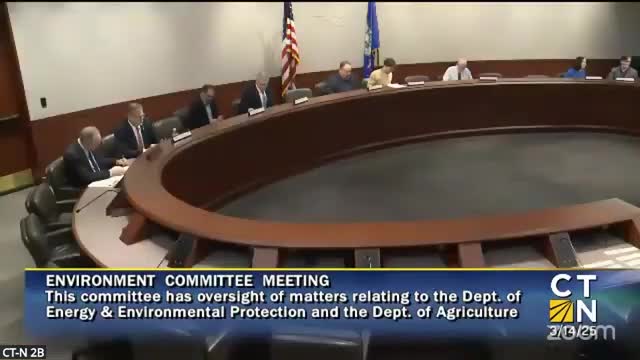
Summary
The Environment Committee voted to send House Bill 5004 to the floor on Friday, March 14, after hours of debate over battery energy storage safety and related energy provisions.
The Environment Committee voted to send House Bill 5004 to the floor on Friday, March 14, after several hours of debate about battery energy storage systems and other energy provisions. Representative John Michael Parker, chair of the committee, opened the session and presided over discussion and a series of roll-call votes.
The bill is a multipart energy and environment measure intended to protect environmental resources while supporting development of renewable energy and related jobs. Committee members debated substitute language and several floor amendments before advancing the bill.
Why it matters: HB 5004 touches on energy reliability, public-safety concerns tied to large battery installations and the state’s path for replacing fossil-fuel generation. Committee members said the bill is intended to balance climate goals, affordability and safety; opponents warned that elements could raise costs or leave reliability gaps.
Discussion focused heavily on large battery energy storage systems, often called BESS. Representative Anderson introduced an amendment that would have imposed a temporary statewide moratorium on new BESS projects until safety standards and emergency-response requirements were adopted. Anderson and other proponents cited recent thermal-runaway incidents, including a widely reported fire in Moss Landing, California, and said first responders and small-town volunteer fire departments may lack training and nearby operator support to manage large BESS incidents.
The moratorium amendment would have required minimum setback distances, a mandatory emergency-response plan for thermal runaway events, bonding or other surety from operators, insurance to cover damages, and a requirement that operators maintain personnel able to respond within two hours. Supporters said the changes were a temporary pause to ensure public safety as the technology scales. Opponents, including Representative Steinberg, argued a moratorium would chill deployment of storage needed for grid reliability and affordability and that siting and safety oversight should be handled through the Siting Council and Energy & Technology Committee.
The committee voted on that moratorium amendment by roll call; the amendment failed (10 yeas, 19 nays, 5 absent). Two other amendments also failed. A second amendment that would have explicitly added modular or “advanced” nuclear to the list of Class I renewable technologies was defeated on a roll-call vote (8 yeas, 21 nays, 5 absent). A third amendment that would have required battery systems be domestically manufactured also failed (8 yeas, 22 nays, 4 absent).
Representatives who opposed the moratorium emphasized the need for storage to balance intermittent wind and solar generation. Those who supported the moratorium stressed documented fires, potential toxic plumes, and long operator response times in some towns. Several members said they would continue discussions with agencies, firefighters and the Energy & Technology Committee to seek technical fixes and siting standards.
After debate and the failed amendments, the committee voted to refer HB 5004 to the House Committee on Judiciary, Finance, and Security (JFS) for a floor referral. A roll-call vote on the bill was held during the meeting; the clerk recorded the outcome on the record.
Committee members said conversations on safety, siting, and cost impacts will continue as the bill proceeds.
Sources and evidence: Committee discussions and roll calls are reflected in the official transcript of the March 14 Environment Committee meeting.