
State and federal representatives address funding uncertainty, trade and immigration impacts for Salinas
Get AI-powered insights, summaries, and transcripts
Sign Up Free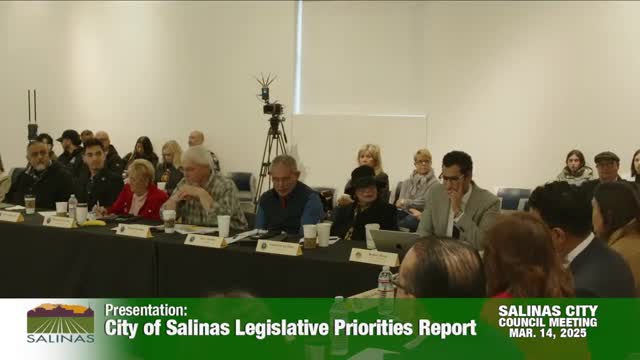
Summary
Representatives from state and federal offices highlighted recent federal funding flows to Salinas, warned of federal budget and tariff risks to agriculture and programs, and pledged support for local infrastructure and immigration issues.
State and federal legislative staff and officials addressed the Salinas audience on March 14, providing updates on appropriations, earmark processes and local impacts of national policy.
A staff member speaking for State Senator John Laird said the senator has engaged with Salinas stakeholders, supports wildfire mitigation planning (SB 326) and highlighted local partnerships on housing, homelessness and healthy‑food access. The senator’s office noted prior engagement with the Salinas Regional Soccer Complex and Hartnell College Alisal campus.
Staff from Representative Salud Carbajal’s office and others described uncertainty in Washington around the continuing resolution and appropriations; an office representative said congressional earmark portals were opening and encouraged local entities to prepare applications. Congresswoman Zoe Lofgren’s representative said the office would share guidance on community funding projects when available and noted the very short turnaround for prior cycles.
A member of Congress addressed the group (speaking virtually) and warned that proposed House Republican budget measures would increase the federal deficit and cut programs including Medicaid (Medi‑Cal in California) and SNAP. The speaker said Monterey County receives significant federal funds and that federal reductions or executive actions withholding funds could jeopardize nearly $47.5 million already allocated to Salinas projects and more than $81 million if business and nonprofit projects in the city are included. The speaker urged local governments to report any denied federal funds so congressional offices can assist.
California Assembly Speaker Robert Rivas also addressed the breakfast in a wide‑ranging overview, stressing affordability, climate resilience and the need to tailor state solutions to regional differences. Rivas said state budget pressures and changes at the federal level make collaboration between local, state and federal partners important for housing, infrastructure and disaster recovery.
Why it matters: legislative staff and members described both the availability of discretionary funding (earmarks/community funding projects) and the short windows typically associated with those programs. They also warned that broader federal budget and tariff actions could harm local agriculture and social safety‑net programs, creating new demands on local services.
Partners at the meeting encouraged Salinas officials to prepare applications for community funding projects, raise specific grant requests for congressional staff, and report any federal funding denials to legislative offices for assistance.