
Salinas officials warn roughly $40 million in federal infrastructure funding at risk; wastewater project bids exceed estimates
Get AI-powered insights, summaries, and transcripts
Sign Up Free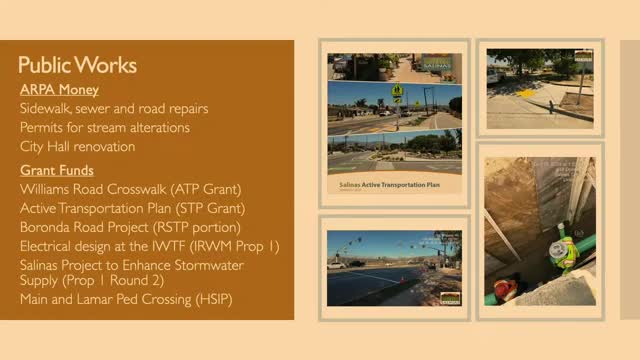
Summary
Public Works and city management updated partners on street, sidewalk, and industrial wastewater projects, and said construction bids have outpaced estimates on a key wastewater electrical design, potentially jeopardizing planned work tied to federal funding.
Public Works Director David Jacobs told the March 14 legislative breakfast that Salinas is making targeted uses of ARPA and grant money for sidewalks, crosswalk beacons and street repairs but faces funding and bidding challenges on larger infrastructure projects.
Jacobs reviewed recent uses of ARPA funds for sidewalks and pavement repairs and said the city advanced stream alteration permitting so it can desilt channels to reduce flood risk. He highlighted projects funded through grants: a flashing beacon crosswalk at Williams Road (an ATP and Active Transportation Plan award), a Highway Safety Improvement Program flashing pedestrian beacon at Main and Lamar, and the Bridal Road corridor under construction to serve future growth; Jacobs said only the first phase of Bridal Road is funded and the remaining two phases need roughly $50,000,000.
On industrial wastewater, Jacobs said the city completed electrical design work using Integrated Regional Water Management (Prop 1) funds but that construction bids subsequently came in far above engineering estimates. He gave an example: an earlier project estimated between $7.5 million and $8.0 million received bids at about $11.5 million, forcing staff to consider cutting scope to fit available grant funds. Jacobs said the city had secured roughly $20,000,000 through the Water Recycling and Reuse Department (WARDA) toward a $42,000,000 industrial wash water capacity project, but the remainder of funds and the timing are not certain.
City Manager Renee Mendez stressed the broader fiscal risk, telling partners there is “approximately $40,000,000 that are at risk” at the federal level because of uncertainty in federal appropriations and program flows. Mendez said wastewater capacity is critical to both housing and industrial development and urged partners to help protect federal funding streams.
Why it matters: the city framed wastewater conveyance and industrial wash capacity as prerequisites for both housing and economic growth, noting that unanticipated bid inflation or a cut in expected federal funds would force scope reductions or require borrowing.
Staff said next steps include seeking additional grant rounds, reevaluating project scopes to match awarded funds, and pursuing remaining phases of transportation projects if additional funding can be found.
Quotes in context: “We bid a project when we estimated the cost between 7.5 and $8,000,000 and the bids came in at $11,500,000,” Jacobs said. “So we’re now having to figure out what we have to cut to be able to actually get something built with the grant monies that we have.”