Get Full Government Meeting Transcripts, Videos, & Alerts Forever!
Get email alerts on the Community Services Immigration Legal Aid topic
No spam. Unsubscribe anytime.
El Centro describes expanded services, warns legal-aid cuts have left 350 on waiting list
Summary
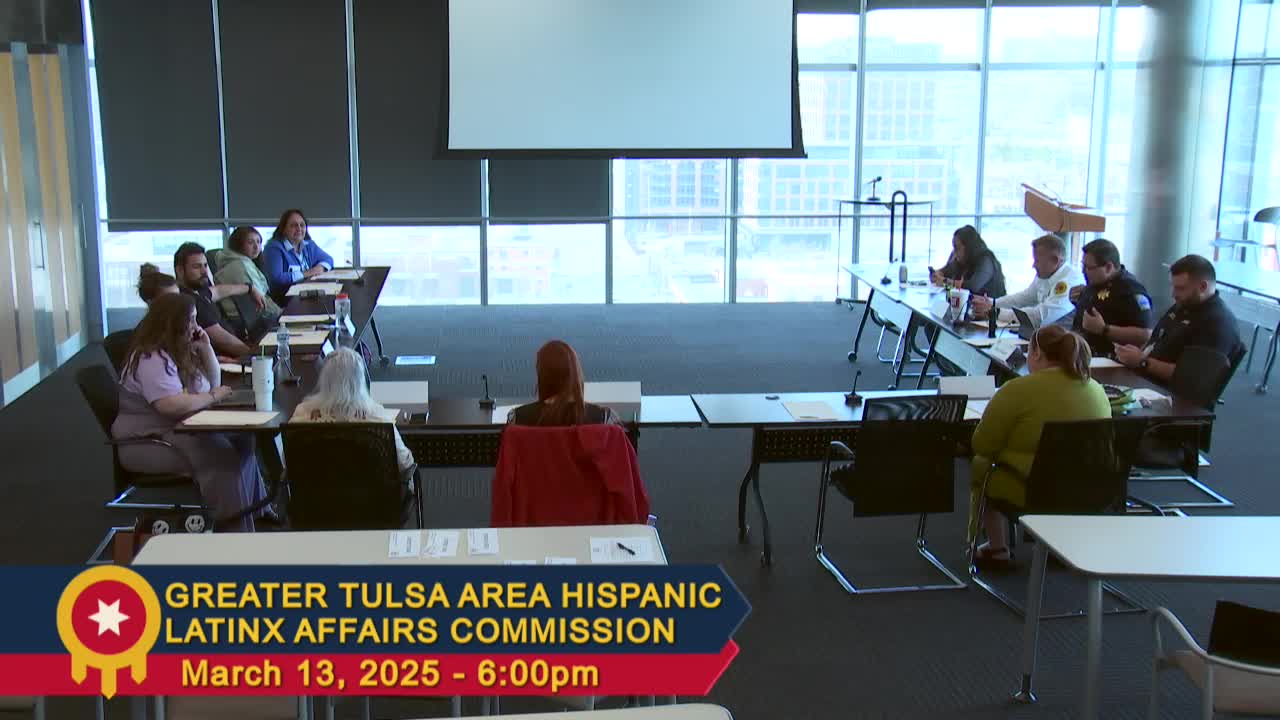
El Centro presented services including a community closet, ID membership card, crisis fund and peer-educator program and asked Tulsa Hispanic Affairs Commissioners for help replacing recently cut legal-aid funding; commissioners approved an officers slate and discussed drafting a letter on pending state immigration bills.
El Centro’s executive director, Marielena Quikindel, told the Tulsa Hispanic Affairs Commission on March 1 that the organization is expanding child-friendly community services and emergency assistance while facing a sudden loss of partner legal aid that has left hundreds waiting for help.
Quikindel, executive director of El Centro, said the nonprofit’s new Sanctuary Empowerment Center offers programs ranging from a free community closet and a membership ID to a crisis fund and community peer-educator training. "Eighty percent of the families we serve, they have kids under 8 years old," Quikindel said, explaining why each room in the center includes a corner for young children.
The commission heard that El Centro’s partnership-based free legal consultations—previously provided through the Tulsa Immigrants Resource Network, TU Legal Clinic and the YWCA—were cut when those partners lost funds under a recent funding decision. "We have 350 people in the waiting list to have these free legal consultations," Quikindel said, adding that the center is seeking new pro bono attorneys and other connections to restore the service.
Nut graf: The presentation underscored immediate community needs—basic material assistance, short-term cash aid and immigration-related legal help—while urging the commission and city partners to mobilize volunteers, funding and advocacy to replace cut services and to respond to state-level immigration bills discussed later in the meeting.
Key programs and service details
- Community closet: Donations of clothing and household items are available Monday–Friday, 10 a.m.–5 p.m.; volunteers sort and verify items so recipients receive clean, usable goods. Maria Nunez, El Centro’s administrative coordinator, described the closet as a steady source of basic needs and community-building: last month 28 community members brought donations.
- Membership ID: El Centro reports 809 members. The nonofficial ID includes a name, birth date and address and is intended to help residents access local services and avoid escalation during traffic stops; the ID explicitly states it is not a driver’s license.
- Crisis fund: Nunez described a small emergency cash program that "could vary. The max that we offer is $240 per family." The program requires an appointment and a one-hour interview with a peer educator; El Centro said the fund can assist roughly 36 families per month and that demand often exhausts available slots within hours of opening applications.
- Peer educators and doula support: El Centro trains community peer educators who provide intake, referrals and "authentic listening"; the organization said roughly 150 peer educators have been certified through prior cohorts. El Centro also partners with the Oklahoma Rural Equity Initiative on a community-based doula program serving 26 pregnant women for prenatal and postpartum support.
Community events and partnerships
Quikindel and staff listed recurring and planned events and partners that provide space and services, including collaborations with CAP Tulsa, Tulsa Parent Child Center, Early Learning Works, Assistance League, Blue Cross Blue Shield and local university programs. Past large events drew multiple thousands; staff said a previous children’s celebration brought more than 2,000 attendees.
State policy concerns raised at the meeting
Speakers urged commissioners to consider advocacy after describing recently proposed and passed bills in the Oklahoma Legislature that they say would affect immigrant residents. Quikindel asked commissioners to use their platform: "We need your voice. We need your rights to call of your people to say, Don't do that," she said, referring to a bill she described as criminalizing undocumented status and carrying large fines.
Commission members discussed three specific measures mentioned during the meeting: HB1688 (a bill to expand the ability to amend birth-certificate information), HB1362 (described in the meeting as an anti-immigrant proposal that would create felony penalties and large bond amounts for some immigration-related offenses), and Senate Bill 865 (described as a proposal to create an interagency platform for sharing information on unauthorized immigrants). The commission did not vote on a formal position at this meeting; commissioners discussed drafting a letter or a draft for approval at the next meeting and pursuing Human Rights Commission sign-on if desired.
Commission business and actions
The commission approved its slate of officers for the coming year and accepted corrected minutes before adjourning. A motion to approve the nominated slate—Am aidani (chair), Jackie (vice chair), Mark Onosorg (recorder) and Jose Bamaka (historian)—was made, seconded and carried by voice vote. The commission also voted to approve February meeting minutes with minor corrections and later voted to adjourn.
What commissioners and El Centro asked for next
El Centro staff asked for help identifying pro bono lawyers and trusted partner organizations to restart free immigration consultations, for support publicizing donation needs and for coordination with city offices on outreach. Commissioners agreed to draft a letter for consideration at the next meeting if the commission wishes to take a formal position on pending state bills; staff offered to forward bill-tracking links and suggested coordination with the Human Rights Commission for additional sign-on.
Ending: El Centro invited commissioners and community members to visit the new center at 1801 (address provided during the meeting) and to donate clothing, small household items and toys. The organization said it remains focused on short-term relief for families while trying to rebuild legal-aid partnerships and strengthen referral pathways for immigrant residents.
Votes at a glance
- Motion to approve slate of officers (nominees: Amaidani chair; Jackie vice chair; Mark Onosorg recorder; Jose Bamaka historian): motion carried by voice vote (motion/second recorded; no roll-call tally provided). Refer to actions[].
- Motion to approve corrected meeting minutes: motion carried by voice vote (motion/second recorded; no roll-call tally provided). Refer to actions[].
- Motion to adjourn: carried by voice vote.