Get Full Government Meeting Transcripts, Videos, & Alerts Forever!
Get email alerts on the Medicare Transition topic
No spam. Unsubscribe anytime.
SFHSS, Blue Shield report fewer calls but members and advocates press unresolved MAPD issues
Summary
SFHSS staff and Blue Shield of California reported a sharp drop in MAPD-related call volume in February and said many transition problems have been fixed, but member advocates and retirees told the board that unresolved issues — including claims for facility fees and acupuncture coverage — persist.
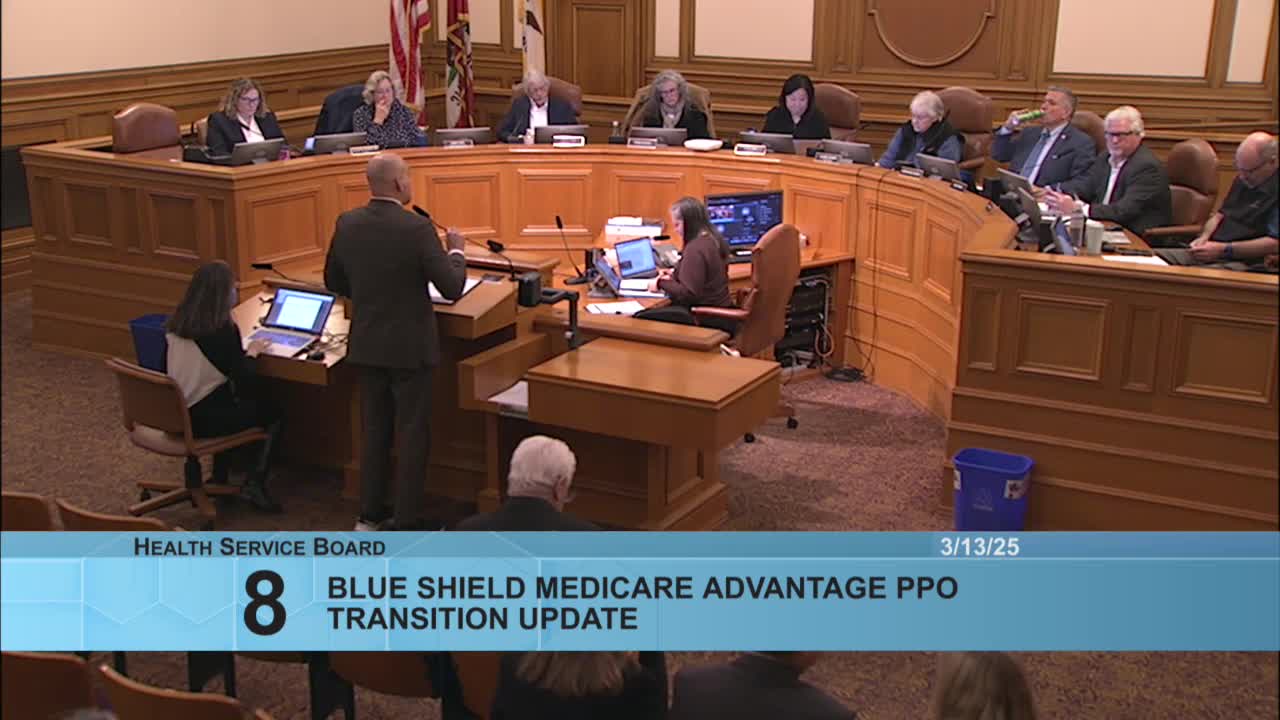
San Francisco Health Service System (SFHSS) staff and representatives from Blue Shield of California told the Health Service Board on March 13 that call volume and service metrics tied to the Blue Shield Medicare Advantage PPO (MAPD) transition fell substantially in February, and that many reported issues have been resolved.
The update came as the board heard repeated public comments from retirees and the advocacy group Protect Our Benefits asking the system and the insurer to resolve remaining claims and to “replicate” services members said they had under the prior carrier.
Ray Guillen, SFHSS chief operating officer, said the system and Blue Shield held a March 4 roundtable with Protect Our Benefits and that both organizations saw call volumes drop by roughly half from January to February. “We have experienced significant improvement in our average speed of answer, our average handle time, and our first call resolution compared to January,” Guillen said.
Charles Lee, senior manager for Blue Shield’s group Medicare business, told the board Blue Shield’s own call metrics also improved: abandonment rates fell to about 1 percent and average speed to answer returned to roughly a 30‑second window. Lee said the carrier identified and corrected several issues, including an eligibility-file problem with its transportation partner and a claims-processing error that led to an extra $100 copay for some outpatient facility services.
“We’ve corrected the issue on the claim side, on the back end, and we will reprocess claims and communicate with retirees on how to get reimbursement should they have paid that $100 claim,” Lee said.
Blue Shield also provided pharmacy data for January showing about 12,000 members used pharmacy benefits and roughly 37,000 prescriptions were fulfilled without issue; another 2,300 prescriptions required prior authorization steps but were largely processed, Lee added. Blue Shield said it meets Centers for Medicare & Medicaid Services (CMS) prior‑authorization turnaround times (24 hours for expedited requests, 72 hours standard) and gave retirees a Blue Shield contact number: (800) 370‑8852, available 8 a.m.–8 p.m., seven days a week.
Tiffany Gill, Blue Shield account executive, said the carrier will issue an additional member communication answering frequently asked questions, will provide monthly and quarterly reports to SFHSS staff, and will participate in retiree‑education webinars alongside SFHSS.
Public commenters acknowledged improvements but urged continued action. Fred Sanchez, president of Protect Our Benefits, praised Blue Shield for fixing the UCSF facility fee issue but told commissioners many members were still contacting advocacy groups. “The email volume that we’re getting from not only POB, RECCSF, CARA people…has not decreased; it has actually increased,” Sanchez said.
Other callers described individual problems. Herbert Weiner said Blue Shield had not “replicated” services retirees received under UnitedHealthcare and urged a policy that would automatically replicate prior services rather than resolve issues case-by-case. Jan Miller said her husband, a retired San Francisco teacher, had six weeks of unresolved claims for acupuncture through American Specialty Health (ASH), and that ASH’s claim processing and co‑pay information had not matched Blue Shield’s evidence of coverage.
Guillen and Blue Shield officials acknowledged remaining variances between the prior plan and the current Blue Shield benefit designs and emphasized education for both members and providers. Blue Shield discussed an expanded “100‑day” supply pharmacy feature and said it would work with providers who generally write 90‑day prescriptions to minimize any disruption. Lee said members who were improperly charged should either receive a mailed EOB (explanation of benefits) showing the reversal or can contact Blue Shield proactively to begin reimbursement.
Blue Shield and SFHSS staff told the board they will continue special monthly MAPD transition updates until metrics stabilize and then fold MAPD metrics into the regular director’s report.
The board did not take a formal vote on the MAPD update; the session was a staff and contractor briefing followed by public comment.
Public comment and follow‑up: Board members and staff said they will monitor monthly call metrics and written complaint volumes, and Blue Shield committed to additional member communications, provider education on 100‑day supplies and ASH benefits, and reprocessing of identified erroneous charges.