
Tulsa committee opens public hearing on draft 2025 HUD annual action plan as residents press for outreach and neighborhood focus
Get AI-powered insights, summaries, and transcripts
Sign Up Free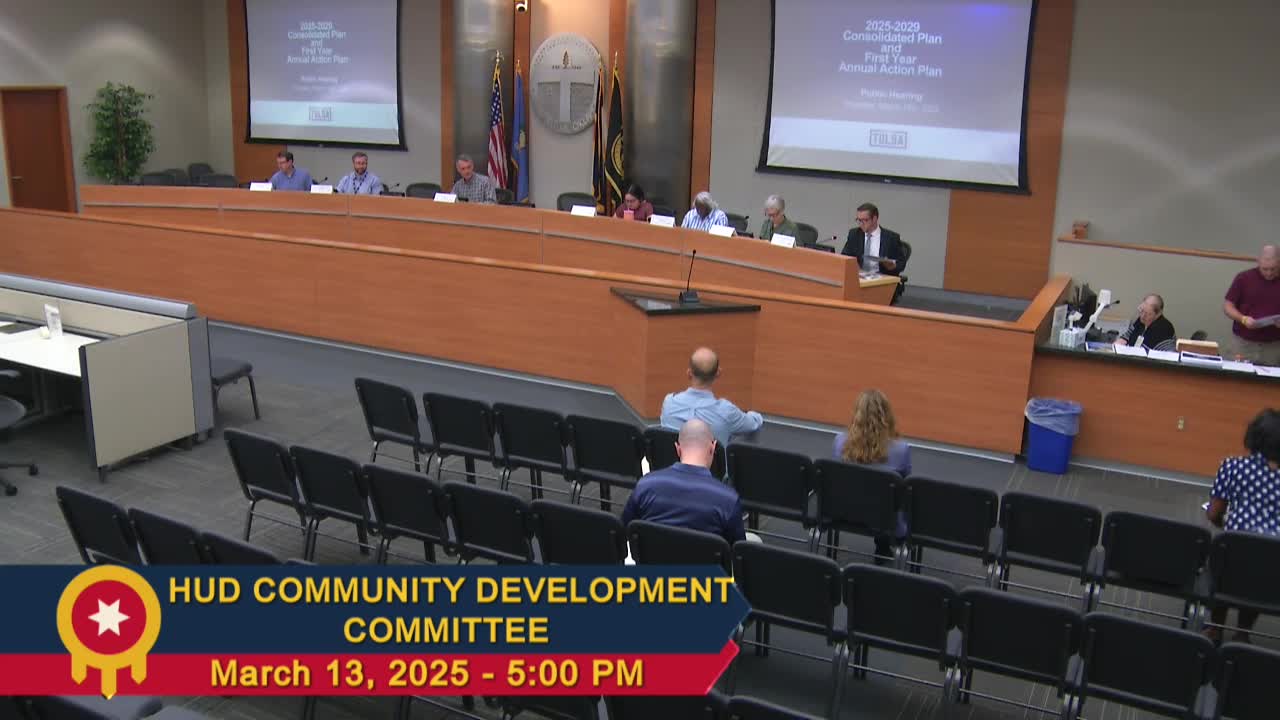
Summary
The City of Tulsa's HUD Community Development Committee opened a public hearing March 13 on the draft Program Year 2025 Annual Action Plan, a five‑year consolidated plan framework and first‑year budget recommendation that directs federal Community Planning and Development formula funds.
The City of Tulsa's HUD Community Development Committee opened a public hearing March 13 on the draft Program Year 2025 Annual Action Plan, a five‑year consolidated plan framework and first‑year budget recommendation that directs federal Community Planning and Development formula funds.
Grants administration staff presented the draft consolidated plan and histrory of the process, saying the plan ties the city's funding priorities to guidelines for the four CPD formula block grant programs and the committee's nine approved priorities, and that remaining public comment will be accepted through April 2 before recommended allocations go to City Council. The staff presentation noted the city’s process is governed by City of Tulsa Ordinance, Title 12, Chapter 8, and that the draft plan will be submitted to HUD by May 15 pending final allocations.
Why it matters: The annual action plan determines which local organizations, neighborhood projects and housing services receive federal HUD funds used for affordable housing, homelessness services, housing rehabilitation and neighborhood investments. This year’s draft allocations are estimates until HUD issues final formula allocations and a grant agreement; staff warned federal budget action could delay HUD’s allocation notice and therefore contract execution with subrecipients.
What staff told the committee
A grants administration representative outlined the schedule and steps: the PY25 request for proposals was released Oct. 4, 2024; RFP workshops were held in October; applications were due Nov. 22; applications were scored in December through January; HUD Community Development Committee funding‑recommendation meetings took place in February; and the draft annual action plan comment period runs March 3–April 2. Staff said 38 applications were accepted across external agencies and city departments, 30 proposals were recommended for funding, and two city departments were recommended to conduct five activities. The draft plan lists 9 priorities and 11 goals, and shows estimated funding drawn from possible PY25 HUD allocations, prior‑period carryover and projected program income. Staff repeatedly cautioned that allocations are estimated and subject to change until HUD issues final numbers and a grant agreement.
Public commenters press for stronger outreach and neighborhood focus
Several public speakers urged the committee to use the plan to expand outreach and to direct more resources to long‑underserved neighborhoods.
Sharla Walker, family self‑sufficiency coordinator with Tulsa Housing Authority, told the committee the Housing Authority’s Family Self‑Sufficiency (FSS) program — which pairs case management, job and education supports with an escrow savings account and a HUD‑funded mortgage subsidy for eligible participants — is underutilized in Tulsa. “This program has been funded through HUD since the nineties,” Walker said. She described a homeownership option that can pay a portion of a qualified participant’s mortgage for up to 15 years (30 years for some seniors or people with disabilities) and urged the city and the committee to help better market the program and to partner on rehabbing long‑vacant homes for first‑time buyers.
Brent Isaacs of Mental Health Association Oklahoma thanked the committee for prior funding and urged continued emphasis on rental housing rehabilitation and services for extremely low‑income households. He cited a National Low Income Housing Coalition report on the local shortage of units affordable at 30% of area median income and warned that “funding has become very challenging” at the federal level.
Long‑time North Tulsa residents also spoke. James Alexander Jr. and Bernice Alexander criticized how HUD and city funds have been spent over time and argued the money originally intended for North Tulsa development has been spread across the city rather than concentrated where residents say it was meant to support long‑term neighborhood wealth building. Bernice Alexander called for the committee to study the program’s original purpose and local spending patterns.
Staff responses and caveats
Committee members and staff responded with procedural and technical clarifications. Grants administration staff noted HUD reviews consolidated plans and that earlier consolidated annual performance and evaluation reports (CAPERs) had been approved by HUD; staff said the most recent CAPER showed about 95% of funds benefitted low‑ and moderate‑income persons, with demolition activities not counted in that LMI total. On the timeline, staff said allocations are estimates and that final HUD allocations and grant agreements often arrive well after federal appropriations are enacted, which can delay the city’s ability to execute subrecipient contracts.
Votes and next steps
The committee voted to open the public hearing, then closed the public hearing later in the meeting and moved the recommended draft to the next step in the process. Staff said the draft allocations, public comments and the committee’s recommendations are scheduled to appear on the April 2 City Council agenda; the consolidated plan and first‑year annual action plan will be submitted to HUD by May 15 if allocations are available.
The committee handled routine business at the meeting as well: minutes from the Feb. 6 meeting were approved before the public hearing was opened, and the meeting adjourned after the public hearing was closed.
Tallying what was said
Speakers urged stronger outreach to low‑income households and to the Tulsa Housing Authority’s FSS program; asked for clearer tracking of neighborhood‑level investments, particularly in North Tulsa; and pressed staff to be transparent about the limits of the city’s authority (for example, zoning and demolition do not count toward LMI measures). Staff reiterated that allocations in the draft are estimates, that HUD must issue a grant agreement for spending to begin, and that federal appropriations delays could postpone contractual work with subrecipients.
What’s next
Public comment on the draft plan remains open through April 2. Staff expect allocation recommendations to be on the April 2 City Council agenda; once HUD issues an official allocation and grant agreement, the city will finalize contracts with recommended subrecipients. The grants office encouraged written comments via grantsadmin@cityoftulsa.org and posted the draft plan and a translatable version on the city website.