Get Full Government Meeting Transcripts, Videos, & Alerts Forever!
Get email alerts on the Conditional Use BA24051C topic
No spam. Unsubscribe anytime.
Howard County Board of Appeals dismisses conditional-use petition after finding public-notice shortcomings
Summary
The Howard County Board of Appeals dismissed the conditional-use petition for 2921 Terrapin Run (case BA24051C), finding the petitioner failed to meet public-notice and posting requirements in Howard County Code §2.203 despite the petitioner’s counsel arguing the deficiencies could be cured.
The Howard County Board of Appeals dismissed a conditional-use petition for a landscaping business at 2921 Terrapin Run in West Friendship on March 13, 2025, after finding the petitioner failed to satisfy public-notice and posting requirements in Howard County Code section 2.203.
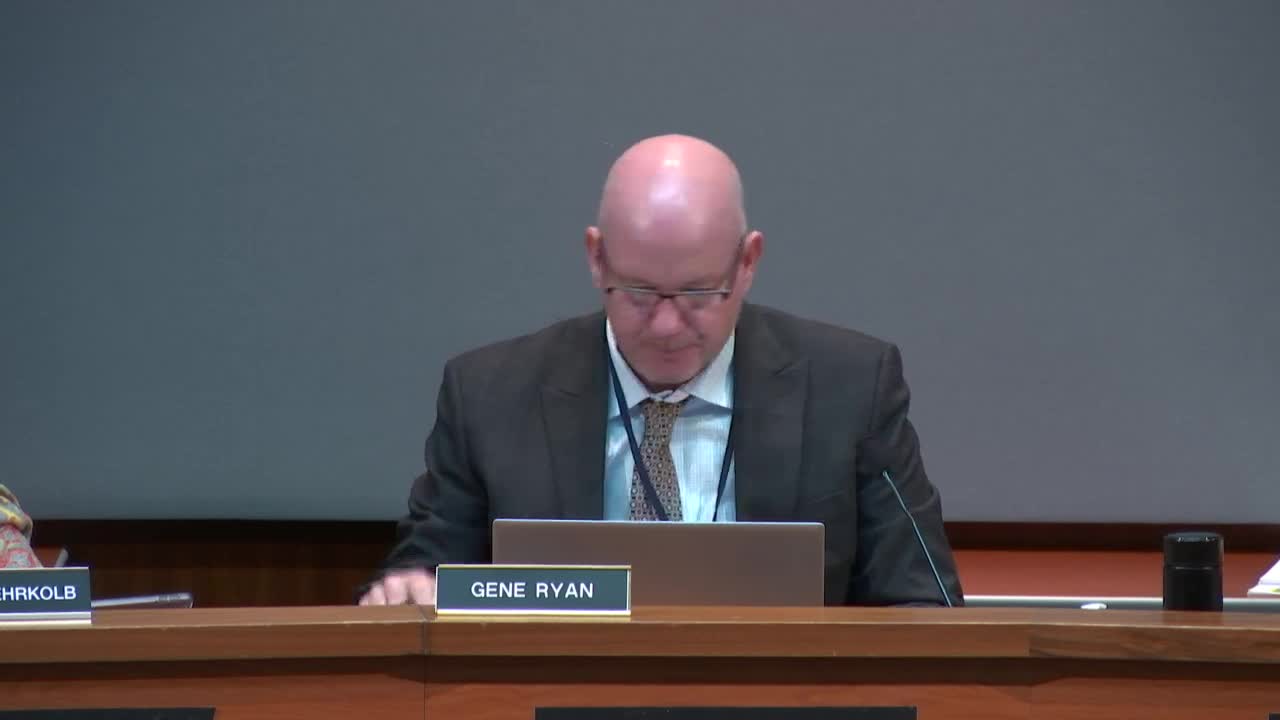
The dismissal came after a contested preliminary hearing on whether the petitioner had made a “good faith effort” to comply with notice requirements. Chair Gene Ryan announced the board’s final vote: “I will vote yes to dismiss. The motion is carried. The petition is dismissed. The office of law will prepare a decision order which we published and transmit all parties and this hearing is adjourned. Thank you, everyone.”
The petition, filed by Bernard Granzo trading as Blythewood Landscape Management LLC (case BA24051C), sought conditional-use approval under the County zoning regulations for a landscape contractor at a 5.48-acre parcel identified as 2921 Terrapin Run (tax map 15, grid 23, partial 160) in the RC/DEO (Rural Conservation Density Exchange Overlay) zoning district. The board heard argument and testimony from petitioner, the petitioner’s counsel Andrew H. Robinson, Board staff (Mr. Sanders), and neighborhood residents opposed to the petition.
Why it matters: Howard County’s rules require both newspaper advertising and on-site posting to provide notice of quasi-judicial land-use hearings; failure to comply can bar a board from hearing an application. Section 2.203 requires publication in at least two newspapers of general circulation in the county (for non-residential petitions at least 30 days prior to the hearing) and on-site posters erected perpendicular to the road and maintained for 30 days prior to the hearing.
Board members focused on three issues: 1) whether advertisement in a newspaper met the 30-day publication requirement; 2) whether the affidavits and certifications for the newspapers were in the record; and 3) whether the on-site poster was erected and displayed as required by code (perpendicular to the roadway, supplied by the Department of Planning and Zoning and maintained for 30 days). Board staff pointed out that one advertisement’s certified publication date (Howard County Times copy certified by the Baltimore Sun Media Group) listed Feb. 13, 2025, which the board concluded was two days short of the 30-day requirement for a March 13 hearing. The affidavit of posting had a signature/notary irregularity, and board members reported differing results from site visits: some said they could not find a perpendicular poster; the petitioner acknowledged the sign had been placed on the property’s fence rather than perpendicular to the road.
Petitioner and counsel asked the board not to dismiss. Counsel Andrew H. Robinson argued that the petitioner had “acted in good faith” to publish ads and post notice, that proofs of the advertisements were submitted to the Department of Planning and Zoning, and that dismissal would be an “extraordinary” remedy causing disproportionate harm to his client. The petitioner testified he attached the poster to the fence to keep it from being blown away or stolen and said the placement was not intended to defeat notice.
Opponents and several board members said the posting and advertising deficiencies undermined effective public notice. Resident Gene D. Gallaher and other neighbors told the board they either did not see the sign or found it difficult to view from the roadway. Several board members said they visited the site and could not find a properly placed poster. The board reviewed the statutory text of §2.203, which places the burden on the petitioner to prove compliance and permits the board to dismiss if it finds no good-faith effort, or to allow a cure or proceed if substantial compliance or good-faith efforts are found.
After discussion and two-minute responses from petitioner and an opponents’ spokesperson, a motion to dismiss the petition for failure to comply with §2.203 was offered, seconded, debated, and then put to roll call. The board concluded that the petitioner had not met the burden of proving a good-faith effort to comply and voted to dismiss. The board instructed the Office of Law to prepare a decision order for circulation to the parties.
Votes at a glance: The board carried two routine procedural votes at the start of the evening approving the open- and closed-session minutes from March 6, 2025. The substantive vote on case BA24051C resulted in dismissal for failure to meet public-notice and posting requirements under Howard County Code §2.203.
What happens next: The dismissal means the petitioner does not receive conditional-use approval. Under the zoning regulations discussed at the hearing, a petitioner may refile, but time limits and requirements for refile or new filings apply; the board noted the record includes options such as allowing a cure if the board had found good-faith effort, or re-advertising and reposting to bring the matter back before the board or examiner. The Office of Law will issue the board’s written decision with the reasons for dismissal.
The board’s hearing record incorporated materials including the Howard County Code and Charter, Howard County Zoning Regulations, the Department of Planning and Zoning technical staff report (Oct. 21, 2024) and attached agency comments, and the conditional-use petition and plan materials. The board explicitly treated its action as a de novo appeal from the December 18, 2024 hearing examiner decision on the matter.
Chair Ryan adjourned the hearing after the board’s vote and directed the Office of Law to prepare and distribute the final decision order to the parties.