Get Full Government Meeting Transcripts, Videos, & Alerts Forever!
Get email alerts on the State Legislation topic
No spam. Unsubscribe anytime.
Gilpin County meets with lobbyists, sets monitoring/support positions and hears sheriff's objection to firearms training-card bill
Summary
The county met with Policy Matters lobbyists and discussed positions on multiple state bills; the sheriff's office urged opposition to a bill requiring a firearm-safety eligibility card, citing potential costs and operational burdens for rural sheriffs' offices.
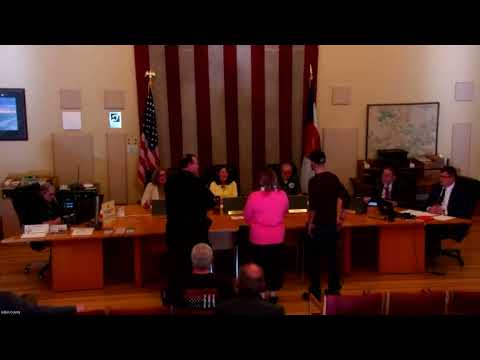
Gilpin County commissioners met March 11 with contract lobbyists from Policy Matters to review the county’s positions on a slate of bills at the Colorado Legislature and to decide whether to monitor, amend, support or oppose selected measures.
Heather Retzko, principal at the Policy Matters firm, and Katie Hancock, budget and policy analyst, introduced themselves and reviewed a tracking sheet of bills. Commissioners and lobbyists agreed to remove several bills that had been “postponed indefinitely.” The group then discussed individual measures on the county’s watch list and, in several cases, set or confirmed positions.
Key early positions recorded during the meeting included: monitoring House Bill 1031 (law-enforcement whistleblower provisions), supporting a measure addressing post-death rental obligations (House Bill 1108), monitoring a local minimum-wage/tipped-employee offset bill (House Bill 1208), and supporting legislation on insurer risk-model transparency (House Bill 1182). Commissioners also expressed support for proposed expansion of county lodging-tax authority (House Bill 1247) with a preference to seek up to 6% in local unincorporated areas, subject to voter approval.
The meeting included testimony from Undersheriff Greg Dimo, speaking for Sheriff Armstrong, on Senate Bill 2503 (a bill that, in its then-current form, would require issuance of a firearm-safety-course eligibility card before purchasing certain semi-automatic firearms). Dimo told the board the sheriff’s office did not support the bill and noted the Colorado County Sheriffs Association and other sheriffs opposed it in its present form. Dimo said the bill originally placed responsibilities and costs on sheriffs’ offices; later amendments removed the sheriff from the issuance process and shifted responsibility toward Colorado Parks and Wildlife, but Dimo warned that the change would not eliminate costs and could create state-level delays for residents seeking to exercise firearm-purchase rights.
Dimo provided a conservative county-level cost estimate in the event Sheriffs’ offices were required to administer the program: a live-scan fingerprint machine ($30,000), one full-time records specialist (~$57,500 salary), one full-time deputy (~$102,750 salary and benefits) and programming or equipment (~$2,000), for an estimated initial impact of about $192,250. He said Gilpin County currently has roughly 366 active concealed-weapons permits and a population of about 6,200; he cautioned the county could face “unfunded mandates” if sheriff duties were restored to the bill.
Policy Matters staff and commissioners agreed to continue monitoring bills and to lean toward ‘amend’ or ‘support’ where stakeholders produce acceptable language. The lobbyists said they would update the county as the Joint Budget Committee and individual committees acted on proposals, and they flagged that many bills were being postponed or reworked during a year with a large budget deficit at the state level.
The board heard no final action to adopt a formal county position on gaming-related legislation; lobbyists said they expected such measures could still be introduced but none had been filed by the governor at that time.