Get Full Government Meeting Transcripts, Videos, & Alerts Forever!
Get email alerts on the Transportation Infrastructure topic
No spam. Unsubscribe anytime.
CDOT outlines multi‑year Floyd Hill construction schedule, traffic and blasting impacts
Summary
Colorado Department of Transportation officials gave Gilpin County commissioners a detailed update on the I‑70 Floyd Hill project, including timelines through 2029, daily rock‑blast holds, traffic mitigation measures and wildlife, trail and air‑quality protections.
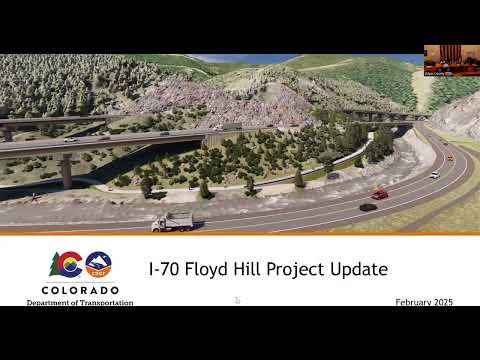
Colorado Department of Transportation officials presented an update Tuesday to the Gilpin County Board of County Commissioners on the multi‑year Floyd Hill reconstruction project on Interstate 70, describing construction milestones through 2029, frequent rock blasting and steps CDOT is taking to limit traffic impacts and protect wildlife and trail users.
The presentation, delivered by Kirk Kianka, CDOT Floyd Hill project director, and Tamara Rollison, CDOT Region 1 communications manager, said construction began in July 2023 and is being delivered in three primary sections — east, central and west — with different completion milestones for each. Kianka told commissioners the project is “under construction for a little over 18 months” and that work on the heavy central section will continue into mid‑2029.
CDOT gave a timeline of major milestones: the west section is expected to be complete at the end of 2027; the eastbound I‑70 alignment is scheduled for the end of 2028; weather‑dependent paving, landscaping and frontage‑road work are expected to extend some finishing work into 2029. Kianka said the project has interim milestones that will open travel benefits earlier than the final completion date.
Why it matters: CDOT said the project aims to improve travel‑time reliability, relieve a westbound bottleneck on the descent of Floyd Hill, upgrade aging bridges and roadway geometry, improve multimodal connections and add resilience by creating a new frontage‑road alternate route that ties into County Road 314. Commissioners were told the project will add a full‑time toll express lane in the westbound direction, extend an eastbound on‑ramp so merging vehicles have more distance to reach highway speed, and reconstruct the Greenway Trail to 10‑foot concrete ADA standards.
Key technical and schedule details provided by CDOT:
- The project adds a third westbound lane (operated as a 24/7 toll express lane) and extends ramp capacity on the eastbound side to improve merge safety on a 7% grade.
- CDOT is building a long viaduct/segmental bridge structure in the saddle area; some spans will exceed 300 feet and require in‑place balanced‑cantilever construction because standard girders cannot be transported to the site.
- The central section is the heaviest‑construction area; CDOT anticipates cranes, temporary bridges and 80‑foot columns to appear in summer and fall construction seasons.
- CDOT reported that it will remove more than 500,000 cubic yards of rock on the project and that crews have completed about 40 rock blasts to date, with more than 200 blasts planned through 2026.
Traffic management and public notices
Kianka and Rollison emphasized strategies to limit disruption on the I‑70 corridor. CDOT said it will keep at least one travel lane open in each direction during off‑peak overnight work windows and will perform most lane closures overnight. When rock blasts require short traffic holds, CDOT said they typically last up to 20 minutes; worst‑case scenarios can take up to 45 minutes to clear in congested areas such as Argo. Kianka said, “we are committed to keeping all lanes and ramps of I‑70 open during peak times.”
CDOT also described measures to reduce traveler impacts: working behind barrier, building over live traffic with protective scaffolding where needed, coordinating schedules with other nearby projects (including the Peaks To Plains Trail), and notifying emergency responders before blasts. Rollison urged residents to sign up for “rock blasting” text alerts (text FLOYDHILL to 21000) and pointed to weekly e‑blasts, a project website on codot.gov, the cotrip.org traffic site and variable message signs as keys to communications.
Safety, environment and multimodal improvements
CDOT noted several non‑motorized and environmental improvements: reconstruction of the Greenway Trail to a 10‑foot concrete, ADA‑compliant route, four miles of wildlife fencing and a wildlife crossing previously constructed at Genesee that CDOT said is already being used by elk, bobcats and other animals. CDOT stated the crossing is expected to reduce wildlife‑vehicle collisions in that area by about 90 percent. The project team also said two permanent air‑quality monitors were installed — one in Idaho Springs (upstream) and one at the eastern end of the project — and the data are posted on the project website.
Community coordination and mitigation
Project staff said they coordinate with first responders and community stakeholders through a CSS stakeholder group that includes recreation, rafting, fishing and biking representatives. CDOT said it has implemented an on‑demand courtesy shuttle (Pegasus) in summer months that can use the Mountain Express lane to reduce single‑occupant vehicles, and it plans to provide a shuttle when the Greenway Trail is closed for construction.
What residents can expect next
CDOT laid out near‑term work by quarter: continued median work and drainage on the east section, major traffic shifts and foundation work for the central section starting in early summer, and continued blasting on the west section with substantial excavation expected near the transmission tower and Saddlecut. CDOT said work that requires low creek flows — river work and close‑to‑stream foundations — will occur in the low‑flow season, and that segmental bridge construction over live traffic will become visible in fall and winter phases.
Commissioners’ questions and public comments
Commissioners asked about hours of closures (CDOT reiterated most work is overnight with lane closures, and that full I‑70 closures are not expected), rock disposal destinations (CDOT said excavated rock is sent to multiple off‑site locations including sites near Central City Parkway and other places in the I‑70 corridor), and whether Central City Parkway would be closed during construction (CDOT said prolonged closure is not planned and that access to Central City is a priority). Commissioners also asked about the size and placement of a future roundabout at the Central City Parkway interchange; CDOT said the roundabout is being designed for semi‑truck turning radii and that artwork and landscaping in the roundabout are under discussion with stakeholders.
Limitations and outstanding questions
CDOT did not present new cost figures in the meeting. Project staff said certain timeline items — paving, landscaping and final frontage‑road work — remain weather‑dependent, which is why some finishing work is scheduled into 2029. Several construction methods (for example, segmental bridge casting in place) were described at a high level rather than with detailed engineering specifications.
Commissioners were told CDOT will continue outreach and coordination, and staff offered to return with further renderings and details, including a future rendering of the Central City Parkway roundabout.
Ending
CDOT left commissioners with two practical recommendations: sign up for rock‑blast text alerts and use cotrip.org for live traffic conditions. The agency said it will continue stakeholder engagement and return with additional design visuals and construction updates as the project progresses.