Get Full Government Meeting Transcripts, Videos, & Alerts Forever!
Get email alerts on the Reproductive Health Funding topic
No spam. Unsubscribe anytime.
Minnesota House Debates, Then Rejects Bill to Restore Grants for Pregnancy Resource Centers
Summary
After hours of floor debate and multiple failed amendments, the Minnesota House declined to reinstate state grants for pregnancy resource centers and maternity homes under House File 25; the presiding officer announced the bill did not pass following a roll call tally of 67 ayes and 65 nays.
The Minnesota House of Representatives debated House File 25, a bill authored by Representative Zalesnikar to restore state grants for pregnancy resource centers and maternity homes, but the chamber did not adopt the measure after a full day of debate and multiple amendment votes. The clerk recorded “There being 67 ayes and 65 nays,” and the presiding officer announced the bill did not pass.
Representative Zalesnikar, the bill’s author, framed House File 25 as a restoration of a bipartisan program that ran from 2005 through 2023. “House file 25 is really a simple common sense bill,” she said on the floor, saying the measure would reinstate “positive alternative” grants that previously funded services such as parenting classes, car-seat programs and maternity-home support.
Supporters described the grants as an extension of services that had been funded for 17 years. Representative McDonald and others cited state and grant-level data during debate, noting programs had served thousands of women and distributed material supports such as cribs and car seats. Representative McDonald said the grants had helped “over 32,000 women” and enumerated examples including car-seat safety classes and crib provision; several supporters urged reinstating the prior bipartisan approach to funding.
Opponents challenged that characterization and raised concerns about the nature and oversight of crisis pregnancy centers. Representative Gomez recounted a personal experience visiting a center and argued those organizations “go to great pains to make themselves appear to be medical clinics,” and said “the deception and the misleading practices of these organizations are not incidental. They're core to their mission.” Representative Hollins, Representative Hansen Jay and others cited data and studies they said show most of these centers do not employ licensed medical staff and are not subject to the same licensure or patient-privacy rules as medical clinics.
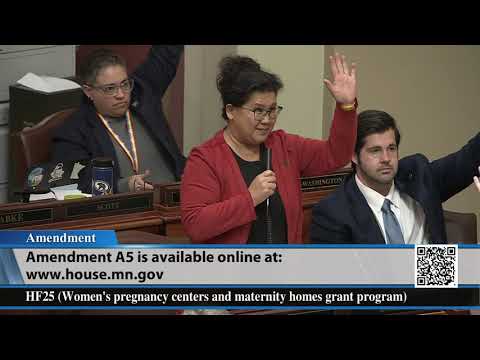
Several floor amendments sought to change the bill’s scope and reporting requirements. Representative Herr offered amendment A5 (to strike language described by proponents as restricting employees’ ability to present options), which failed on a roll call (66 ayes, 67 nays). Representative Ryer offered amendment A6 (and a related amendment to the amendment) to require that centers disclose on-site licensed medical staffing and to require visible signage when no licensed medical professional is present; the amendment to the amendment failed on a roll call (66 ayes, 67 nays) and the underlying amendment also failed (66 ayes, 67 nays). Representative Gomez’s amendment A7 (which would have changed the bill title on the statute) did not pass (66 ayes, 67 nays). Representative Bierman’s amendment A8, which would have given the Commissioner of Health limited oversight authority and added privacy protections, failed (66 ayes, 67 nays). Representative Purcell’s amendment A9 (which would have redirected or coordinated funding with existing family-planning grants) also failed (66 ayes, 67 nays). The clerk recorded the repeated 66–67 tallies for those amendments and announced they were not adopted.
Debate on the floor reflected sharply divided views. Proponents emphasized restoring previously bipartisan funding for “positive alternative” programs and described concrete services provided by centers and maternity homes, including the loss of multi-year grant funding for specific providers. Representative Zalesnikar noted grant amounts she said programs had lost when the earlier funding ended. Opponents argued the centers often operate without clinical licensure, can present misleading information to people seeking medical care, and in some cases may decline to refer clients to abortion providers; they urged state funds be directed to regulated, clinical providers and other maternal-health investments instead.
The House also heard personal testimony from multiple members about their own experiences accessing care or working with providers; several members recounted visits to both crisis pregnancy centers and licensed health clinics to illustrate divergent experiences. Speakers on both sides referred to audits, grant compliance periods, and state studies; proponents pointed to prior compliance and auditing practices dating back to 2005, while opponents cited national and Minnesota figures they said showed low percentages of centers reporting physicians or registered nurses on staff.
After the amendment votes and the third reading, the clerk conducted the roll for final disposition. The clerk announced the vote tally and the presiding officer announced that the bill did not pass. There were no further amendments at the desk and no formal direction to staff or committees recorded on the floor during the transcript segment provided.
Votes at a glance - Amendment A5 (mover: Representative Herr) — result: not adopted; tally: 66 ayes, 67 nays. - Amendment A6 (mover: Representative Ryer) — result: not adopted; tally: 66 ayes, 67 nays. An amendment to the amendment (mover: Representative Reimer/Ryer) also failed (66 ayes, 67 nays). - Amendment A7 (mover: Representative Gomez) — result: not adopted; tally: 66 ayes, 67 nays. - Amendment A8 (mover: Representative Bierman) — result: not adopted; tally: 66 ayes, 67 nays. - Amendment A9 (mover: Representative Purcell) — result: not adopted; tally: 66 ayes, 67 nays. - Final disposition, House File 25 (third reading, final passage roll call) — clerk announced: 67 ayes, 65 nays; presiding officer announced the bill did not pass.
What the record shows and does not: The transcript records the text of floor arguments, amendment motions, roll-call tallies for each amendment and a final tally; it does not include a full, named roll-call vote listing for each member in the excerpt provided, nor does it record post-floor committee referrals or next procedural steps. The transcript also contains multiple personal anecdotes and differing interpretations of audit and licensing history; the article reports those claims and the speakers who made them but does not assert facts beyond the statements attributed to members or the tallies announced by the clerk.