Get Full Government Meeting Transcripts, Videos, & Alerts Forever!
Get email alerts on the Legislation topic
No spam. Unsubscribe anytime.
House Environment and Transportation Committee approves wide slate of bills on housing, traffic enforcement, and local regulation
Summary
At its seventh voting session the committee advanced more than two dozen bills, approving measures on rental assistance administration, eviction notices, landlord entry, fair housing disparate-impact language, expanded speed monitoring authority, on-site wastewater inspection requirements and other local- and state-level changes.
The House Environment and Transportation Committee on the afternoon of its seventh voting session approved a large package of bills that included changes to the state’s rental assistance program, new notice and handling requirements for evictions, landlord entry rules, a codification of disparate-impact housing law, an expansion of speed-monitoring authority and new inspection requirements for on-site wastewater systems.
The measures advanced by the panel were mostly approved on voice votes after subcommittee recommendations and amendments. Several items drew extended discussion from members about enforcement mechanics and equity, particularly the proposal to expand automated speed monitoring and a bill clarifying how housing discrimination based on disparate impact is handled under state law.
Why it matters: The package touches multiple areas of everyday life — rental assistance administration and eviction process changes for tenants and landlords; parking, speed and automated enforcement that affect drivers and lower-income communities; and local regulation changes that can affect permitting, lighting and wastewater inspection practices. Several bills will require implementing steps by state agencies or local jurisdictions or will be subject to further action on the House floor.
What the committee did
- House Bill 716 — amendments to the Statewide Rental Assistance Voucher Program administered by the Department of Housing and Community Development (DHCD) were moved and approved by the committee; amendments included letting public housing agencies administer the state program consistent with local administrative plans and restoring the percentage of adjusted gross income families pay under the state program.
- House Bill 767 — the committee approved amendments that add requirements for notice of eviction and for the handling of tenant property and pets when a sheriff executes a warrant of restitution; one amendment requires landlords to provide electronic notice of the date of sheriff repossession if the landlord knows the tenant’s email or cell number.
- House Bill 1076 — the committee approved amendments specifying required notice before landlord entry and expanding the time window for entry after notice to 7 a.m.–7 p.m., among other adjustments.
- House Bill 1152 — the committee approved amendments requiring landlords who own or operate five or more dwelling units to post a property’s pet policy on the property website and in digital advertising and to include a summary with rental applications; the record includes clarification that liability for third-party scraped postings was limited by the bill language.
- House Bill 1239 — the committee voted to favorably report a bill that adds language to state discrimination law reflecting disparate-impact theory. Committee Counsel explained that disparate impact addresses neutral policies that have a discriminatory effect and that the bill largely codifies existing practice and relevant court rulings.
- House Bill 644 — as amended, the committee expanded authorization for speed-monitoring systems in residential districts with posted speed limits of 35 mph or less to all local jurisdictions. During debate, some members raised concerns about the equity effects of automated enforcement and registration flags for unpaid fines.
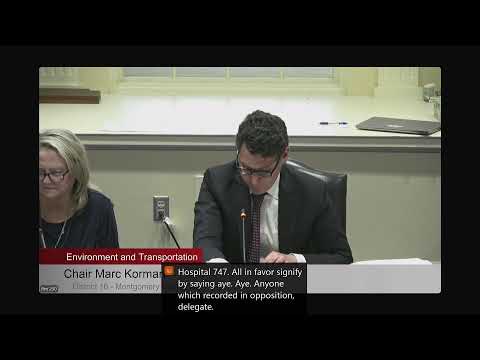
- House Bill 747 — the committee approved a bill requiring on-site wastewater systems serving rental properties to be inspected and pumped by a licensed professional before each new tenancy beginning Jan. 1, 2028, and requiring inspections as a condition of certain property sales; the bill also delays the effective date for some licensing and property transfer inspection provisions by two years and requires notice to delegated approval authorities if inspections identify failing systems.
- Other bills advanced include changes to hiring preference authority for veterans (HB1443), alterations to Washington Suburban Sanitary Commission reporting (HB1195), technical changes to a noise-monitoring pilot (HB18), changes to penalties for causing serious injury to vulnerable individuals (HB234), modifications related to registration plate covers and obscuring plates (HB470), expansions of uniform service benefit eligibility (HB475), sidewalk funding prioritization (HB628), automated traffic enforcement reporting requirements (HB915), and several local and vehicle registration items. A bill was withdrawn from the voting list (House Bill 1234) and several bills were rolled onto the next day’s voting list.
Votes at a glance (outcomes and recorded opposition where noted)
- HB 716 — Favorable as amended; recorded opposition: Delegates Jacobs, Otto, Naraki, Morgan and Baker. (motion moved and seconded; bill passed)
- HB 767 — Favorable as amended; recorded opposition: Delegates Jacobs, Otto, Naraki, Morgan and Baker. (passed)
- HB 1076 — Favorable as amended; recorded opposition: Delegates Jacobs, Otto, Naraki, Morgan and Baker. (passed)
- HB 1152 — Favorable as amended; recorded opposition: Delegate Otto and Delegate Baker (the record shows some members in opposition; bill passed). Additional cosponsors listed during the roll call.
- HB 1239 — Favorable; recorded opposition: Delegates Jacobs, Otto, Naraki, Morgan and Baker. Committee Counsel addressed disparate-impact questions; committee described the bill as codifying existing practice. (passed)
- HB 1167 / HB 11 67 (local development standards) — Favorable as amended; local bill; passed.
- HB 1443 — Favorable as amended; authorizes local hiring/promotion preferences for eligible veterans; passed.
- HB 1195 — Favorable as amended (WSSC reporting and operational changes); passed.
- HB 18 — Straight favorable (noise monitoring pilot technical changes); passed.
- HB 234 — Favorable as amended; amended penalty structure and added vehicle types including golf carts/unicycles; passed.
- HB 470 — Favorable as amended; makes sale/advertising of unlawful license-plate covers civilly liable and removes an intentionality requirement; passed.
- HB 475 — Favorable as amended; expands applicability in the transportation article to additional uniform-service members; passed.
- HB 628 — Favorable as amended; requires the State Highway Administration to prioritize sidewalks tied to complete-street or similar policies; passed.
- HB 644 — Favorable as amended; expands authorization for speed-monitoring systems statewide for local jurisdictions; recorded opposition: Delegates Jacobs, Otto, Naraki and Baker. Several delegates raised concerns about enforcement impacts on low-income residents. (passed)
- HB 915 — Favorable as amended; requires quarterly reports on unsatisfied out-of-state automated enforcement citations; passed.
- HB 1032 — Favorable as amended; modifies automated enforcement program coverage by adding Baltimore City and Montgomery County to an existing local program; passed.
- HB 1371 — Straight favorable; authorizes MVA to facilitate issuance and verification of electronic credentials through a national association of motor vehicle agencies; passed.
- HB 1464 — Straight favorable; creates alternate registration process for rental-fleet vehicles and distinctive plates; passed.
- HB 178 — Favorable as amended; prohibits stopping/standing/parking in bike lanes with specified exceptions; includes a local-preemption-savings clause allowing localities to adopt stricter rules; passed.
- HB 747 — Favorable as amended; on-site wastewater inspection and pumping requirement for rental properties and certain sale provisions; requires notice to delegated approval authorities for failing systems and delays some licensing dates; recorded opposition: Delegates Jacobs, Otto, Naraki and Baker. (passed)
- HB 452 — Favorable as amended; broadens an existing prohibition on using state funds to install or replace certain outdoor luminaires to include state parks and trails and adds exemptions and prospective-only application; passed.
- HB 1193 — Favorable as amended; requires localities to report permit data (amendment changed monthly reporting to quarterly); passed.
- HB 1234 — Withdrawal requested and granted; bill withdrawn from consideration.
Procedure and next steps
Most measures carried subcommittee recommendations and passed the committee on voice votes; a small number recorded specific members as opposed. The committee indicated there will be additional voting tomorrow and potentially Saturday morning; several items were placed on the next-day voting list and one bill was withdrawn. Bills that passed the committee will be placed on the House floor calendar for further action.
Quotable from the hearing
Committee Counsel explained the change in the housing discrimination bill: "Basically, disparate impact is that if the policy is neutral, but is having a discriminatory effect, then that is what the Supreme Court...has determined to be discriminatory nonetheless." (Committee Counsel)
On speed-camera enforcement equity concerns, Delegate Naraki said: "There are 80,000 vehicles that have flags on their registrations because of speed camera tickets...these folks...seem to be in areas that, frankly, are some of the poorer communities in Baltimore County." (Delegate Naraki)
Ending
The committee advanced a large package that will now proceed to the House floor for further consideration. Several bills require agency implementation or local actions, and a subset drew clear policy questions that lawmakers flagged for additional attention on the floor and in follow-up hearings.