Bridgeport planners present $702.5 million, 10‑year facilities need; enrollment projected to decline modestly
Loading...
Summary
Bridgeport Public Schools presented findings from a facilities master plan and 10‑year demographic study during a virtual session, outlining $702,500,000 in capital renewal and improvement needs across 37 buildings and projecting a modest districtwide enrollment decline over the next decade.
Bridgeport Public Schools presented findings from a facilities master plan and 10‑year demographic study during a virtual session, outlining $702,500,000 in capital renewal and improvement needs across 37 buildings and projecting a modest districtwide enrollment decline over the next decade.
The report, delivered by consultants from MP Planning Group and Studio Jade, summarized 10‑year enrollment projections, capacity and utilization analyses and a facility‑condition assessment (FCA). Dr. Avery, interim superintendent, said the district will use the analysis to guide capital investment and community engagement: "We are very excited to receive, this information and explore the next steps based on the recommendations and ongoing stakeholder feedback, regarding the facility master plan in a demographic study."
The consultants said the study is intended as a planning framework to help the district determine whether to pursue capital renewal, renovations, consolidation or new construction and to identify opportunities to leverage state and federal reimbursement. "It provides a framework for the district to be able to guide those key capital investments, help provide efficient operation," MP Planning Group project lead Mike Zuba said.
Why this matters: The analysis pairs condition‑based capital needs with enrollment projections and building capacity so the district can weigh investments that affect students, neighborhoods and long‑term operating costs. The FCA identifies work that district staff and voters would need to prioritize in the near term to avoid accelerating deferred maintenance costs.
Key findings - Scope and cost: Studio Jade reported a districtwide FCA scope covering 37 buildings and roughly 3,500,000 square feet. The consultants estimated just over $702,500,000 in needed capital work over 10 years. Pam Babuka of Studio Jade summarized the scope: "Our total scope was, 37 buildings." The team said 56% of the estimated cost falls in the first three years and 84% falls within five years; the estimates are stated as unescalated Q4 2024 dollars.
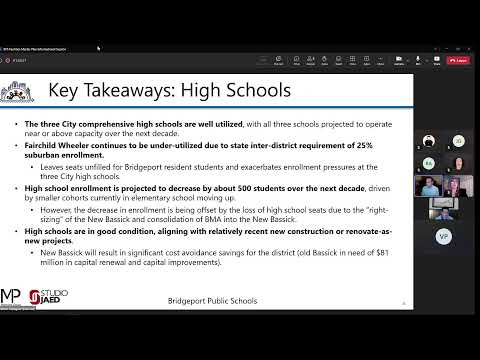
- Enrollment projections: Consultants reported October enrollment of about 20,050 students and projected an overall decline to roughly 19,200 students in ten years. They forecast a decline of about 300 students in elementary/middle grades and about 500 students at the high school level over the decade. High school enrollment was projected to remain near current levels in the near term (around 5,700) before trending toward roughly 5,300–5,400 later in the window.
- Capacity and utilization: MP Planning Group calculated an elementary planning capacity just under 18,000 seats compared with roughly 14,200 enrolled students, producing an estimated districtwide elementary seat surplus of about 3,600 and an overall utilization near 80%. The consultants highlighted variation across buildings: several elementary schools and magnet programs operate above 90% utilization, while seven elementary schools are in underutilized categories (below 80%, some below 70%). "Capacity is always changing and evolving as those educational needs change," Pat Gallagher of MP Planning Group said.
- High schools and the BASIC project: Consultants noted three comprehensive city high schools have pronounced utilization pressures while Fairchild Wheeler remains underused in part because of the state policy that sets suburban student percentage targets at the magnet campus. The new BASIC facility is reported with a design capacity of 1,250 students and the consultants expect it to open operating slightly above design capacity; when BASIC and program moves occur they will alter high school capacity balances. The team said optimizing enrollment at Fairchild Wheeler could relieve pressure at other high schools.
- Facility condition priorities: The FCA breaks corrective actions into four priority groups (immediate, 1–3 years, 4–5 years, and 6–10 years). On a districtwide basis, the largest line items are interior architecture (roughly 30% of the cost) and mechanical systems (about 27%). The consultants also provided normalized costs per gross square foot and per student to help compare buildings of different size and utilization. The consultants flagged the former BASIC building with an estimated roughly $81,000,000 of capital needs, a figure used in evaluating reuse versus replacement and "cost avoidance" if new construction is undertaken.
What the consultants recommended next - The MP Planning Group team will present recommended long‑term options on March 4 and then hold three community engagement sessions: one in March at Harding High School and two in April (Central High School and Bassett High School). Dr. Avery encouraged families and community members to attend the in‑person sessions.
- The team said next steps will consider a mix of capital renewal, targeted renovations, potential consolidation or realignment of buildings, and opportunities to maximize existing capacity (including enrollment strategies for Fairchild Wheeler). Pam Babuka noted the FCA is a current‑state assessment and that program‑driven repurposing would add cost implications.
Quotes "We are very excited to receive, this information and explore the next steps based on the recommendations and ongoing stakeholder feedback, regarding the facility master plan in a demographic study," Dr. Avery, interim superintendent, said at the start of the presentation.
"It provides a framework for the district to be able to guide those key capital investments, help provide efficient operation," Mike Zuba of MP Planning Group said, describing the plan's purpose.
"Capacity is always changing and evolving as those educational needs change," Pat Gallagher of MP Planning Group said when explaining how capacity calculations account for special programs and scheduling.
"Our total scope was, 37 buildings," Pam Babuka of Studio Jade said when summarizing the FCA coverage and cost estimate.
Ending Consultants said their next formal presentation of recommended options will be March 4; they will then support district staff through the scheduled community workshops in late March and April and respond to technical questions from district staff and residents. The district has posted plans for continuing community engagement and invited public input before finalizing the master plan report later in the spring.