Get Full Government Meeting Transcripts, Videos, & Alerts Forever!
Get email alerts on the Equity topic
No spam. Unsubscribe anytime.
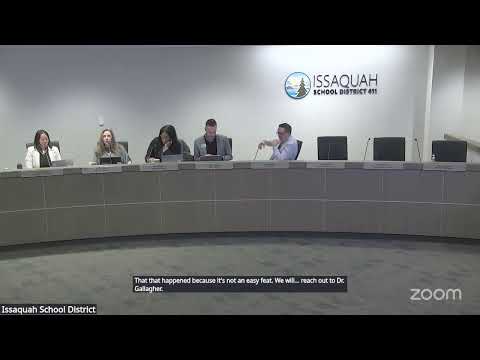
Issaquah School Board accepts OE‑16 equity monitoring report after student presentations
Summary
The Issaquah School District board accepted the Operational Expectation 16 (equity) monitoring report after staff highlighted recruitment, family engagement and professional development work and students from four high schools presented survey feedback.
The Issaquah School District Board of Directors accepted the district's Operational Expectation 16 (equity) monitoring report during its March meeting, following presentations from district staff and student representatives from multiple high schools.
The report and subsequent discussion described recent district actions on staff recruitment and retention, family and community engagement, and professional development tied to equity work. Elena Sivadasan, the district's executive director of equity, belonging and family partnerships, said the monitoring report reflects "the culmination of so many years worth of investments" and stressed a move from technical to adaptive work that aims to translate policy into day-to-day practice.
The report highlighted specific efforts: expanded recruitment at job fairs and with historically Black colleges and universities, an Educators of Color Leadership Cadre operated in partnership with the Puget Sound Educational Service District, and expanded family engagement events (the report lists more than 19 engagement events covering topics from Canvas to college financial aid). Donna Hood, assistant superintendent of human resources, told the board the district has increased retention supports and solicited educator input for affinity spaces and professional development.
Students from Issaquah, Liberty, Skyline and Gibson (Gibson) high schools presented survey findings and qualitative feedback gathered at each campus. Key points included: - Issaquah High School: 190 student responses (about 7% of the school); 45% said the school "most definitely" recognizes institutional inequities, 46% said "somewhere in between," and 9% said "definitely not." Several respondents urged broader curricular diversity and more consistent follow-through when concerns are raised. - Liberty High School: 259 responses (about 17%); student respondents raised cost barriers to extracurriculars and reported mixed awareness among families about district communications and opportunities. - Skyline: responses noted gaps in feeling heard and recommended clearer, more timely communication when students can affect decisions. - Gibson: 70 responses (about 35% of the school); students cited the school's limited racial diversity and asked for more intentional inclusion efforts and better staff understanding of IEP and 504 implementation.
Board members asked detailed questions about the report's charts and data. Director questions focused on a culturally responsive TFI (Tiered Fidelity Index) chart the board found difficult to read; Dr. Dana Bailey clarified that the TFI is used biennially as an implementation check on multi-tiered systems, and noted elementary schools had completed it more often than middle and high schools. Another chart labeled "equity allowance" (used to show an acceptable range in participation for the highly capable program) prompted staff to clarify that the visual should have shown a 20% above/below allowance; staff said the chart as printed did not display that line clearly.
Board discussion also included questions about identification and access to the highly capable program and whether a single low subscore could disqualify a student. Staff said the district now uses a composite/z-score approach and professional judgment to reduce overreliance on a single test score and that the district is exploring more advanced/accelerated opportunities keyed to students' unique strengths.
After questions and comments the board voted to accept the monitoring report. A student advisory vote was taken prior to the board's final vote. The motion to accept was moved and seconded; the board's chair called for the ayes and declared the motion adopted.