Get Full Government Meeting Transcripts, Videos, & Alerts Forever!
Get email alerts on the Municipal Finance Levy Cap topic
No spam. Unsubscribe anytime.
Providence finance committee backs request for one-year levy-cap exemption amid school settlement and budget shortfall
Summary
The Providence City Finance Committee voted to ask the state General Assembly for authority to exceed the city’s 4% tax levy growth cap for one year — up to an 8% ceiling — to cover generation costs, including an ongoing school settlement and rising pension and medical costs.
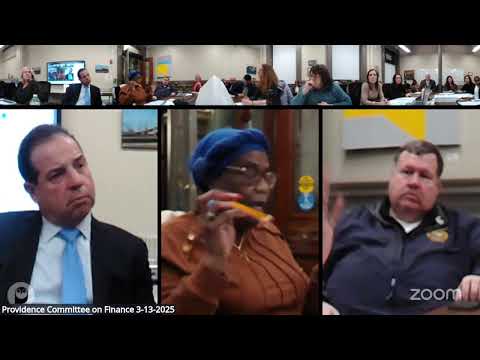
The Providence City Finance Committee voted March 13 to approve a resolution asking the Rhode Island General Assembly to permit the city to exceed the statutory 4% property tax levy cap for one year, up to a specified 8% ceiling, to give the city additional flexibility in assembling a balanced fiscal 2026 budget.
Councilwoman Ryan, who sponsored the amendment, told the committee the request was a response to “the monumental impacts associated with the unexpected port awarded settlement with Bridal” and to other fixed cost increases. She described the amendment as a temporary, one-year tool to help the city address this year’s budget challenge.
“This amendment before you tonight, still asks the General Assembly to allow us to go over a maximum 4% on a levy this year,” Ryan said. “However, it specifies a maximum, amount of 8%.”
City staff provided detailed projections and gaps: Chief Financial Officer Lawrence J. Nancini and finance staff presented a five-year budget projection that identified a roughly $22 million gap between projected fixed costs and revenue the city can raise under the 4% cap for FY 2026. The staff described the principal drivers of the gap as a school settlement payment that will add roughly $11.5 million to annual city costs beginning in FY 2026, a projected $97 million general-fund pension payment, rising medical insurance costs, and negotiated labor-cost increases.
Finance staff framed the math: under existing state law the city can increase the levy by up to 4% year‑to‑year (new growth permitting), which the finance director calculated would produce about $15.8 million in new levy capacity for FY 2026; applying an assumed collection rate reduced the budgetable amount to about $14.9 million. Departments and the administration are pursuing other revenue sources and expenditure reductions, but staff said those actions alone likely would not close the projected gap.
The resolution passed after committee discussion and questions from councilors about alternatives, use of reserve funds, and distributional impacts on low-income homeowners. Several councilors emphasized efforts to identify non-levy revenue sources, to protect vulnerable residents, and to scrutinize departmental budgets for efficiencies.
On fiscal choices and reserves: Finance staff and the finance director explained that using the city’s fund balance (rainy‑day fund) to plug a recurring gap would be temporary and would weaken the city’s reserves and credit position. The staff described the audited combined fund balance as roughly $28 million but said the portion usable in the general fund for budget balancing is closer to $12 million; best-practice guidance would target a much larger reserve for long-term stability.
Committee action: Councilor Taylor moved to approve the substituted resolution; Councilor Graves seconded the motion. The committee chair called the vote and the motion was approved.
What this does and does not do: The committee vote approves a local resolution asking the General Assembly for enabling legislation; it does not itself change state law or the city tax levy. If the General Assembly grants temporary authority and the council adopts a budget using that authority, the new levy would become the base for future annual levy growth calculations.
Next steps: Staff and council members said they will continue to pursue alternative revenues (fees, consumption‑based taxes, grant and philanthropic support) and expenditure efficiencies while the city seeks action from the state delegation. The administration plans to publish more detailed budget models before the April budget adoption date.