Get Full Government Meeting Transcripts, Videos, & Alerts Forever!
Get email alerts on the Public Safety Dispatch topic
No spam. Unsubscribe anytime.
Hartford emergency communications reports 498,000 total calls in 2024; staffing and training efforts under way
Summary
Director Jeff Cavallo told the Quality of Life and Public Safety Committee that Hartford’s public safety communications handled 498,000 total calls in 2024, including about 140,000 911 calls, and outlined staffing shortfalls, a planned training class and hires.
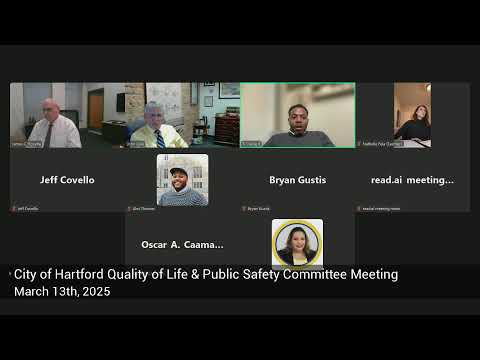
Hartford’s public safety communications division handled 498,000 total calls in calendar year 2024, including roughly 140,000 calls that were 911 calls, Director Jeff Cavallo said at a March 13 Quality of Life and Public Safety Committee meeting.
The volume, Cavallo told committee members, reflects a combination of 911 calls, administrative transfers and callers routed through an automated attendant. “This place has never been busier than it is right now,” he said.
Why it matters: high call volume strains dispatch staffing and affects response capacity across public safety departments. Cavallo said staffing has improved since he began in 2022 but gaps remain, and the department is pursuing hires and training to increase floor coverage.
Cavallo gave more detail on current staffing and near-term recruitment plans. The communications supervisors are authorized at eight positions and the division is down to six following a retirement and an internal lateral. The authorized number of dispatchers is 45; Cavallo said 30 personnel are currently on the floor in various stages of training or certification, with 25 fully trained dispatchers and two fully trained call takers.
He said the department expects a civil-service certification list next week that should supply candidates for a planned class. “The goal right now is to have a class of 15 [in] April,” Cavallo said, and he added that the city’s HR office had provided a list of about 18 names and the department had already issued three job offers.
Cavallo also described recent personnel moves: a long‑tenured employee moved into quality assurance and a training coordinator was hired from Wethersfield. The deputy director position remains vacant and the search is active.
On funding and budget, Cavallo described the division’s fiscal picture as reported to the mayor’s office: “Our total budget is 5.3. We’re into it for 2.9,” he said (the presentation did not specify currency units or whether figures are in millions). He also said the department recouped $8,500 from hosting a homicide investigation training class and has submitted materials to corporation counsel to pursue alarm-enforcement revenue.
Committee members asked whether the department has analyzed drivers of the high call volume. Cavallo said some callers are routed through automated options and so the exact reasons for those calls are sometimes unclear, and he recommended a deeper review to identify drivers and possible reductions. “Some of those would be…we don’t know why you’re calling because you are just using the system,” he said.
The committee chair, Councilman TJ Clark, and other members praised the hiring progress and asked for further breakdowns. Cavallo said he will continue to pursue recruitment, training and process improvements and noted the department’s goal to add capacity through upcoming classes and certified candidates.
Ending: Cavallo closed his presentation saying the city’s public safety communications will continue active recruitment, training and efforts to improve floor staffing; committee members asked for follow-up data and further analysis on what drives the high call volumes.