Get Full Government Meeting Transcripts, Videos, & Alerts Forever!
Get email alerts on the General Plan Apr Housing topic
No spam. Unsubscribe anytime.
Planning staff: Santa Barbara far short of RHNA target; commission presses for funding, zoning tools
Summary
At the March 13 Planning Commission meeting, staff presented the draft 2024 General Plan Annual Progress Report showing 592 units permitted so far this RHNA cycle against a required 8,001; commissioners urged faster implementation of funding and regulatory tools including an in‑lieu option, a nexus study and a permanent local housing trust fund.
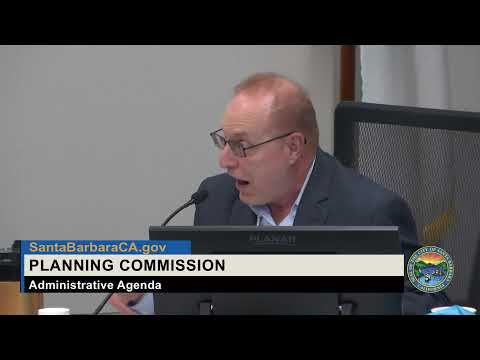
On March 13, 2025, Dan Gillet, principal planner, presented a draft 2024 General Plan Annual Progress Report to the Santa Barbara Planning Commission that documents the city's progress — and gaps — toward state housing goals for the current RHNA (Regional Housing Needs Allocation) cycle.
Gillet told commissioners the city is required to plan for 8,001 housing units in the sixth RHNA cycle. “The total number of units that have been permitted in the sixth cycle thus far is 592 units,” he said, adding that 204 of those were permitted in 2024. Staff and commissioners described a substantial gap between required planning numbers and current production rates and discussed the range of regulatory and funding tools the city is pursuing to increase affordable housing production.
Why it matters: the General Plan APR is a state‑mandated annual report (Senate Bill 1333 reporting requirements were cited) used to track implementation of general plan policies and housing production against RHNA allocations. Shortfalls can expose jurisdictions to state streamlined review tools such as SB 35 and can affect eligibility for certain grants.
Key findings presented to the commission - Pipeline and permitting: Staff reported 163 new applications in 2024 covering about 1,521 potential units, including two large proposals that together account for a majority of units in the pipeline: a Macy’s site redevelopment (reported as 689 units at 3805 State Street) and a builder’s‑remedy project (reported as about 450 units). Thirteen projects received building permits in 2024, producing the 204 units counted for that year.
- Unit mix and ADUs: Staff said accessory dwelling units (ADUs) dominate applications — 89% of applications were for ADUs — but that ADUs remain modest contributors to total permitted unit counts because a few large multi‑unit projects drive totals. Staff noted roughly half of permitted units in recent years have been ADUs.
- Affordability: Staff described a heavy concentration of permitted units categorized as above‑moderate (market) rate in the recent pipeline and noted very limited production of new lower‑income units to date in the cycle. Commissioners pressed staff about tools to increase very low, low and moderate income unit production.
Policy tools and funding discussed Commissioners and staff reviewed several near‑term and longer‑term measures in the housing element work program: - Nexus/feasibility study and inclusionary housing amendments: The city contracted BAE to prepare an economic feasibility and nexus study. Staff said the study will examine inclusionary rates, in‑lieu fees, unit mixes and a hotel linkage (impact) fee, and will inform whether inclusionary requirements and fees can be changed.
- In‑lieu fees and developer options: Commissioners emphasized that many market developers prefer to pay in‑lieu fees rather than operate affordable units; staff said an in‑lieu option is under study and will be part of BAE’s work.
- Local Housing Trust Fund and funding sources: The report documents establishment of a local housing trust fund but commissioners repeatedly asked for clarity on permanent funding. Staff said the city has taken initial steps but that a permanent revenue source has not been fully identified; commissioners urged the council to consider dedicating a portion of the recently passed half‑cent sales tax or other ongoing sources to the trust fund.
- Streamlining and accelerated processing: Staff described changes to accelerate processing for affordable housing projects and noted use of SB 35 by the housing authority on at least one project. Staff also said the city had adopted objective design and development standards and a pre‑approved ADU design program intended to shorten review times.
Public comment and commissioner concerns Steve Johnson, a resident who addressed the commission during public comment, said state bonus density rules allow larger bonuses than previously described and warned that many incoming projects will use the state density bonus. "State bonus density now allows a 100% bonus," Johnson said, and he predicted more projects would use bonus density provisions.
Commissioners pressed staff for follow up information: the balance and funding sources of the local housing trust fund, timelines for the BAE nexus/feasibility study and prospective ordinance changes, the status of two competitive grant applications for affordable projects (staff said applications had been submitted and awards were pending), and whether city‑owned lands would be evaluated for potential housing sites (staff identified the city land registry program as a housing element action and said evaluation of city lands is scheduled later in the housing element cycle).
No formal action taken The commission received the report, asked questions and offered a set of recommendations and clarifications for staff to incorporate before the report goes to the City Council and is submitted to state agencies. Staff told commissioners the draft will be revised to reflect the discussion before final submittal to the state.
What comes next Staff said they expect to circulate an administrative draft of the feasibility/nexus study and to bring housing‑element implementation items (adaptive reuse ordinance, inclusionary/in‑lieu options, ADU revisions) forward in the coming months. Commissioners urged the city to prioritize establishing a permanent funding source for the local housing trust fund and to accelerate ordinance work that would enable developers to contribute meaningful dollars or units to meet the RHNA goals.