Get Full Government Meeting Transcripts, Videos, & Alerts Forever!
Get email alerts on the Signs And Permits topic
No spam. Unsubscribe anytime.
Solvang workshop signals move to allow courtyard A‑frame signs on private property, tighten temporary sign rules and clarify enforcement
Summary
After a lengthy discussion, staff heard general support to permit A‑frame (sandwich) signs on private property only with time/place/manner rules, to revise temporary-banner regulations, and to remove content‑based restrictions tied to a Supreme Court decision; staff will draft specific sign-code language for council review.
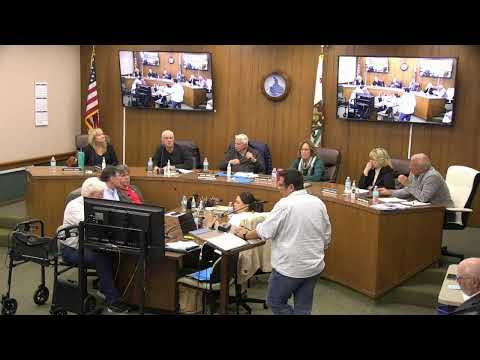
Solvang planning staff, commissioners and business representatives spent the latter portion of a city workshop debating sandwich-board (A‑frame) signs, temporary banners and how to enforce sign rules in the village.
The workshop produced informal consensus on three core directions: allow A‑frame signs on private property (not in the public right-of-way) under clear time/place/manner rules; revise temporary‑sign rules to be time‑limited and content‑neutral; and remove content-based prohibitions that conflict with Reed v. Town of Gilbert’s constitutional limits on regulating sign messages.
On A‑frame signs: business owners and chamber representatives urged limited use for courtyards and side streets where foot traffic needs direction. Tracy of the Solvang Chamber of Commerce argued that European-style A‑frames can work, saying: “If we wanna be European, they are. There’s a way to do it.” Critics warned that widespread sidewalk A‑frames cause visual clutter and trip hazards; one participant said, “If everybody had 1 a frame sign in Solvang, you wouldn't see them. It defeats the purpose.”
Staff summary and next steps: Rafael, the planning presenter, summarized the likely course: craft regulations to allow A‑frames on private property only, maintain the existing public-right‑of‑way ban, require ADA clearance and limit quantity (for example, one sign per business), and include manner restrictions (materials, anchoring for wind). He said staff would take the direction back to develop a registration/permit program and enforcement approach for the council to consider.
Temporary signs and content-based rules: Staff noted the current code contains content-based language — for example, allowing banners for a “grand opening” — and said that approach is vulnerable under Reed v. Town of Gilbert. The city attorney explained the preferred path is content-neutral, time/place/manner limits (days on display, size limits, and site-specific rules). Commissioners asked staff to allow more practical temporary signage for new businesses and special events while preventing year‑round proliferation.
Enforcement: The city attorney described the legal enforcement toolbox available to the city — from warnings and fines to civil injunctions — and emphasized the city typically pursues voluntary compliance first. Jennifer, the code officer referenced in the discussion, was cited as using an education-first approach. The attorney also noted the practical limits of enforcement and collection: fines may be small and litigation is a costly last resort; staff said landlords can be held accountable when a code violation involves property use, but pursuing remedies can require civil procedures.
Survey and outreach: Staff acknowledged the sign-survey had a limited response (about 53 respondents) and recommended broader outreach as regulations are drafted.
Outcome: No ordinance change was adopted at the workshop. Staff will prepare draft code language that (a) allows A‑frame signs on private property with standards, (b) defines temporary sign time/size rules and (c) removes content-based restrictions where constitutionally vulnerable, and return to the council and public for review.