Get Full Government Meeting Transcripts, Videos, & Alerts Forever!
Get email alerts on the Community Reinvestment topic
No spam. Unsubscribe anytime.
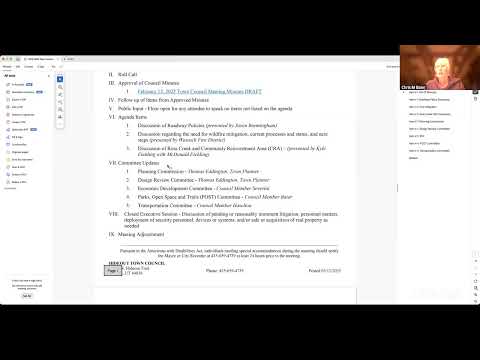
Town staff brief council on community reinvestment agency (CRA) option for Ross Creek site
Summary
Hideout Town Council members received an overview on March 13, 2025, of community reinvestment agencies and how the tool could be used to help finance infrastructure and mixed-use development at the Ross Creek site.
Hideout Town Council members received an overview on March 13, 2025, of community reinvestment agencies (CRAs) and how the tool could be used to support infrastructure and mixed-use development at the Ross Creek property.
Kyle (economic-development advisor) explained that a CRA is a separate political subdivision whose governing board is the same as the town council; the agency can create project areas and — with agreements from other taxing entities — capture tax increment to fund public infrastructure, land acquisition or public–private partnerships. "To take full advantage of what's available under Utah law... the city or the town can create a community reinvestment agency," Kyle said.
How it works: The town adopts an ordinance creating the agency, files notice with the lieutenant governor and records notice with the county recorder. The agency then may adopt bylaws, an interlocal agreement with the town for administrative support, and (if desired) create a project area and negotiate interlocal agreements with taxing entities to allocate a portion of future tax increment to the agency.
Key points discussed: - Project-area duration and scale: Kyle said project areas commonly run 10–20 years (Vineyard was cited as an outlier at 40 years) and that the length and percent of increment captured are negotiable based on the financing needed to catalyze development. - Taxing-entity participation: Any entity that levies property tax in the boundaries (town, county, school district, special service districts) may opt to participate; school districts are often sensitive to capturing increment for projects that increase residential enrollment. - Comparison to other tools: Tax-increment funding is not a new levy on the project area; it captures the increase in tax revenue from new development and therefore does not directly raise the certified tax rate like a PID can. If growth does not occur, the town and other taxing entities incur no cost.
Why it matters: Councilmembers and the economic-development consultant described CRA tools as one financing path among several to make infrastructure and mixed-use development at Ross Creek possible. Eric (economic consultant) noted that tax-increment financing is lower risk for taxpayers because if the project does not generate increment, no funds are collected.
Next steps and council direction: The council asked staff and the EDC to continue refining a development vision for Ross Creek, to narrow options for financing (CRA and alternatives), and to engage taxing entities and potential private partners for early feedback. The town's EDC and staff will return with more detailed financial analysis and scoped options for CRA project-area design and associated costs.
Ending: No action to create a CRA was taken at the meeting. Councilmembers requested further analysis on financing scenarios, likely participant commitments, and a refined development concept before any agency or project-area formation.