Get Full Government Meeting Transcripts, Videos, & Alerts Forever!
Get email alerts on the Land Use Commercial Nursery topic
No spam. Unsubscribe anytime.
Commission questions Larkin Meadows wholesale nursery, ag-exemption and bathroom addition in residential zone
Summary
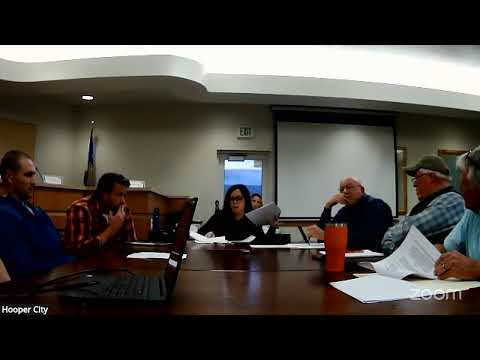
Hooper commissioners spent the March 13 work meeting debating whether Tyler Larkin’s Larkin Meadows operation qualifies for an agricultural exemption and whether a proposed bathroom and office in a greenhouse/structure conflict with the prior conditional use permit and zoning.
At a March 13 Hooper City Planning Commission work meeting, commissioners and staff flagged potential noncompliance at Larkin Meadows, a proposed wholesale nursery, and asked the applicant to seek a revision to permits or clarify how the operation fits within code definitions.
Why it matters: The applicant’s website and materials describe a wholesale nursery selling ornamental plants to wholesalers and contractors. Wholesale nursery activity is not listed as an allowed use in R‑1 residential zones under staff guidance; retail nursery uses can be allowed after a conditional-use review. Commissioners said that adding an office and restroom to a structure the applicant previously described as agricultural would contradict the terms of the earlier agricultural exemption and the conditional-use authorization.
Staff summarized the history: the applicant previously obtained an agricultural exemption and told the commission the use was agricultural and not a business with customer traffic. Staff recounted language the applicant signed acknowledging that uses other than agricultural production could render the permit ‘‘null and void,’’ and staff said the applicant later described his business on a public-facing page as a dedicated wholesale nursery. One staff member said: "What he signed up for and what he's presented is that this would be for an agricultural use. That ... goes against what he signed up for in the first place." Commissioners noted there has been prior neighborhood attention, a prior fine and that a porta‑potty was being used on site.
Code questions and options discussed: Staff advised that wholesale nursery operations are allowed in commercial and industrial zones but not in residential zones. Retail nursery — defined in code as grounds, greenhouses or premises where the public may purchase goods in small quantities — can be considered as a conditional use in some zones, which would require a separate application. Commissioners discussed whether the applicant could pursue a retail conditional-use permit, convert classification, or request a modification of the earlier conditional-use permit. Staff and the building inspector, Nate Coleman, said the presence of an office and restroom in the structure would indicate a shift away from the granted agricultural exemption because agricultural exemptions protect structures that are generally not intended for human occupancy.
Several commissioners and staff raised enforcement and zoning-consistency concerns but also noted interest in whether the city should revise its ordinances to address modern horticulture operations. One commissioner suggested the commission could recommend ordinance changes to the city council to allow wholesale or larger nursery activities in particular circumstances; others said that any ordinance change would be a separate, city-council-level process and that the commission’s immediate task was to resolve permit compliance.
Next steps: Staff said the applicant will be asked to revise permits or seek the appropriate conditional-use approval; staff also suggested the commission could consider recommending code updates to the council in the future. No formal decision or vote was recorded at the March 13 meeting.