Get Full Government Meeting Transcripts, Videos, & Alerts Forever!
Get email alerts on the Utilities Water topic
No spam. Unsubscribe anytime.
Nibley council opens public process to raise water rates to fund new well and system upgrades
Summary
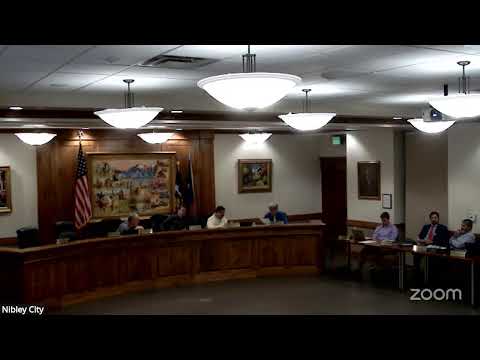
The Nibley City Council held a public hearing and approved a first reading to raise water rates in a phased plan intended to help pay for a new municipal well, line upsizing and long-term system needs; staff said impact fees would cover most but not all of the new well cost.
Nibley City staff told council members at a March 13 meeting that they will seek a phased increase in the city's water rates and apply for a low-interest loan to build an additional municipal well. Council approved the ordinance for first reading and set a follow-up public hearing.
City engineer/staff member Justin presented a financial model showing decades of slow growth in the base charge and rising operational costs. He said the city is planning to apply to the Utah Division of Drinking Water for roughly $3 million to drill and equip a new well and that impact fees would cover much but not all of the cost. To maintain industry-standard reserves and debt-coverage ratios, staff proposed increasing the monthly base rate in stepped increments and modestly raising usage tiers; the medium scenario in staff's model equated to roughly a 10—17% increase for the average residential customer, about $50 a year.
The rate change matters because Nibley's base rate has not kept pace with inflation and operating costs, Justin said. The city has fewer than recommended days' cash-on-hand for emergency repairs and faces several capital needs: a new production well to meet source-capacity expectations, upsizing of development lines in growth corridors, and eventual replacement of older distribution pipe. Justin said that impact fees should cover the majority of the well cost but that roughly 20—25% of the well's cost would fall to ratepayers under current impact-fee and cost-allocation assumptions.
Councilmembers asked about how the increases would affect different customer types, conservation incentives, and how the city could reduce demand. Staff said the proposed plan emphasizes increasing the base charge (monthly fixed fee) to stabilize revenue while keeping usage tiers to preserve customer incentives to conserve. Staff noted the state recently adopted legislation (HB 274) that affects conservation-based rate design; that law will be considered as staff finalizes the structure.
Justin asked the council's permission to publish clearer outreach materials and to schedule a second public hearing with a tightened presentation of the numbers; the council agreed and approved the ordinance for first reading. Justin said the city will proceed with an application to the Division of Drinking Water for funding and will return with a refined proposal and another public hearing.
The next steps the council directed: additional public outreach explaining the estimated household impact, staff follow-up on the loan application, and refinement of the rate table for second reading and a final vote.
Votes and formal action: the council approved the ordinance for first reading and scheduled further public notice and a second public hearing.