Get Full Government Meeting Transcripts, Videos, & Alerts Forever!
Get email alerts on the Governance Training topic
No spam. Unsubscribe anytime.
City attorney and planning staff brief Stockton Planning Commission on Brown Act, conflicts and permit process
Summary
Deputy City Attorney Zoe Merle and planning staff gave a training on the Brown Act, conflicts of interest, ex parte contacts, public-comment rules and how the Development Code and permit authority work; staff emphasized that ministerial approvals lock in the law at the time an application is deemed complete.
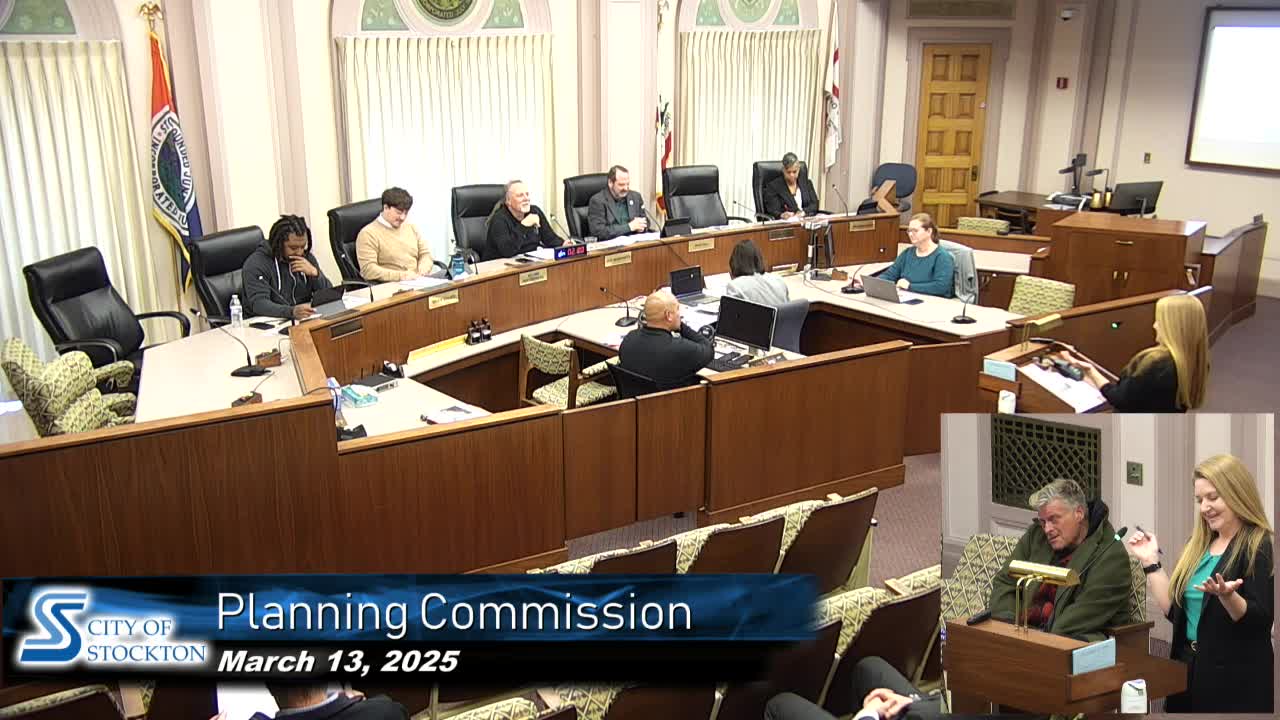
Deputy City Attorney Zoe Merle and planning staff gave an extended training and overview at the March 13, 2025 meeting of the Planning Commission of the City of Stockton on legal responsibilities, public meeting rules and how planning permits are processed.
Merle framed the briefing around core legal principles, saying the planning process balances "property rights" with the community's interest in orderly development; she told commissioners that "property rights are... sacrosanct," but that local government can use its police powers to regulate land use for public health, safety and general welfare. She reviewed requirements under the California Brown Act about public meetings, criticized serial or hub-and-spoke contacts among commissioners, and cautioned about social-media interactions and reply-all email chains that could create the appearance of deliberation among a quorum.
Merle summarized key points for commissioners: disclose any communications about pending quasi-judicial matters (ex parte contacts) so the record shows what information each commissioner relied on; recuse when a financial conflict, close personal relationship or prejudgment would prevent objective decision-making; and recognize that the Brown Act treats a meeting as occurring when a majority of the body (four or more for a seven-member commission) deliberates together, including by electronic or serial communications.
On public comment, Merle explained that the public has a right to be heard and that the chair may set reasonable time limits, provided limits are applied evenly. She also described the narrow circumstances under which a disruptive attendee can be removed and said staff will support chairs in that process.
Planning Manager Scott Spear and Senior Planner Arturo Carrasco reviewed how the general plan, zoning and Development Code interact and how the city implements policy through ministerial and discretionary permits. Spear said the Development Code is codified in Title 16 of the Stockton Municipal Code and walked commissioners through land-use tables, the difference between ministerial actions (checklist-like approvals) and discretionary actions (which require findings and evidence), and who has authority to approve each permit.
Spear gave a specific procedural point about changing state law: "If the application has been deemed complete prior to the effective date of the new law, then they're locked into the law at the time of being deemed complete," he said, adding that the state's current completeness clock gives staff 30 days to determine whether an application is complete for processing.
Arturo Carrasco summarized the typical workflow: an applicant submits, staff checks zoning and code requirements, circulates referrals to other city departments and outside agencies as necessary, and prepares a staff report that recommends findings or conditions for approval. Staff told commissioners they will flag items to the commission when director-level discretion or public appeals make commission review appropriate.
Commissioners asked clarifying questions about appeals, the interplay between commission recommendations and City Council actions, and how to avoid inadvertent Brown Act violations; staff and counsel encouraged commissioners to consult the city attorney's office when unsure and to keep official commission business on city-provided email/accounts to reduce public-records complications.
Commissioners thanked staff for the training and said it made them more comfortable carrying out their duties.