Get Full Government Meeting Transcripts, Videos, & Alerts Forever!
Get email alerts on the Liquidity topic
No spam. Unsubscribe anytime.
Staff: pension plan has liquidity to meet three years of pension payments under stress scenarios
Summary
Investment staff and the liquidity team presented an annual liquidity review, reporting improved liquidity scores after rebalancing, use of a $600 million credit facility if needed, and stress-test results that show a liquidity coverage ratio above 1.0 in severe scenarios.
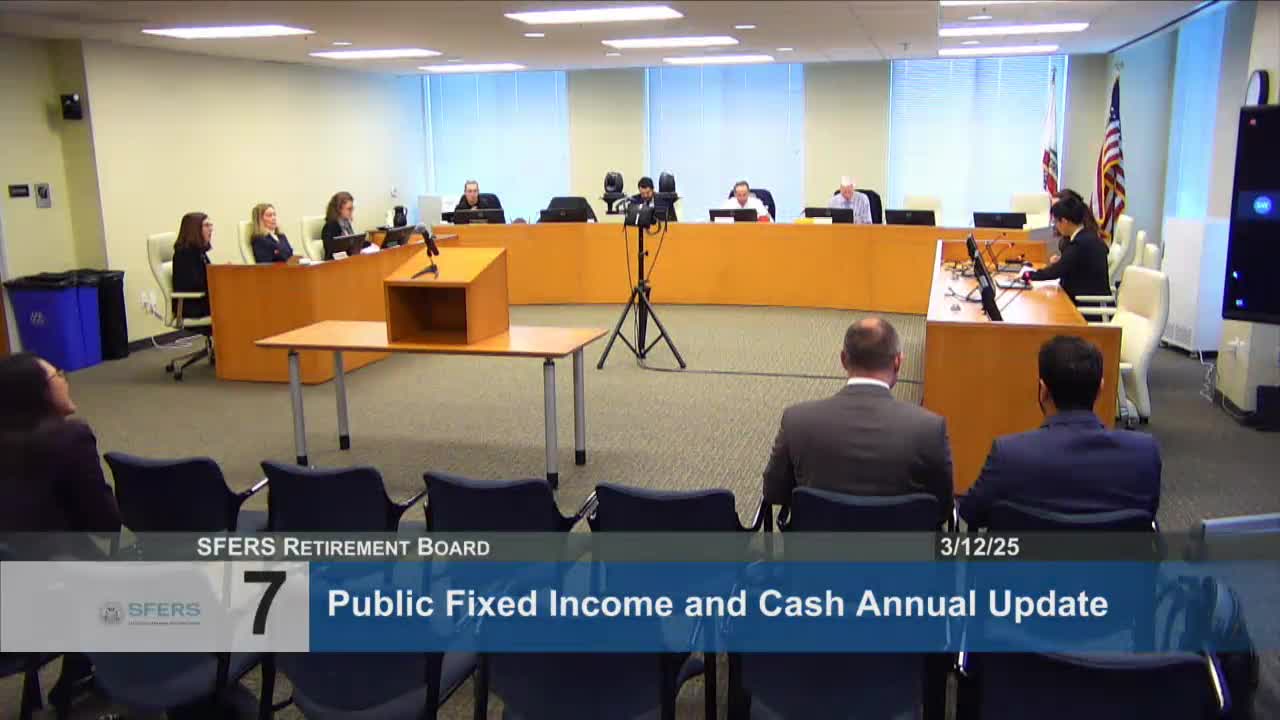
Staff presented the retirement system’s first annual liquidity management update, explaining the models and contingency plans the fund uses to ensure it can meet benefit payments, capital calls and rebalancing needs in a stressed market.
Anna (liquidity lead) and Kevin (analytics) said the team used three complementary approaches — Wilshire liquidity scoring, scenario-based stress tests and probabilistic simulations developed with Cambridge Associates — to measure near- and medium-term liquidity. Staff reported it raised more than $2.3 billion from public equities and absolute-return allocations during 2024 and deployed roughly $1 billion of that to fixed income and about $600 million to the cash allocation while using the remainder for pension and operational payments.
Anna said the fund expects to send about $1.1 billion in net benefit payments from the fund in the current fiscal year, roughly 3.1% of the plan’s net asset value at the end of 2024. To backstop short-term needs staff pointed to existing liquidity tools: a credit facility with the custodian (BNY Mellon) with capacity up to $600 million, the ability to use synthetic exposures and the system’s liquid absolute-return sleeve. Kevin summarized results from the three models: first-portfolio liquidity (tier 1–3) increased to about 43% of assets at the end of 2024 from 41% in 2023; Wilshire’s stressed liquidity improved from about 6% to 9% (Wilshire’s model); and Cambridge simulations show a median liquidity coverage ratio that improves over time under base-case assumptions.
Using a liquidity-coverage-ratio metric (available liquid assets plus expected three-year cash inflows divided by expected three-year cash outflows), staff said the base-case LCR was about 2.09. In an extreme scenario (a 1% probability “GFC-type” stress combined with adverse private-market pacing) the LCR fell to about 1.22 — still above 1.0, staff said — indicating liquidity sufficient to cover three years of obligations under the stressed assumptions.
Commissioners asked about the effect of pacing on deal acceptance and whether managers’ capital calls were likely to rise. Staff said the team has been prudent in pacing new commitments, generally declining or delaying commitments when they don’t fit the allocation or conviction framework, and noted that real‑asset distributions have helped fund some new commitments. The board thanked staff for the analysis. There were no public commenters on the item.