Get Full Government Meeting Transcripts, Videos, & Alerts Forever!
Get email alerts on the Street Vacation topic
No spam. Unsubscribe anytime.
Spokane Valley planning commission studies vacation of Appleway alley tied to Regal Care proposal
Summary
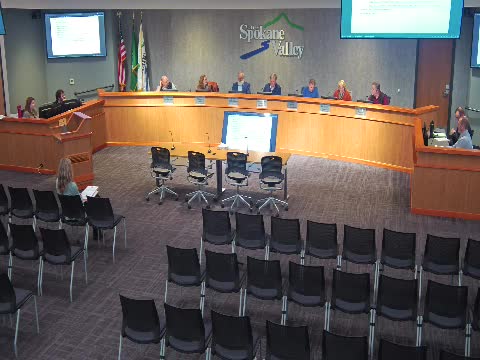
The Spokane Valley Planning Commission held a study session on a privately initiated request to vacate a roughly 185-foot-long alley off Appleway Avenue, the commission heard.
The Spokane Valley Planning Commission held a study session on a privately initiated request to vacate a roughly 185-foot-long alley off Appleway Avenue, the commission heard. Senior planner Lori Barlow told commissioners the applicants, Edith and Don Corson, own approximately 87% of the abutting property and Robert Carroll owns the remaining 13%, satisfying the state signature requirement for a privately initiated vacation.
The vacation request would terminate the public right of way and transfer roughly 4,000 square feet of alley to adjacent owners. Barlow said the alley "is paved, but it's not paved to street standards; it pretty much operates as part of that site's... driveway area," and that the applicants are proposing two residential services facility buildings along with a gymnasium and offices. The applicants also plan boundary line adjustments and at least one conditional-use permit; Barlow said those other land-use actions would be considered administratively or by the hearing examiner and not return to the commission. She added the project has been designed so it could proceed without the vacation because the proposed buildings currently sit outside the right of way.
Why it matters: vacating the right of way would transfer public land into private ownership, change maintenance responsibility, and could alter taxable parcels. Commissioners pressed staff on access, utilities and tax implications. Vice Chair Robertson asked whether the transfer triggers reassessment; Barlow said the ordinance recording the vacation is sent to the auditor and assessor, which maps the vacated strip into adjacent parcels and can result in the property becoming taxable. She told the commission the city uses adjacent-property values on a per-square-foot basis and a 2021 council resolution applies a 50% reduction in the formula used to set the reimbursement the applicants must pay.
Key facts and constraints: the alley is about 20 feet wide for most of its length and expands to roughly 25 feet where it meets Appleway. County records indicate the two buildings that border the alley were constructed in 1959 and 1963 and appear to encroach into the right of way. Barlow said water, gas and electric lines run in the portion of alley proposed for vacation; Avista and Consolidated Irrigation have already notified staff that they will require easements to maintain service if the vacation is approved. The fire department has not identified access concerns for this first 185-foot segment; staff said access to nonparticipating properties would remain via Appleway or the northern alley segment that would remain public.
Unresolved items and public engagement: commissioners noted there was no correspondence in the file from Robert Carroll and asked whether Carroll could lose a loading-dock access; Barlow said she had not had contact with Carroll and would follow up. Commissioners also discussed whether the alley has become de facto private space used for storage and vehicles; staff noted prior street vacation cases began after maintenance or nuisance concerns were raised. Barlow said staff has not completed its full analysis and will return with a staff report and recommendation at the next meeting, when the commission will hold a public hearing and then be asked to make a recommendation to city council. The council makes the final decision by ordinance, and staff must certify that any conditions are met before property transfers are recorded.
Next steps and implications: staff will prepare a formal report that will include a detailed analysis of connectivity, traffic, utilities, recommended conditions (including utility easements) and any required improvements. The commission will take testimony at the public hearing at its next meeting; a recommendation from the commission would then be forwarded to the city council for ordinance action. If a vacation is adopted and recorded, staff explained, the assessor remaps the vacated strip into adjacent parcels and those parcels then become taxable once transferred.