Get Full Government Meeting Transcripts, Videos, & Alerts Forever!
Get email alerts on the Residential Workforce Housing Deed Restrictions topic
No spam. Unsubscribe anytime.
Maui committee weighs longer deed restrictions as lenders and developers warn of financing, market impacts
Summary
Maui County’s Housing and Land Use Committee heard expert testimony March 13 on proposed extensions to workforce housing deed restrictions, with economists warning longer restrictions can reduce housing supply and lenders and builders describing financing and resale challenges tied to very long buyback periods.
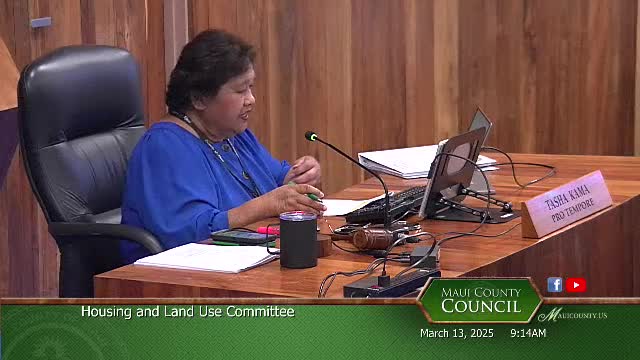
Maui County’s Housing and Land Use Committee on March 13 heard several hours of expert testimony as members weighed proposals to lengthen deed restrictions on workforce housing aimed at keeping homes available to local residents.
The committee convened with the stated goal of balancing two aims: increasing the long-term availability of housing for local workers and avoiding policy changes that make new construction or financing impractical.
Why it matters: Committee members, housing officials and outside experts said deed restrictions are one of the main tools available to preserve affordable units for people who live and work in Maui. But economists and several private lenders told the committee that extending restrictions — especially to multi‑decade or perpetual terms — can discourage production or lead to units sitting unsold, reducing the total number of homes available.
In opening testimony, Justin Tindall, an economics professor with the University of Hawaii Economic Research Organization (UHERO), said Maui’s regulatory and cost environment already makes multifamily housing difficult to build. “If we look at the research across other markets,” Tindall said, “the consensus seems to be that expanding inclusionary zoning rules, leads to increases in rents” because stricter requirements discourage new construction. He cautioned the committee to consider how longer deed restrictions affect developers’ plans and overall housing supply.
Several lenders and mortgage specialists described concrete effects they have seen. Rusty Rasmussen, senior vice president and home loans division manager at Central Pacific Bank, told the committee that projects with 30‑year buyback restrictions on Oahu have produced many vacant units because buyers were unwilling to accept such long resale limits. Rasmussen said, “anything over a 10 year buy back…there’s a lot of challenge there.”
Tara Paleka, a certified mortgage specialist, and a loan officer with the Money Store both described underwriting friction when deep restrictions intersect with federal lending rules. Paleka referenced FHA guidance noting how shared‑appreciation formulas and buyback terms can make FHA or VA underwriting more difficult in some cases. The Money Store representative said some projects could not obtain FHA or VA approval because of program rules around shared appreciation. Those underwriting constraints can lead buyers to seek conventional financing — or to be unable to qualify at typical first‑time‑buyer terms — shrinking the pool of likely purchasers.
Not everyone agreed that longer restrictions always harm Maui’s housing goals. Randy Chu of the Hawaii Housing Finance Development Corporation framed deed restrictions as a “powerful tool for supporting the local workforce,” saying they can discourage speculation, preserve affordability for longer periods and help stabilize neighborhoods. Simon Windell of the Northwest Community Land Trust Coalition and the Lahaina Community Land Trust urged the committee to consider perpetual restrictions used in several mountain resort communities, arguing they helped keep a meaningful share of housing stock available to workers and local families.
Committee and staff discussion focused on tradeoffs rather than a single approach. Housing director Remi Mitchell summarized the day’s testimony for members and recommended the council consider both the temporal element (length of restriction) and the “non‑temporal” elements (income caps, equity‑sharing formulas, occupancy requirements) together, since both affect buyer demand and lender willingness to finance.
Committee action and next steps: Members did not take a final vote. The chair said staff will prepare draft language that incorporates the committee’s discussion and will post a revised proposal for a follow‑up committee meeting. The committee directed staff to examine technical issues raised by lenders — including how shared‑equity formulas and buyback terms interact with FHA/VA underwriting — and to provide a timetable and options for buyback periods and enforcement mechanisms.
What remained unclear: Witnesses offered different views on how to measure success (total units produced, units occupied by local workers, or long‑term preservation of affordability) and provided different examples from other states. Committee members asked staff to compile comparative data on other jurisdictions and on how Maui’s existing rules (including Maui County code provisions referenced during the hearing) interact with federal mortgage programs.
The committee recessed for lunch and then continued its discussion. Members agreed to reconvene in a special session next week to review staff’s draft and to identify specific policy choices the council will consider for final ordinance language.
Ending: The March 13 meeting made clear the committee faces a tradeoff: restrictions can preserve a portion of affordable housing for locals but can also change financing calculations and market behavior in ways that reduce production or lead to units sitting unsold. The committee asked staff for a focused, technical draft addressing time periods, enforceability and interactions with federal loan programs so members can return to policy choices at their next session.