Get Full Government Meeting Transcripts, Videos, & Alerts Forever!
Get email alerts on the Student Discipline topic
No spam. Unsubscribe anytime.
District presents discipline framework and suspension trends; middle school shows uptick
Summary
Student services described the district’s discipline framework, use of a county discipline action guide and data showing higher suspension rates at Coronado Middle School; staff cited MTSS/PBIS frameworks and data tools for monitoring.
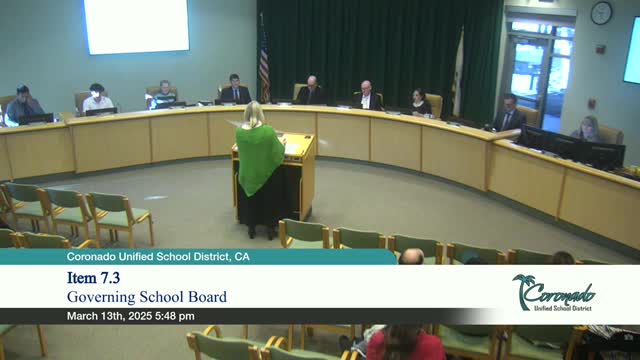
Coronado Unified’s student services director, Nee Foley, presented an in‑depth review of district discipline policies, procedures and recent suspension data during the March 20 board meeting.
Foley walked trustees through the district’s discipline philosophy emphasizing a “positive school climate,” tiered supports (MTSS) and Positive Behavioral Interventions and Supports (PBIS). She described the district’s use of the San Diego County Office of Education’s Discipline Action Guide (DAG) — a matrix aligning Education Code offenses with suggested consequences and restorative interventions — and noted that administrators apply procedures consistent with California Education Code and federal rules for students with disabilities.
Foley showed state dashboard suspension metrics and more recent local data drawn from analytic tools (ITAP and EduCLIMBER). The district’s 2023–24 suspension rate on the state dashboard was 3.4% and ITAP/EduCLIMBER data showed a notable spike at Silver Strand Elementary in 2022–23 and a larger, ongoing increase at Coronado Middle School. District data indicated that most incidents are categorized as “disruption,” followed by bullying/harassment and physical aggression. Grades 7 and 8 account for a disproportionate share of suspensions; males are suspended at higher rates than females and students with disabilities are suspended at higher rates than students without.
Foley described practical operational adjustments driven by data: opening gates and giving students access to the field during nutrition breaks to reduce crowding in the quad, targeted T3 advisory time and counseling interventions, in‑school supports and restorative practices. She emphasized investigations and due‑process protections for students, options for appeals, and special procedures for students with individualized education plans. Foley also addressed expulsion procedures and the “big five” mandatory expulsion offenses defined by Education Code.
Public comment asked the district to publish clearer data and to report not only on students disciplined but also on students harmed — victims of bullying — and requested concise, one‑page summaries of expectations and reporting pathways. Trustees asked about anonymous reporting tools (WeTip), interdistrict transfer revocations for suspended students, and whether the district could adjust the DAG matrix for local priorities. Foley said the district has modified some local matrix entries and that additional site‑level and district interventions are underway.
Foley concluded that establishing a positive school climate, consistent expectations, and targeted interventions reduces the need for removal from instruction; she invited continued community engagement and emphasized counselor and site staff roles in follow‑up supports.