Get Full Government Meeting Transcripts, Videos, & Alerts Forever!
Get email alerts on the CDBG Consolidated Plan topic
No spam. Unsubscribe anytime.
Carlsbad commission backs draft 2025–2030 consolidated plan and recommends $550,741 in CDBG funding for FY25–26
Summary
The Carlsbad Housing Commission voted to recommend the draft 2025–2030 consolidated plan and staff funding recommendations for the city’s Community Development Block Grant (CDBG) program, advancing a draft that prioritizes affordable housing, homelessness prevention and fair housing.
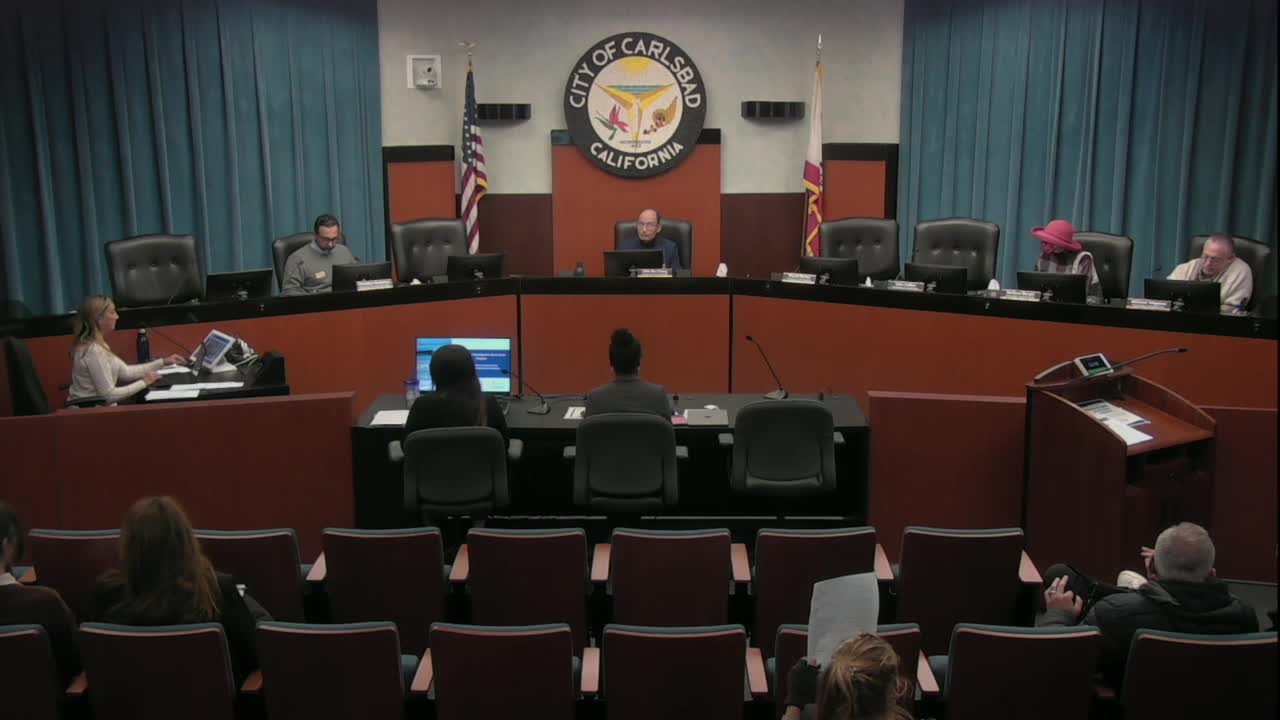
The Carlsbad Housing Commission on March 13 recommended that City Council approve the draft 2025–2030 consolidated plan and staff funding recommendations for the city’s CDBG program, advancing a plan staff said will guide spending if the city receives an estimated $550,741 for fiscal year 2025–26.
The consolidated plan is a HUD-required five-year planning document that sets local priorities for CDBG funds, and the draft presented to the commission ranks affordable housing, homelessness services and fair housing as the highest needs. Dominique Clark, a consultant with RSG, told the commission, “These grants serve a very specific purpose and they if you expend the funds, you have to use it for 3 purposes.” Clark said HUD has not yet announced exact allocations but staff is “anticipating that we will receive about $550,741 in CDBG funds for the 25-26 fiscal year.”
Why it matters: CDBG dollars may be spent only on activities that benefit low- and moderate-income persons, prevent or eliminate blight, or meet urgent needs, and HUD requires an annual action plan and reporting on how funds are used. The commission’s recommendation moves the draft and funding list to City Council and a 30-day public review period before a final plan is submitted to HUD by the May 15 deadline.
Key details from staff: Nicole Piena Jones, senior program manager for Housing and Homeless Services, and consultant Dominique Clark described the planning and funding process. Staff reported that public-services requests exceeded the statutory 15% cap; the commission packet showed four public-service applications requesting a total of $224,222 while the program estimate for that category was roughly $82,000. Staff recommended funding two public-service applicants with CDBG; the other two would be funded from other sources identified in the city’s Homelessness Action Plan. Staff also noted that 20% of the grant is the cap for planning, administration and fair housing activities.
Specific funding recommendations identified in the presentation include an award of $27,968 to the Legal Aid Society of San Diego for fair-housing work and roughly $82,000 for program administration. Staff said the city also maintains a priority list for spending program income if and when it is received.
Public comment and stakeholder input shaped priorities. Gary Nesem told commissioners he was concerned local zoning and density bonuses were producing luxury housing rather than affordable units: “We really have a shortage of affordable housing,” he said. Anne Marie, a resident speaker, urged the commission to prioritize rental assistance, arguing payments stabilize households and benefit property owners.
Nonprofit service providers described how CDBG funding would be used. Bobby Case, a supervisor and attorney at the Legal Aid Society of San Diego’s Fair Housing Center, said the agency has served “approximately over a hundred residents of Carlsbad” in recent quarters and that the proposed funds would sustain counsel, testing and outreach. Rebecca Nispaum, chief program officer for Community Resource Center, summarized a homelessness-prevention proposal targeted to assist 25 low-income Carlsbad residents at imminent risk of housing loss with case management and flexible financial assistance, with typical client payments in the $1,000–$3,000 range.
Conflict of interest and vote: Vice Chair Holden recused from the item, stating, “Due to my employer’s direct involvement with the material in item 1, I will be recusing myself from item 1.” After discussion and clarification that the commission was voting on staff’s funding recommendations (not the final annual action plan), the commission voted to recommend the draft consolidated plan and funding recommendations to the City Council. The record shows the resolution passed with a tally of yes: 3, no: 0; absent: 1; recused: 1.
Next steps: The commission’s recommendation will be included in a draft annual action plan and released for a 30-day public comment period, followed by city council hearings and final submission to HUD by May 15.