Get Full Government Meeting Transcripts, Videos, & Alerts Forever!
Get email alerts on the Energy Efficiency topic
No spam. Unsubscribe anytime.
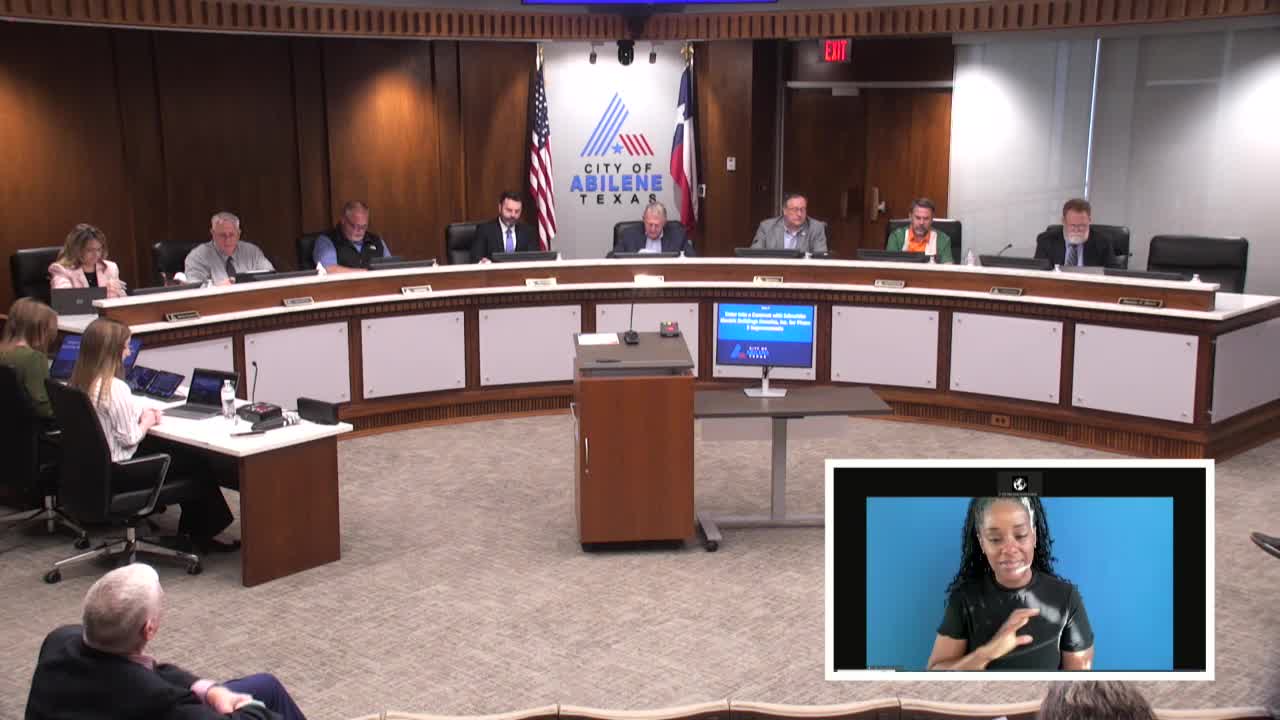
Abilene council approves Schneider Energy Services contract after debate over savings and financing
Summary
Council approved a Phase 5 energy and equipment replacement contract with Schneider Electric despite questions about how projected savings were calculated and whether the city should finance $10.6 million now or replace equipment more slowly to avoid added debt.
Abilene City Council voted to approve a performance contract with Schneider Electric to replace aging HVAC and building systems across city facilities, approving the measure despite a divided discussion on whether to take on debt for a citywide, single‑vendor project.
The measure authorizes Phase 5 work costing $10,627,520 and contemplates issuing certificates of obligation. Council Member Reagan recorded the lone “no” vote; the motion carried with other members voting yes.
Council critics focused on how Schneider’s projected savings were calculated, and on the financing choice. Schneider representatives and city staff told the council that the contract’s biggest financial benefit is avoiding a string of emergency replacements and consolidating many deferred maintenance projects into a single program, not immediate line‑item utility bill savings. Matt Lombardo of Schneider Electric told the council the contract bundles measured energy savings with “capital cost avoidance” and operational‑maintenance savings, and that some large measured savings shown in the packet came from earlier phases of the program.
Reagan pressed the company and staff on a spreadsheet that attributed roughly two‑thirds of projected savings to park lighting and asked whether those figures were part of Phase 5. Schneider and staff explained the table combined Phase 4 and Phase 5 performance measures and that the park lighting savings were largely the result of work already completed in Phase 4, not new work in the Phase 5 scope. Schneider also noted a one‑year warranty on parts and labor for installed HVAC equipment; ongoing maintenance would remain the city’s responsibility after that period under separate maintenance agreements.
Council members discussed tradeoffs between replacing many near‑end‑of‑life systems at once and doing staggered replacements over time. Council Member Reagan said he favored avoiding new debt where practical; other council members and staff argued that single‑contract management reduces construction management overhead and leverages a longstanding relationship with Schneider, which has been a city partner for years.
Council also learned the project includes a onetime credit (discussed during the meeting as being provided by a local school district partnership) that reduces the city’s net cost if the city proceeds. Schneider and staff said they will document prior Phase 4 savings so Phase 5 performance accounting does not double‑count prior measured results.
The council approved the contract after the discussion. Staff will proceed with the procurement and financing steps outlined in the packet.
Ending: Council and staff signaled they will continue to monitor performance, require documented measurement protocols, and ensure prior phase savings are separated from Phase 5 savings in the implementation and guarantee language.