Get Full Government Meeting Transcripts, Videos, & Alerts Forever!
Get email alerts on the College Career Readiness topic
No spam. Unsubscribe anytime.
HCPSS reports on college, career and community readiness; data show racial and service‑group gaps
Summary
HCPSS reported March 13 that 78% of ninth graders and 64% of tenth graders in 2023–24 met the district’s on‑track and state CCR markers, respectively, and that Black, Hispanic, economically disadvantaged students and students with IEPs meet those markers at lower rates.
Howard County Public Schools presented its college, career and community readiness (CCR) update to the Board of Education on March 13, reporting baseline rates and outlining a districtwide approach to close readiness gaps.
Key findings
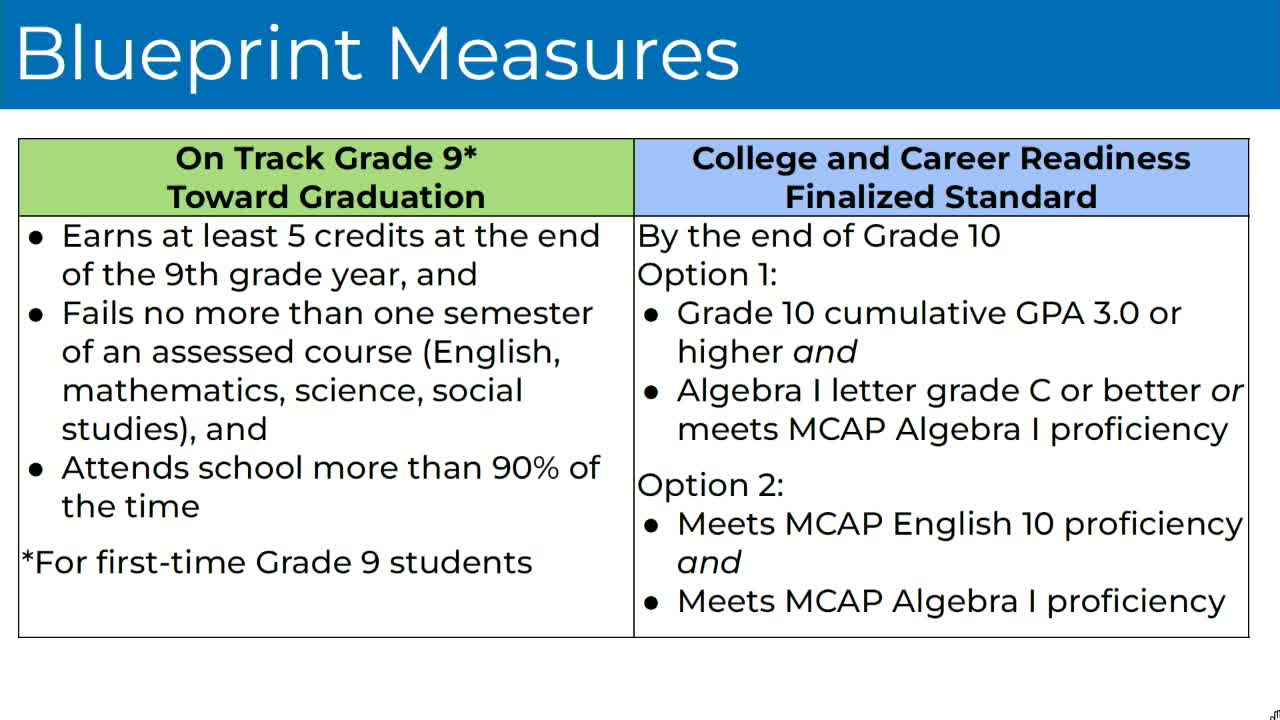
- On‑track by Grade 9: 78 percent of 2023–24 ninth graders met HCPSS’s on‑track definition (earn at least five credits, fail no more than one semester of an assessed subject, and attend over 90% of days). That leaves roughly 22 percent of ninth graders “not on track.” - College, Career & Community Ready (Blueprint CCR) by Grade 10: 64 percent of 2023–24 tenth graders met the state’s CCR standard as HCPSS defines it (composite measures including GPA, Algebra 1 performance and MCAP assessments).
Disparities
District staff highlighted persistent disparities by race/ethnicity and service group. Black/African‑American and Hispanic/Latino students, economically disadvantaged students, students with IEPs and multilingual learners met on‑track and CCR measures at lower rates than their peers. The presenters noted that disparities by race/ethnicity remain even after controlling for special‑education status and other service indicators.
Strategies and school‑level work
The CCR focus team emphasized three core strategies aligned with the district strategic plan:
1) Quality first instruction with differentiated supports in Tier 1; look‑fors include structured collaborative planning, formative assessments and co‑teaching models for multilingual learners and students with IEPs. 2) Life‑planning conversations and career exposure beginning in middle school, supported by Career Readiness Advisors who collaborate with counselors and teachers to embed career awareness and pathways. 3) Use of the master schedule as an equity tool — schools are being asked to design schedules that prioritize interventions, collaborative planning and course access aligned with students’ strengths and interests.
Examples from schools
District leaders highlighted cross‑school collaboration in some feeder patterns. Principals from Elkridge Landing Middle School and Long Reach High School described vertical articulation work — middle‑school teachers visiting high‑school classrooms and teachers conducting student panels — to give middle‑grade teachers a clearer picture of ninth‑grade expectations and to inform master‑schedule choices.
What the district will do next
HCPSS said central office teams will continue quarterly reviews of school improvement plans, support master‑schedule redesigns that prioritize intervention and enrichment, and extend professional learning on differentiated instruction and co‑teaching. Progress monitoring will be embedded in school improvement processes.
Speakers
- Diane Morris — Executive Director, Secondary Schools (presentation lead) - Janice Yetter — Director of Special Education (joined presenters) - Marie Sudiki — Coordinator, Post‑Secondary Access - Adam Eldridge — Principal, Long Reach High School (described vertical articulation) - James McVay — Principal, Elkridge Landing Middle School (described feeder collaboration)
Why it matters
Blueprint on‑track and CCR standards are leading indicators of post‑secondary success; the district said early intervention (especially in the ninth‑grade year) and strategic master‑schedule design are levers to improve outcomes. Board members pressed for school‑level data and for concrete timelines to translate strategy into measurable improvement.
Sections
Lede: HCPSS reported March 13 that 78% of ninth graders and 64% of tenth graders in 2023–24 met the district’s on‑track and state CCR markers, respectively, and that Black, Hispanic, economically disadvantaged students and students with IEPs meet those markers at lower rates.
Nut graf: District leaders said they will pursue a three‑part strategy — high‑quality differentiated instruction, early life‑planning and career connections, and using master schedules as equity tools — and will monitor progress through school improvement plans and quarterly reviews.
Ending: The district plans additional professional learning for teachers and administrators and will report back on progress. Pending state changes to Blueprint indicators could affect future measurement and implementation timelines.