Get Full Government Meeting Transcripts, Videos, & Alerts Forever!
Get email alerts on the Energy Commission Programs topic
No spam. Unsubscribe anytime.
California Energy Commission details programs, permitting workload and charging/station investments
Summary
CEC Executive Director Drew Bowen and staff outlined the agency's work on permitting, appliance standards, investment programs, hydrogen fueling, and the surge in power plant applications tied to SB 100.
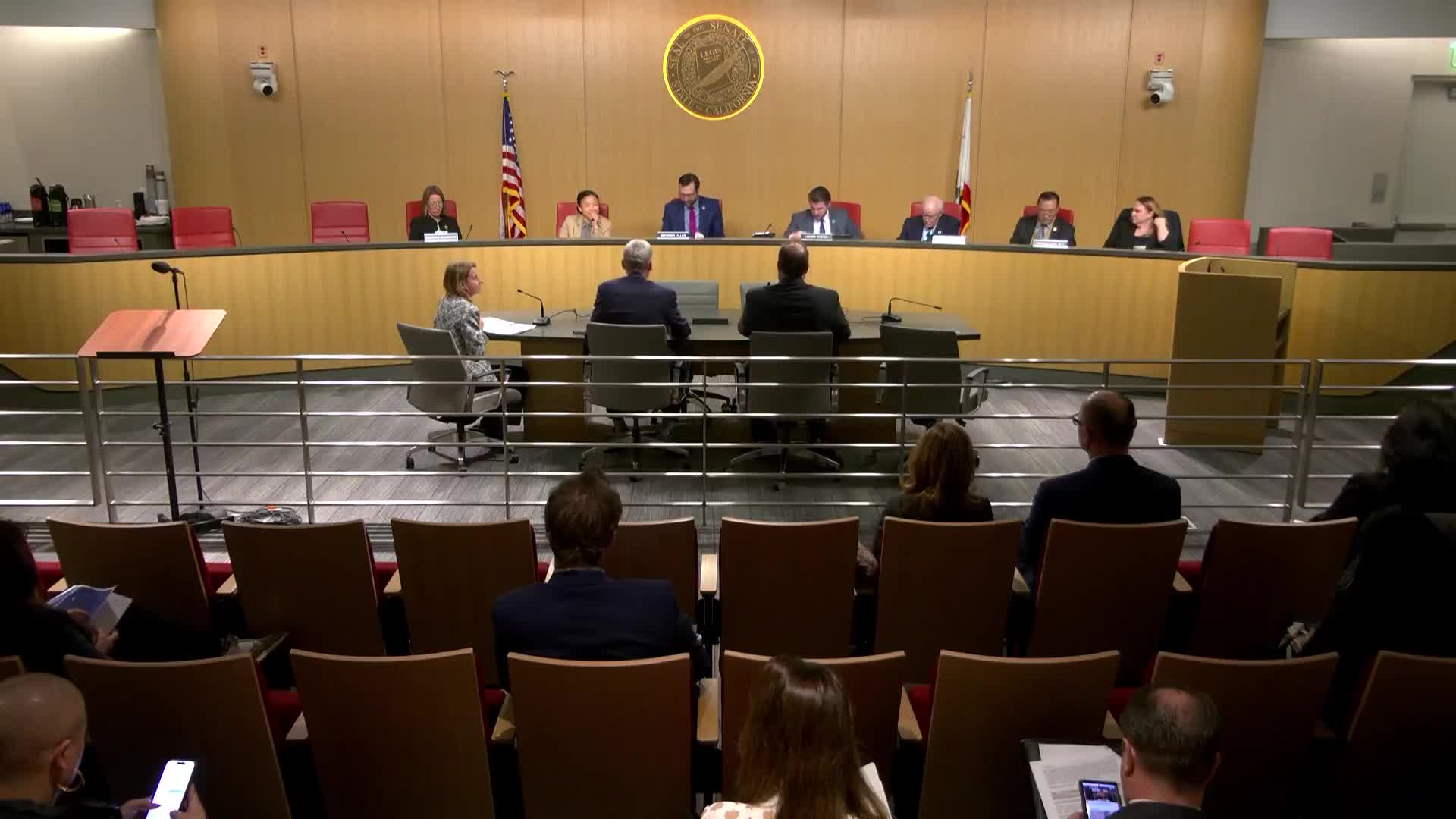
Drew Bowen, executive director of the California Energy Commission, briefed Senate budget subcommittee members on March 13 about the commission's structure and recent activity, including permitting, appliance standards, investments in charging infrastructure and hydrogen dispensers, research funding and the opt-in power plant permitting workload.
Bowen said the commission is celebrating its 50th year and described six divisions: three focused on public investments in clean energy (including vehicle-charging and hydrogen stations), three focused on policy work and a licensing unit created by AB 205 to hear "opt-in" power-plant permit applications. Bowen said the commission has a flood of opt-in applications: about 17 gigawatts in the queue, roughly one-third of the CAISO system peak load in recent years.
Why it matters: The CEC manages appliance and building standards that reduce statewide electric demand, stewards funds for clean-energy investment programs, and now has a major permitting role for large clean generation. Its activity intersects ratepayer bills, regional reliability planning and infrastructure that supports decarbonization.
Key program updates and staff responses: - Opt-in permitting: Bowen cited a very large solar-plus-storage application in Fresno County (the Darden project, ~2.3 GW) and noted the commission met statutorily required timelines for preliminary staff assessment and public review. - Appliance and building standards: the CEC adopted regulations for flexible appliance standards that will, for example, ship pool pumps preprogrammed to run at times favorable to the grid, and the agency plans to broaden such measures to other devices. - CalSHAPE school program: Bowen and staff said about $200 million remains from the schools program, largely for plumbing work; CEC has paused new applications and unspent school funds revert to the state Treasury under statute if not encumbered by mid-2026. - Clean Transportation Program and hydrogen: Bowen said the commission remains committed to a long-standing aspirational goal of 100 hydrogen fueling stations; Shell withdrew from a hydrogen contract during the pandemic but the commission believes it can reallocate funds to keep progress toward the goal. - Demand-side programs and storage: Ashley Emery, program manager for reliability reserve incentives, told the committee DSGS (Demand-Side Grid Support) has enrolled hundreds of thousands of participants and hundreds of megawatts of resources and works alongside DEBA (Distributed Electricity Backup Assets), which seeks to bring new behind-the-meter assets into strategic locations. CEC paused use of some flexible funds to provide multi-year certainty that encouraged resource aggregators to enroll customers.
Staff and LAO asked several follow-ups about vacant positions, fund reversion rules and whether the CEC could reprogram unspent school funds; the commission staff replied funds revert to the state if not encumbered and that agency staff can provide further granular accounting to the committee.
Ending: Bowen said the CEC will return for follow-up on several budget items and program details, including Prop 4 grant administration and the opt-in permitting pipeline.