Get Full Government Meeting Transcripts, Videos, & Alerts Forever!
Get email alerts on the Wildfire Mitigation topic
No spam. Unsubscribe anytime.
Office of Energy Infrastructure Safety outlines inspections, enforcement and limits on cost mandates
Summary
OEIS Director Carolyn Thomas Jacobs briefed the Senate budget subcommittee on the office's role reviewing utility wildfire mitigation plans, its enforcement activity and the statutory limits on requiring cost-effectiveness analyses.
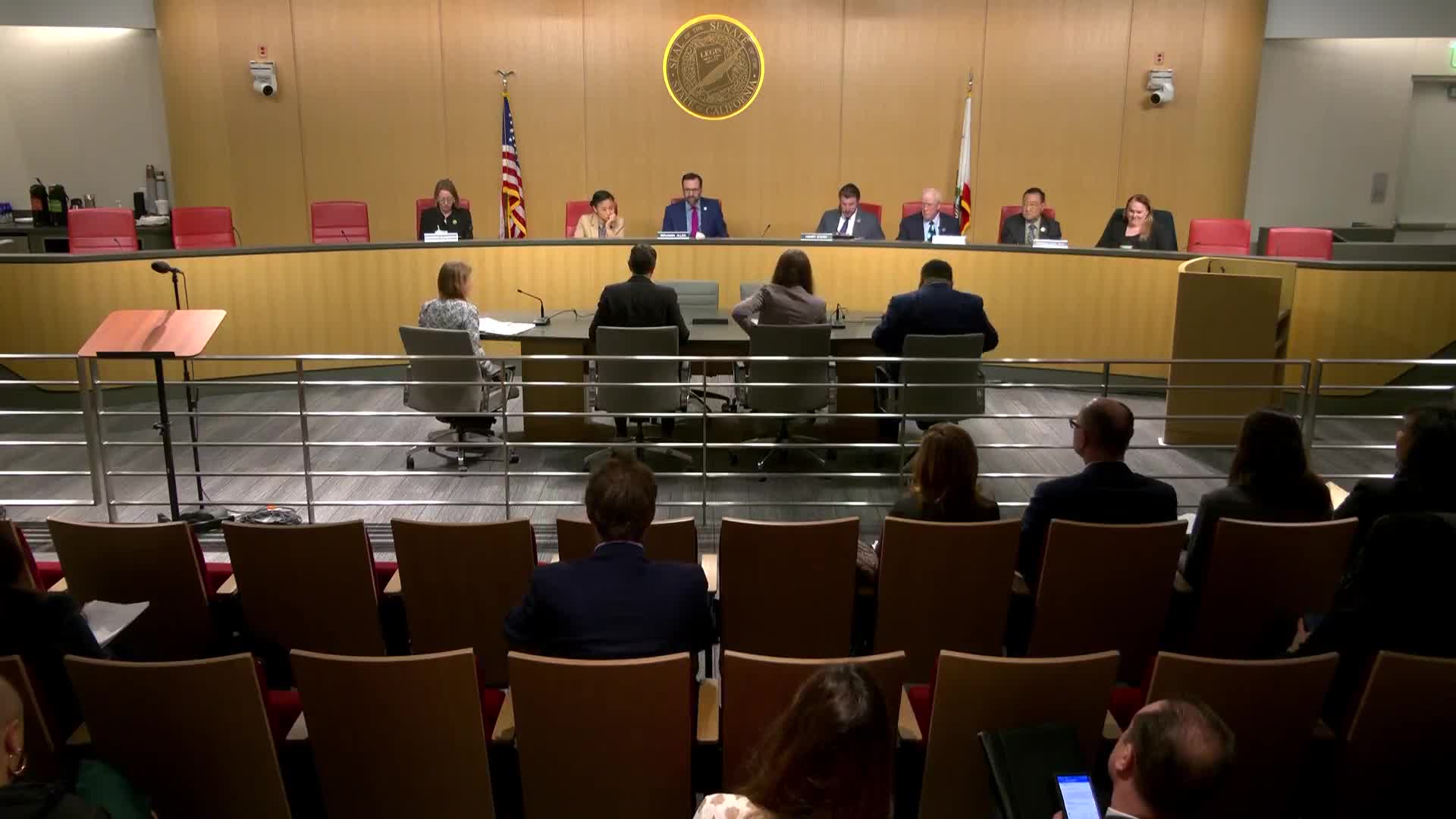
Carolyn Thomas Jacobs, director of the Office of Energy Infrastructure Safety, told the Senate Budget Subcommittee No. 2 on March 13 that OEIS reviews electrical corporations' wildfire mitigation plans, inspects implementation and issues violations when companies fail to meet their plan commitments.
The agency, created in 2021 and moved into the Natural Resources Agency, completed more than 7,000 inspections and issued over 900 violations in a recent year, Jacobs said. Year-to-date in 2025 OEIS had completed over 1,600 inspections and issued more than 200 violations. The office also conducts safety-culture assessments, vegetation-management audits and safety certifications for utilities that meet statutory criteria.
Why it matters: OEIS is the state's primary watchdog for utility actions tied to wildfire risk. Its decisions and findings feed into regulatory and rate-recovery decisions at the California Public Utilities Commission and shape how utilities prioritize work that affects public safety and customer bills.
OEIS emphasized the office's statutory boundaries on cost-effectiveness. Jacobs told the committee the statute does not require OEIS to perform a cost-effectiveness review and OEIS cannot deny a mitigation plan solely because measures are not cost-effective. Instead, OEIS evaluates safety first and uses "areas of continued improvement" (ACIs) to push utilities to improve transparency on costs and risk modeling. An example Jacobs described: OEIS pushed utilities to move risk models away from maximum-consequence emphasis toward probability-focused modeling so the utilities would better prioritize lower-cost, higher-probability reductions.
Senators asked whether OEIS can set minimum vegetation-management standards or otherwise force more cost-effective approaches than current practice. Jacobs said OEIS reviews and approves plans and enforces implementation, but it does not set statutory minimums; those standards and rate-recovery decisions remain with the CPUC. OEIS monitors implementation during the plan year, reviews the utilities' self-assessments the following year, and commissions independent evaluators to assess compliance.
Jacobs also described OEIS' expanded responsibilities under recent laws such as Senate Bill 884, which gave the office authority to evaluate large electrical corporations' 10-year undergrounding plans and assess compliance with those plans; OEIS issued guidance on submission requirements in February and is awaiting plan filings.
The committee pressed on time horizons for mitigation choices (three-year plan cycles with annual updates) and on coordination with regional wildfire and landscape-scale fuels efforts. Jacobs described examples where utilities coordinated with federal and regional partners in Tahoe to layer utility actions with broader fuels treatments.
Ending: The subcommittee did not take votes on policy changes at the hearing. Jacobs said OEIS would continue to use inspections, ACIs and independent evaluations to press utilities for better risk modeling and clearer cost transparency so regulators and rate-setting bodies can weigh safety priorities and cost impacts.