Get Full Government Meeting Transcripts, Videos, & Alerts Forever!
Get email alerts on the School Liability Childhood Assault topic
No spam. Unsubscribe anytime.
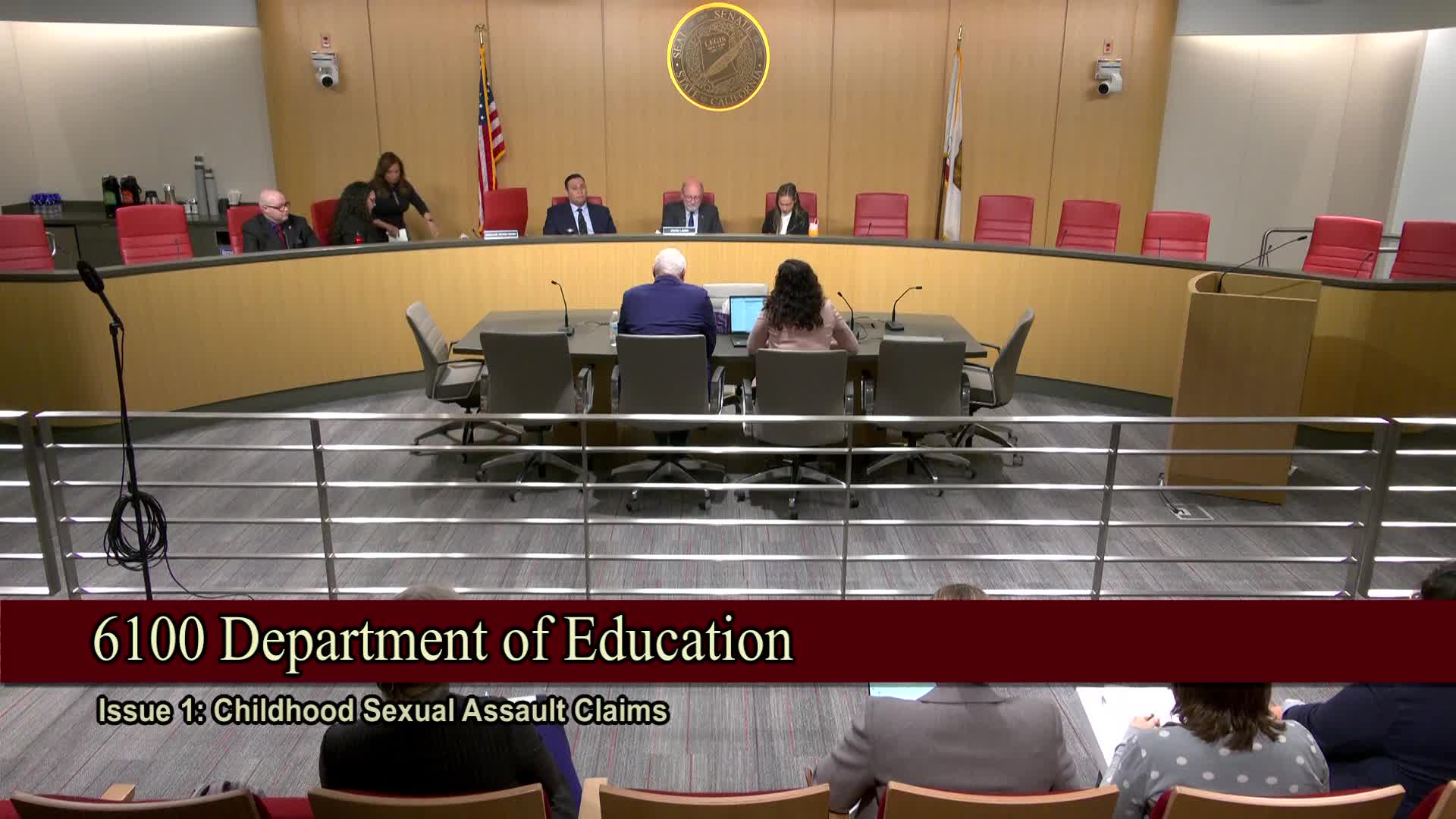
Senate subcommittee hears FCMAT report on financing school liability from childhood sexual‑assault claims
Summary
The Fiscal Crisis and Management Assistance Team told a state Senate budget subcommittee it produced 22 recommendations to address financing, data gaps and prevention related to childhood sexual‑assault claims against public agencies; the report focuses on financing options, a possible victims' compensation fund and prevention measures.
Senator Bill Laird, chair of the California State Senate Budget Subcommittee No. 1 on Education, on the committee's request, heard a report from the Fiscal Crisis and Management Assistance Team (FCMAT) on the fiscal implications of childhood sexual‑assault claims for public agencies.
Mike Fine, a representative of FCMAT, told the committee the team was charged by a budget trailer bill to study the issue and issued a report on Jan. 31 that lays out 22 recommendations across four themes: data, financing, a victims' compensation fund and prevention measures. “The report contains 22 recommendations,” Fine said, adding the recommendations are a roadmap “on how to finance the indebtedness that is created by settlements and judgments resulting from uninsured or underinsured causes of action.”
Why it matters: subcommittee members and witnesses said settlements and judgments tied to so‑called revival statutes (referred to in the hearing as AB 218) have created financial uncertainty for school districts and other local public agencies, and that many claims date back decades. Fine said available statewide data are fragmented across risk pools, commercial carriers and self‑insured entities, and that the lack of consistent classification hampers efforts to estimate total exposure.
Key report points the committee heard: FCMAT estimated exposure to school districts between $2 billion and $3 billion using the data it could collect; municipal exposure could be larger, the report said. The financing recommendations cover timing and constitutional debt‑limit hurdles and propose options to amortize judgments over time so agencies can continue to provide services. The report also proposed studying a first‑resort, full‑service victims' compensation fund, modeled in part on the federal September 11 Victim Compensation Fund, and said funding might come from public agencies and their insurance partners rather than necessarily the state.
FCMAT emphasized prevention as a core group of recommendations. “Simply put, these assaults on children need to stop,” Fine told the panel, calling prevention “more important than any of the other recommendations” though he ranked financing and timing as top priorities for the budget committee to consider.
Committee members pressed FCMAT on data limitations, how retrospective claims set expectations going forward and whether other states experienced similar impacts — Fine said roughly 30 states have some form of revival statute but that state constitutional debt limits and insurance markets differ, making direct comparisons imperfect. Laird and other members said the hearing is an opening step toward possible legislative change but emphasized the report’s recommendations are not enacted policy.
The subcommittee did not take action at the hearing; members said the report will inform follow‑up hearings and potential budget or trailer‑bill language.