Get Full Government Meeting Transcripts, Videos, & Alerts Forever!
Get email alerts on the State Budget Labor topic
No spam. Unsubscribe anytime.
Senate Labor Committee advances governor’s Department of Labor and Industry budget with fee changes, teacher apprenticeship funding and new enforcement dollars
Summary
Senator Erin McEwen, chair of the Minnesota Senate Committee on Labor, moved and the committee adopted an amendment to Senate File 2,373, the governor’s Department of Labor and Industry budget and policy bill, and then voted to recommend the bill, as amended, to the Senate Judiciary and Public Safety Committee.
Senator Erin McEwen, chair of the Minnesota Senate Committee on Labor, moved and the committee adopted an amendment to Senate File 2,373, the governor’s Department of Labor and Industry (DLI) budget and policy bill, and then voted to recommend the bill, as amended, to the Senate Judiciary and Public Safety Committee.
The proposal funds operating adjustments for DLI divisions, adds staff and enforcement resources for worker misclassification, creates a statewide mechanism to sponsor registered teacher apprenticeships using Workforce Development Fund dollars, updates construction code and licensing fees to better cover inspection and plan-review costs, clarifies required rest and meal breaks for employees, and extends funding availability for a study on single-egress stairways for apartment buildings.
Why it matters: The bill ties budgetary adjustments and new program funding to operational changes at DLI that affect contractors, construction permitting timelines, school districts and prospective teacher apprentices, and workers who allege misclassification. Changes to manufactured-home and modular-home requirements and fees prompted extended debate from industry representatives and rural legislators concerned about affordability and inspection capacity.
Key provisions and committee discussion
Fee alignment for construction codes and licensing: The bill would adjust permit, inspection, plan-review and registration fees across multiple units in DLI’s Construction Codes and Licensing Division (CCLD). Commissioner Nicole Lisonbee (Department of Labor and Industry) told the committee fees are the exclusive revenue source for the division and “fees have generally not been increased since 02/2007.” Supporters including the Minnesota State Building and Construction Trades Council, the IBEW state council and NECA testified that updating fees is necessary to avoid operational deficits, reduce inspection and plan-review delays, and keep projects on schedule.
Manufactured and modular home provisions: Mark Bruner of the Manufactured and Modular Home Association said his group largely supports some fee increases (for example, an increase in the installation seal from $80 to $130) but objected to a proposed new $75 transportation/shipment label fee and to a new used-manufactured-home resale inspection and decal program. Bruner warned that a new mandatory resale inspection with a $1,200 state-conducted inspection in areas lacking local code enforcement could raise costs for sellers of older homes and reduce resale value in lease-land communities. Department staff and Gregory Metz, a state building official, said the resale-decal proposal is intended to fund auditing and site follow-up for habitability complaints and that the $1,200 fee the department proposed is to provide a state inspection option when local officials or private inspectors are not available.
Misclassification enforcement: The governor’s budget would provide funding equivalent to 2.5 full-time positions in DLI’s Labor Standards Division, earmarked as roughly $281,000 in fiscal 2026 and $286,000 in fiscal 2027 to increase enforcement of worker misclassification laws. Commissioner Lisonbee and labor representatives said misclassification complaints have increased and that additional staff would allow the agency to investigate across industries including construction, health care, transportation and food service.
Statewide registered teacher apprenticeship sponsor: The bill would appropriate Workforce Development Fund dollars—$5 million in FY26 and $2 million in FY27—to support a statewide registered teacher apprenticeship program administered through a labor organization acting as a statewide sponsor. Commissioner Lisonbee and supporters including Education Minnesota and district officials described the model as an “earn-as-you-learn” pathway that pairs on-the-job learning (6,000 hours) with at least 144 hours per year of related classroom instruction and results in a tier 3 teaching license. Testimony emphasized using joint apprenticeship training committees (JATCs) or similar governance to coordinate districts, teacher-preparation providers and unions and to provide stipends, scholarships and supports to apprentices.
Operating adjustments and workers’ compensation funding: The proposal includes modest general-fund operating adjustments (the department cited roughly $144,000 in FY26 and ongoing adjustments thereafter to cover inflationary costs) and a workers’ compensation fund operating increase described in testimony as intended to fully fund current FTEs, restore IT staffing and fund a medical consultant position. The precise recurring amount for the workers’ compensation fund request was discussed but not fully specified on the record.
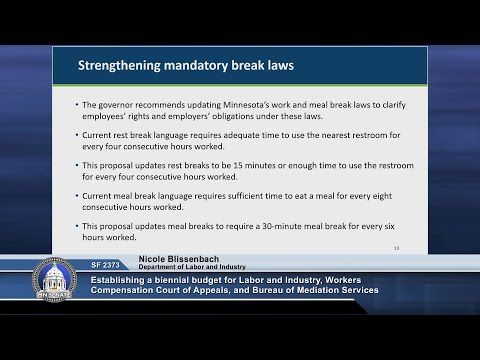
Mandatory break-language clarification: The bill would clarify Minnesota’s rest- and meal-break language by specifying a 15-minute rest break for every four consecutive hours worked and a 30-minute meal break for every six consecutive hours worked, while preserving employer ability to set the timing of breaks so long as the minimum windows are met. Supporters, including the Minnesota AFL-CIO, said clearer statutory minimums reduce confusion for workers and employers; some business groups voiced concerns about flexibility for small employers.
Committee votes and next steps
The committee first adopted the A2 amendment (Senator McEwen moved the amendment; committee voice vote: “Aye,” no recorded roll-call tally). The A2 amendment added policy language that the chair noted will also be reviewed in the Judiciary Committee before the bill returns to Labor.
Senator McEwen then moved that Senate File 2,373 as amended be recommended to pass and be re-referred to the Senate Judiciary and Public Safety Committee. The motion carried on a voice vote with no roll-call tally recorded in the transcript. The bill will proceed to Judiciary for review of the policy provisions the chair identified.
Notable testimony and points of contention
- Manufactured/modular home industry: Mark Bruner detailed concerns about resale inspection requirements, a proposed $75 transportation label fee, and a new salesperson licensing scheme. He warned a mandatory resale inspection and high fee could hinder resale of older, lower-value homes on leased land and drive up costs for buyers and sellers.
- Contractors and trades: Ryan Gilbertson (Minnesota State Building and Construction Trades Council) and Ryan Sen Cartier (government affairs director, NECA/MMCA) urged fee alignment to prevent backlogs and accommodate new technologies (for example, class 4 circuits and a proposed virtual inspection fee) that can speed inspections and lower costs.
- Apprenticeship supporters: Education Minnesota, district leaders and program pilots (CDF Freedom Schools, Black Men Teach partnerships) described registered teacher apprenticeships as a path to increase teacher supply, diversify the workforce and enable current paraprofessionals to earn licensure while remaining employed.
What the committee did not decide: Several aspects remain under negotiation. Department staff said they are discussing manufactured-home fee and decal language with industry representatives and that some fees or licensing items (for example, a proposed salesperson license) are likely to be revised or removed. The bill’s policy language that affects legal enforcement will go to Judiciary for further review before the Labor Committee’s omnibus recommendation is finalized.
Quotes from the hearing
State building official Gregory Metz: “Plumbing plan review is currently sitting at 6 weeks for plan review.”
Melissa Heising, legislative director, Minnesota AFL-CIO: “This funding will help ensure DLI has the resources to handle increased complaints, to conduct complex investigations and enforcement, to protect workers, employers, and taxpayers.”
Mark Bruner, Manufactured and Modular Home Association of Minnesota: “The provision that would establish a new transportation fee in the bill of $75 for every manufactured home that’s constructed … we have concerns about the fee being added on.”
Senator Erin McEwen (motion to advance the bill): “This bill will need to go to the Judiciary Committee before it comes back to us to build our committee’s omnibus.”
Ending note
Committee members and witnesses said continued negotiations are expected as the bill moves to Judiciary. The Labor Committee record shows broad support for addressing DLI funding shortfalls that have slowed inspections and plan reviews, and vigorous debate over manufactured-home-related changes and the appropriate mechanism to fund resale-audit work and site inspections in areas lacking local code officials.