Get Full Government Meeting Transcripts, Videos, & Alerts Forever!
Get email alerts on the Hoa Reform topic
No spam. Unsubscribe anytime.
Committee advances HOA reform bill after testimonies of foreclosures, fees and governance failures
Summary
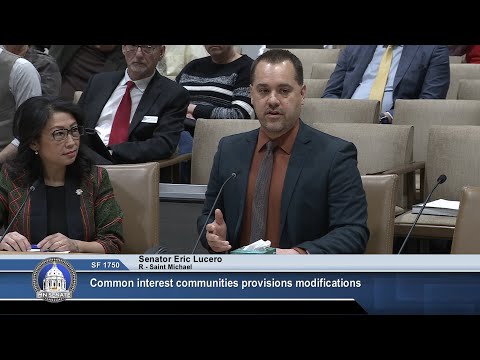
Senate File 1750, a bill to change oversight and governance rules for homeowners associations and common interest communities, was recommended to pass and re‑referred to the Committee on Judiciary after an extended, widely attended hearing.
Senate File 1750, a bill to change oversight and governance rules for homeowners associations (HOAs) and common interest communities (CICs), was recommended to pass and re‑referred to the Committee on Judiciary after an extended hearing that included dozens of in‑person and remote testifiers.
Sen. Matthew Lucero, one of the bill’s authors, said the measure responds to thousands of constituent contacts and a multi‑stakeholder legislative work group that met 14 times with three listening sessions. “HOA and CIC reform will help Minnesotans achieve the American dream by assisting in housing stability, greater fairness, and increased opportunity,” Lucero said.
Coauthor Sen. Brad Pa said the bill incorporates many recommendations from the bipartisan 20‑member work group and highlighted data the authors cited: roughly 1.5 million Minnesotans live in HOAs, the state has about 7,950 common‑interest associations, and in 2023 roughly 82% of new homes were sold as part of an HOA. The bill would add transparency requirements, place limits on certain fines, require dispute-resolution processes, restrict aggressive foreclosure triggers for small unpaid fines and impose new notice and billing transparency for legal and collection charges.
Homeowners who testified described a range of practices they said harmed families, including contested capital projects, alleged self‑dealing by management companies, lack of competitive bids, surprise legal bills and foreclosures for small unpaid balances. Roxanne Williams, who described a 96‑unit community in which roof replacement contracts totaling nearly $2 million were executed after a single meeting, testified that bidders were not allowed to compete and said unit owners received no itemized billing for legal charges.
Witnesses with HOA governance experience urged caution about unintended consequences. Mark Foster of the HOA Leadership Network said most HOA board members are unpaid volunteers and warned that stricter requirements could raise governance costs and deter volunteer service, increasing fees or leaving positions unfilled. Finn Jacobson, an attorney who advises boards, also urged refinements to avoid shifting enforcement costs to compliant homeowners and to limit a “chilling effect” on volunteer boards.
Nonprofit and counseling testimony highlighted foreclosure risk. Sheila Hawthorne, a HUD‑certified housing counselor, said statewide pre‑foreclosure notices have risen and that HOA foreclosures are often harder to resolve than mortgage foreclosures because homeowners face legal fees when negotiating. She pointed to local cases in which legal fees exceeded several thousand dollars.
Key bill provisions described by committee counsel include: applying chapter 515B definitions and rules to certain cooperatives and planned communities; declaring that the chapter prevails over conflicting declarations or bylaws; limits on late fees, fines and interest; additional notice requirements and standards for rule changes; strengthened conflict‑of‑interest rules for boards and management companies; a requirement to provide proposed budgets and allow unit‑owner comment before annual meetings; restrictions on using fines as a lien enforceable by foreclosure until a defined threshold (the draft sets a $5,000 minimum lien/enforcement trigger and a six‑month period in one section); and requirements for itemized invoices when legal fees are charged to unit owners.
Members of the committee praised the authors’ outreach and said the bill marks a starting point. Sen. Roger Abler described extreme anecdotes from constituents — including homeowners facing thousands of dollars in fines for small rule infractions — and urged robust protections. Other senators cautioned authors to continue refining the bill to avoid undue burdens on functioning HOAs and volunteer boards.
Sen. Lucero moved that Senate File 1750, as amended, be recommended to pass and re‑referred to Judiciary; the motion carried and the chair announced the bill will go to Judiciary.
Ending note: authors and counsel said the bill will continue to evolve; supporters urged stronger homeowner protections and limits on legal and enforcement charges, while HOA leaders asked for changes to avoid higher fees and deterrence of volunteer board service.