Get Full Government Meeting Transcripts, Videos, & Alerts Forever!
Get email alerts on the Liquor Policy topic
No spam. Unsubscribe anytime.
Senate commerce committee hears a slate of local liquor‑license requests as members prepare a liquor omnibus
Summary
The Senate Commerce and Consumer Protection Committee heard a series of bills on March 13 that would authorize local governments or special venues to obtain on‑sale intoxicating liquor or temporary licenses. Lawmakers plan to consolidate favorable measures into a liquor omnibus for floor action; each bill was laid over for possible inclusion.
The Minnesota Senate Commerce and Consumer Protection Committee on March 13 heard a series of local liquor‑license proposals and related technical amendments and laid each over for possible inclusion in a liquor omnibus to be considered on the Senate floor.
Committee Chair Klein opened the hearing saying the committee would "lay them all over" and try to "compile the ones that we...find favorable into a liquor omnibus bill" for floor action next week.
The bills are narrow, mostly special‑law requests that would let cities or public entities issue on‑sale intoxicating liquor licenses in circumstances state statute does not currently authorize. Testimony emphasized local economic and civic uses for the venues and the intent to align with existing state licensing rules when possible.
Highlights from bills the committee heard:
- Senate File 1168 (Rochester, Chateau/Chateau Theatre): Sen. Nelson said the bill "authorizes the city of Rochester to issue an on sale intoxicating liquor license" for the historic Chateau, described by the author as a landmark community gathering venue built in 1927. Kristan Cottright, deputy city clerk for Rochester, testified the Chateau "does not meet the definition of theater under Minnesota statute 348.404 subdivision 1" and described community uses including weddings, cultural celebrations and children’s activities. SF1168 was laid over for possible inclusion.
- Senate File 265 (City of Mankato / Taylor Center): Sen. Frentz said the measure would allow the City of Mankato to authorize beer and wine sales at the 4,800‑seat Taylor Center. Kevin Biesman, Minnesota State University Mankato athletics director, said dining services Sodexo would hold the license and ensure ID and responsible‑service training. SF265 was laid over for possible inclusion.
- Senate File 1655 (Baudette Arena, Lake of the Woods County): Anthony Perkle, Lake of the Woods County public works director and Baudette Arena Association member, described a 2018 donation that funded a 6‑million‑dollar arena serving a community of about 900. He said prior temporary authorizations expired and the bill would restore the ability to request temporary licenses for events; the county board and arena association support the bill. SF1655 was laid over for possible inclusion.
- Senate Files 1654 and 2059 (food‑hall licensing, Minneapolis / St. Louis Park): Sen. Dibble and Sen. Latz said the bills would allow cities to issue a liquor license for a food hall model similar to Malcolm Yards, where common seating and a single license can serve multiple food vendors. Patty Wall, operator of the Market at Malcolm Yards, described the 2017 legislative carve‑out that enabled her existing site and requested the change to permit new locations. Both bills were laid over; Latz offered an author's A1 amendment that was adopted and the bill was laid over as amended.
- Senate File 1588 (Bloomington / Dwan Golf Course): Sen. Wicklund said Bloomington seeks authorization to issue an on‑sale intoxicating liquor license for the Dwan Golf Course; Anne Cottrey, Bloomington parks and recreation director, said the course hosts 50,000 rounds per year and is currently limited to 3.2 malt liquor. The city intends to keep local oversight; SF1588 (as amended) was laid over.
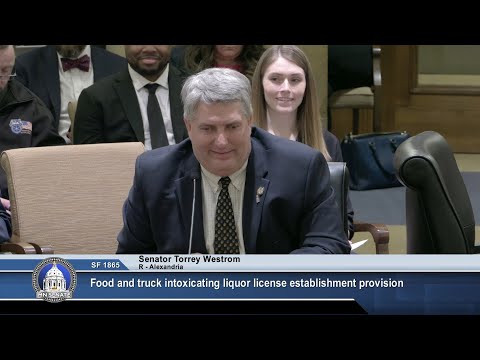
- Senate File 1865 (food‑truck catering): Sen. Westrom described a permissive measure that would allow municipalities to issue temporary on‑sale licenses for food trucks that provide contracted catering services for private events. Caterer Jason Schmidt said his business primarily seeks licenses for one‑day private events such as rehearsal dinners and wedding receptions, not street festivals. The bill was laid over for possible inclusion; committee members asked staff to work with counsel on numeric limits in the bill's blanked provisions (consecutive days per event and total days per year).
- Senate File 2202 (St. Paul / Science Museum and Union Depot): Sen. Pappas said the bill would let the City of St. Paul issue on‑sale intoxicating liquor licenses to the Science Museum of Minnesota and to Union Depot, both large, multi‑space facilities that do not fit existing statutory categories. Dan Nijieblic of St. Paul Department of Safety and Inspections testified the change would be similar to special provisions granted for other cultural institutions. SF2202 was laid over.
- Senate File 2376 (Springfield Area Community Center): Amber Dale, Springfield city manager, testified the city contracts out liquor service at the community center and the bill would allow the city to step in if a private vendor stops providing service; the bill was laid over.
- Senate File 2221 (University of Minnesota): Sen. Clark and Amy Kieran of the University described removing a cap on university licenses across the system, clarifying noncontiguous space and concessionaire rules, and aligning university practice with private colleges. SF2221 was laid over for possible inclusion.
Committee procedure and next steps
No committee roll‑call votes were taken on final passage; in each case the chair announced that the file "will be laid over for possible inclusion" in the liquor omnibus. Chair Klein said the committee plans to consolidate favorable measures and not accept floor amendments to the omnibus once it reaches the floor, following long‑standing practice.
Why it matters
The bills are narrowly targeted to individual venues and local governments but collectively reflect a recurring issue: municipal and cultural venues seeking authority to manage food‑and‑beverage operations directly rather than contract out. Proponents argued the changes support local economic activity and downtown activation; committee members pressed for details on local oversight and public‑safety safeguards.
Ending note
Committee members signaled a desire to standardize language where possible before folding favorable measures into a single omnibus bill for floor consideration next week.