Get Full Government Meeting Transcripts, Videos, & Alerts Forever!
Get email alerts on the Water Infrastructure Bonding Roundup topic
No spam. Unsubscribe anytime.
Capital Investment committee hears more than a dozen requests for water and sewer bonding across Minnesota
Summary
Representatives and local officials presented requests totaling millions for water and wastewater projects — from small towns seeking basic sewer service to regional systems addressing emerging contaminants — during an informational hearing of the House Capital Investment Committee.
The House Capital Investment Committee held an informational hearing March 13, 2025, where local officials and elected representatives presented more than a dozen requests for state bonding to repair, replace or expand drinking water and wastewater infrastructure across Minnesota.
Committee members heard requests that ranged from a $600,000 gap request for a Chisago County lakeshore sewer extension to multimillion-dollar needs for regional systems and a proposed 2-million-gallon water tower in Brooklyn Park. No committee votes were held; the session was an informational hearing to gather project details ahead of bonding bill negotiations.
Why it matters: Committee members repeatedly noted the breadth of need across Greater Minnesota and the Twin Cities suburbs — from failing septic systems and aging wells to emerging contaminant treatment and regional capacity limits. Presenters stressed equity concerns where small or low-income communities cannot absorb large rate increases and where delaying projects could trigger public-health advisories or regulatory violations.
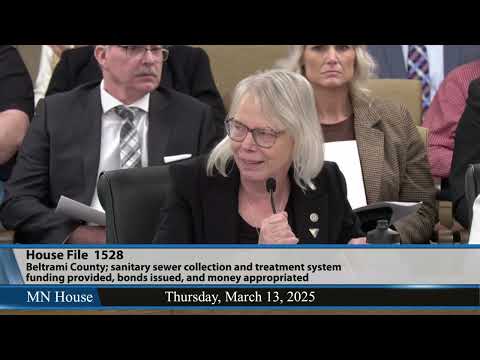
Key requests and project summaries (presenter, community, state request, major problem described): - House File 1904 — East Bethel: Representative James Scott presented a $10.5 million ask to extend clean water and sewer service to shorelines and two schools; Matt Look, East Bethel city administrator, said wells in the area show tannins, radium, manganese and volatile organic compounds and that the city lacks capacity to issue additional bonds. - Shorewood Park Sanitary Sewer District (Chisago County): Becky Myers testified that project ranking lists and federal funding reduced the state ask from $2.2 million to $600,000 to extend sewer around Rush Lake; the MPCA has listed Rush Lake and Rush Creek as impaired. - House File 1528 — Northern Township/Lake Bemidji: Chris Lane sought $14 million (after $6 million federal and $1 million local) to build wastewater infrastructure protecting Lake Bemidji and the Mississippi headwaters; he said 65% of residential systems are more than 25 years old and coordination with planned County Road 20 work could save construction costs. - House File 1541 — Joint Powers Water (Albertville/Hanover/St. Michael): Adam Naustad and John Seifert asked for $10 million toward roughly $21 million in treatment improvements to address high manganese and radium in seven supply wells; Seifert said measured manganese averages were hundreds of micrograms, exceeding recommended levels for infants and others. - House File 1748 — Monticello: Rachel Leonard described a long-running need for a centralized treatment plant to remove manganese; the estimated project cost rose from $28 million (2022 feasibility) to about $45 million at 30% design; the city previously received $11 million in 2023 and is requesting an additional $10 million. - House File 448 — Lafayette: Representative Schwartz and Mayor Kurt Talber requested $1,893,000 for a reverse-osmosis system after elevated disinfection byproducts and a prior EPA grant of $1 million; Alan Fox, the city superintendent, said January sampling showed elevated byproducts and operational evaluation requests from the health department. - House File 1536 — Jordan: Mayor Travis Fremming asked for $6.25 million to replace an influent lift station, build a 60-foot final clarifier and rehabilitate pretreatment infrastructure to meet anticipated state discharge limits and reduce overflow risks. - House File 674 — South Haven: Representative McDonald and Melissa Stinson requested $3.5 million for water and sewer improvements, citing bacterial slime in distribution lines, water tower issues and stormwater-related flooding; Stinson said more than half of households are low- or moderate-income. - House File 811 — West Union: Representative Mike Weiner and council member Jim Bottleberg asked for $1.9 million to fund a new municipal wastewater collection and treatment system after inspections found many private septic systems failing or posing immediate health threats. - House File 1670 — Red Lake Falls: Representative Steve Gander sought $5.947 million toward a broader $12 million-plus utility and street project; Mayor Alan Bertelrude and others described an older housing stock, a high share of older residents and limited local tax base. - House File 1438 — West Central Regional Water System: Representative Gander and Lucas Spathe described a proposed regional drinking-water pipeline for multiple small towns with arsenic and other contaminants; the study/design/construct request was $9.7 million to serve dozens of communities and tens of thousands of residents in a three-county area. - Wrenshall / Rentshall area (Dotseth): Jeff Bloom and Carlton County Commissioner Susan Zimzaloney (as testified) requested $1.5 million toward a $3 million Pioneer Drive corridor project (sanitary sewer, sidewalks and water mains) serving a small community and its school entrance. - Thompson Township: Nathan Barta asked for $3.5 million to extend sewer mains to areas with private interconnections and to serve a commercial corridor lacking municipal utilities. - Fairmont — House File 1714: Representative Bjorn Olson and city officials asked for infrastructure to open roughly 55 acres to housing and to unlock 75 acres owned by the city; projects are intended to address landlocked parcels and access issues tied to trunk highway access. - Aitkin (Aiken in transcript) wastewater treatment upgrades: Dave Clough requested $5 million toward a larger project to replace aging influent/lift station piping, add clarifier capacity and update electrical systems to protect the Mississippi River watershed. - Brooklyn Park — House File 1942 (Representative Vang presentation): Mayor Hollis Winston and City Engineer Mark Culver sought $12 million for a 2-million-gallon water tower to restore fire-flow pressure and allow development of a biotech innovation district and 700 acres of housing-ready land. - Rapid/Three Rivers Park District dam maintenance: 3 Rivers Park superintendent Bo Carlson and Representative Ray Rauer described urgent maintenance needed at the Rapids Dam (hydraulic cylinder failures on riser gates); Carlson estimated about $1.5 million to replace cylinders and a much larger long-term repair cost the DNR lists for full replacement. - St. Louis County / Rainy River corridor: Commissioner Mike Jukovich and Joint Powers engineers asked for roughly $7 million to help extend sewer infrastructure in rocky, high-cost terrain to protect lake and river water quality in the Rainy Lake/Rainy River watershed.
Discussion, oversight and equity concerns: Committee members asked multiple presenters about local matches, the phaseability of projects and whether federal funding listed was secured. Presenters repeatedly stressed that increasing construction costs had driven some project estimates sharply higher since initial feasibility work or prior appropriations (Monticello, Monticello’s cost escalation from $28 million to about $45 million; Jordan’s 24-year-old equipment and flood-response needs). Several presenters said projects are shovel-ready or at 30% design and could proceed quickly if a financing package is completed.
No committee action was taken during the hearing; members said the testimony would inform the larger bonding bill deliberations.
Ending: Committee members thanked presenters and noted there were many competing water and infrastructure needs statewide; the committee adjourned with the understanding the requests will be considered during the bonding bill process.