Get Full Government Meeting Transcripts, Videos, & Alerts Forever!
Get email alerts on the Federal Parks And Wildfire Capacity topic
No spam. Unsubscribe anytime.
Minn. senators hear from fired park workers and DNR on wildfire capacity after Feb. 14 federal workforce cuts
Summary
An informational hearing heard testimony from two recently separated National Park Service employees about the effects of large, recent federal personnel cuts on park operations, visitor programming and species monitoring, and the Minnesota DNR described existing wildfire mutual‑aid and grant programs it says will help meet spring needs.
An informational hearing of the Minnesota Senate Environment, Climate and Legacy Committee on March 13 heard testimony about the local and statewide consequences of recent federal workforce separations affecting the National Park Service and other land management agencies.
Two former national park employees described immediate effects of the federal actions and the risks to park programming and natural‑resource work. Kate Severson, who said she was “the former chief of interpretation and education at Voyageurs National Park,” told the committee she was fired on Feb. 14 while still in a probationary period and described program cuts that would reduce environmental education and visitor services. “We provide field trips for grades K through 12,” Severson said. “At Voyageurs National Park, the 2023 report showed that $20,400,000 was spent by visitors.”
Jessica Loeffler, identified as a former biological science technician at the Mississippi National River and Recreation Area, told senators that a quarter of her natural‑resources department was lost in the action and listed monitoring and restoration work that has been halted, including monarch and heron rookery monitoring and a nationwide beaver management plan. “With my termination, all of these vital conservation efforts have been halted, leaving a fragile ecosystem vulnerable and unprotected,” Loeffler said.
The committee heard from Patty Thielen, forestry division director for the Minnesota Department of Natural Resources, who explained how DNR coordinates wildfire planning and response with federal agencies and regional compacts. Thielen said Minnesota anticipates meeting wildfire suppression needs through existing agreements, mutual aid and recently announced federal grants under the Infrastructure Investment and Jobs Act. “We will continue to prepare for and respond to wildfire in Minnesota, to the best of our capabilities,” Thielen said, adding that DNR participates in weekly coordination calls and that the state is a member of the Great Lakes Forest Fire Compact (GLIFSI).
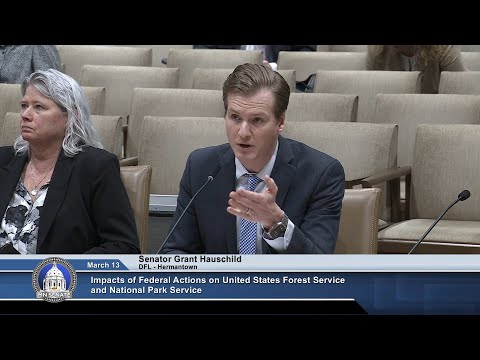
Senators pressed witnesses on the scale of federal separations, workforce reinstatement prospects and local capacity to respond. Committee members cited reports that large numbers of federal employees across multiple agencies were affected on Feb. 14, and several senators expressed concern that cuts or coerced early retirements could shift costs and operational burden to counties and volunteer fire departments. Senator Hauschildt described calls from rural mayors worried about response capacity and said many separated federal employees have wildfire suppression responsibilities in addition to other resource work.
Thielen told senators DNR has proactively reached out to recently separated federal staff about seasonal firefighter openings and that the department maintains reciprocal response agreements with neighboring states and provinces to surge resources if needed. She said DNR recently received notification that implementation will proceed for Bipartisan Infrastructure Law fire‑related grants that include community wildfire defense funding for St. Louis County and grants to local volunteer departments.
Committee members and witnesses also discussed uncertainty about future federal reductions, whether separations were performance‑based or targeted at probationary employees, and the potential ecological consequences if monitoring programs and invasive‑species work lapse. Several senators said they intend to continue outreach to federal officials and to consider state measures for supporting affected employees.
The hearing was informational; no committee action was taken on legislation during the session portion devoted to this topic. The committee then moved on to other bills on the agenda.