Get Full Government Meeting Transcripts, Videos, & Alerts Forever!
Get email alerts on the County Elections Administration topic
No spam. Unsubscribe anytime.
Committee reviews bipartisan county elections administrator bill; bill laid over for possible omnibus inclusion
Summary
Senate File 2232, a bipartisan package of administrative changes drafted with county input, was presented to the Senate Elections Committee on March 13 and laid over for possible inclusion in an omnibus bill.
Senate File 2232, a bipartisan package of administrative changes drafted with county input, was presented to the Minnesota Senate Elections Committee on March 13 and laid over for possible inclusion in an omnibus bill.
State Senator Mark Horan introduced the measure and Michael Stolberger, director of property and environmental resources for Blue Earth County, testified for the Minnesota Association of County Officials (MAKO), describing a series of technical changes counties say will improve election administration and voter clarity.
Stolberger said the bill would allow combined polling places to share electronic rosters when precincts are officially combined, change the deadline on absentee ballot applications submitted by mail or online to a week before the election (with certain exceptions), remove party-balance requirements on county ballot boards for county-only special elections, and adjust candidate-filing and sample-ballot requirements. He told the committee the changes were intended to reduce administrative redundancies, give election officials more time to process absentee applications, and reduce voter confusion from prefilled or inaccurate third-party mailings.
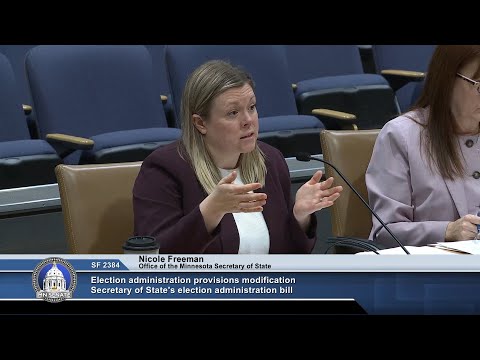
Nicole Freeman of the Office of the Secretary of State testified in support and said the office appreciated MAKOs work. Freeman noted the secretary of states preference that the absentee-application deadline be the Friday before Election Day and said the office would continue discussions with counties on that timing.
Key provisions discussed in committee include: - Electronic rosters at combined polling places: when precincts are combined, officials would be able to use a single electronic roster across the combined site to avoid duplicative devices and procedures. - Absentee-application deadline: the bill as drafted would require all non-exempt mail and online absentee applications be received by election officials at least seven days before the election to allow processing and mailing time; the secretary of state indicated a preference for the Friday before Election Day and staff and counties agreed to continue discussions. - Verification fields for online applications: online absentee-application forms would require both the last four of Social Security number and a drivers license or state ID number to reduce mismatched records that can lead to rejected ballots. - Emergency and healthcare procedures: the bill allows absentee ballots to be handed to two health-care facility employees for delivery to voters in isolation if election judges cannot safely enter a unit. - UOCAVA and delivery efficiency: the bill would allow counties and delegated municipalities to streamline delivery and processing of Uniformed and Overseas Citizens Absentee Voting Act ballots to reduce multi-hour courier trips and potential chain-of-custody issues. - Third-party mailings: the bill would require non-governmental entities distributing sample ballots or absentee-application mailings to indicate the materials are not official and ensure blank, non-prefilled applications to avoid sending outdated or inaccurate data to voters.
Committee members sought clarifications on implementation details: what constitutes an "original bill" for proof-of-residence; how chain-of-custody requirements would be executed; whether city clerks or counties would bear certain operational deadlines; and how party-list exhaustion would work for appointment of election judges. Stolberger and Freeman said many items came from county administrators real-world experience in 2024 and that continued intergovernmental work was expected.
Senator Port told the committee he would remain engaged on the absentee-application deadline given his concerns about moving the deadline a full week before Election Day; Freeman and Stolberger said they would continue to work with legislators to refine the timing.
The committee laid Senate File 2232 over for possible inclusion in an omnibus bill; no final committee vote on the bill occurred during the hearing.