Get Full Government Meeting Transcripts, Videos, & Alerts Forever!
Get email alerts on the Elections Administration topic
No spam. Unsubscribe anytime.
Senate Elections Committee approves Secretary of State election-administration bill with authors amendment
Summary
The Senate Elections Committee on March 13 advanced Senate File 2384, the Office of the Secretary of States election-administration bill, voting to pass the measure as amended and sending it to the Judiciary and Public Safety Committee.
The Senate Elections Committee on March 13 advanced Senate File 2384, the Office of the Secretary of States election-administration bill, voting to pass the measure as amended and sending it to the Judiciary and Public Safety Committee.
The bill, introduced by Senator Westland, contains a wide set of technical and policy changes intended to adjust absentee-voting timelines, update ballot handling procedures, require counties to file chain-of-custody plans, and codify use of the states Election Night Reporting System (ERS) for unofficial results.
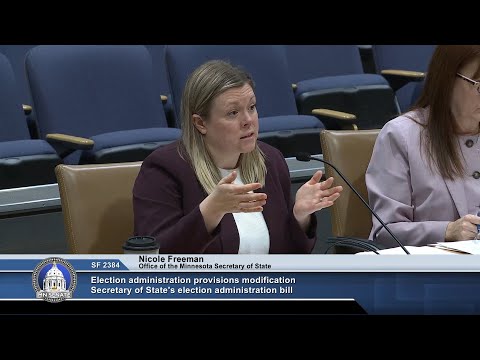
Senator Westland, the bills author, said the measure "includes provisions to improve the way that our elections function for voters across race and place, and it's brought forward by voters and local election administrators." Counsel King Stengel and Nicole Freeman of the secretary of states office walked the committee through the bills sections and the A4 authors amendment. Freeman, identified as Nicole Freeman, Office of the Secretary of State, said the changes reflected "collaboration and input from our local election partners, in MAKO, AMC, LMC, the township association, as well as individual jurisdictions."
The A4 amendment, described in committee as an authors amendment, was adopted by voice vote early in the hearing. The committee later adopted a motion to pass the bill as amended and forward it to the Judiciary and Public Safety Committee.
Major provisions explained to the committee include: - Election-day registration and proof-of-residence: the bill adjusts what counts as acceptable proof and removes a requirement that residential facilities produce lists of employees; employees may instead present proof of employment to vouch for residents. - Absentee voting and timelines: jurisdictions that conduct elections by mail would be required to send ballots at least 28 days before an election (up from 14 days in current law). The bill also allows municipalities designated for in-person absentee voting to be open for 46 days or for only the 18-day early-voting window, giving local officials staffing flexibility. - Ballot handling and chain-of-custody: new language requires county auditors to develop chain-of-custody plans accounting for physical and cyber security of election materials, to be filed with the secretary of state and reviewed prior to every election; initial county plans must be filed by Sept. 1 of the year specified in the amended text. - Election Night Reporting System (ERS): the A4 amendment would require the Office of the Secretary of State to maintain an election reporting system and require counties to submit unofficial election results through that system for state and federal contests; counties would also be required to perform a results-reporting test at least seven days before Election Day. - Candidate filing and privacy: the bill changes affidavit-of-candidacy requirements (for county attorney and sheriff candidates, for example) so candidates need not include a residence address on public affidavits but must provide phone and email contacts; when proof of residence is mailed to election officials it is classified as private data. - Election judge lists and oath: the bill tightens the information parties must provide on election-judge lists (including willingness to serve in the last two years and contact information), moves the list timeline earlier to provide more time for appointments, and adds language to the election judge oath prohibiting knowingly sharing materially false information or hindering voting; the oath pulls language from a statute criminalizing intimidation and interference with voting.
Supporters and local election administrators who testified told the committee the bill contains many technical fixes informed by 2024 administration experience. Michael Stolberger of Blue Earth County, testifying for the Minnesota Association of County Officials (MAKO), said counties "strongly support" several provisions, including changes to the permanent absentee process and improvements to party appointment lists for election judges. He said counties wanted to continue discussions on some details, including timing for student housing lists and how permanent absentee status should be requested.
Committee members pressed staff and the secretary of states office on implementation details. Questions addressed where the term "original bill" is defined for proof-of-residence uses, how long absentee ballot envelopes must be retained (the bill requires retention for the duration of the contest period), whether counties and cities could use off-reservation tribal lands for temporary polling places, and how chain-of-custody failures would be handled under existing statutes and contest procedures. Freeman said remedies for contested procedures could include errors-and-omissions petitions and election-contest processes already in statute.
On questions about evidence authenticity for candidate affidavits, several senators raised concern about manufactured utility bills and other digitally altered documents. Freeman told the committee she was not aware of prosecutions specifically for use of fabricated utility bills in voting or candidate filings, and she noted that candidates and voters are required to present both proof of residence and an approved form of identification in many contexts. Committee members suggested possible future work on verification or consequences where false documents are used.
The committee recorded two formal outcomes related to the bill: the A4 authors amendment was adopted by voice vote, and the committee voted to pass Senate File 2384 as amended and forward it to the Judiciary and Public Safety Committee. The vote was taken by voice; no roll-call tally was recorded in the hearing transcript.
The committee session then moved on to separate legislation. The bill will proceed with the A4 changes as described and return in later committee and floor steps where additional refinement and technical corrections will be made.