Get Full Government Meeting Transcripts, Videos, & Alerts Forever!
Get email alerts on the Teacher Apprenticeship topic
No spam. Unsubscribe anytime.
Committee hears plan to expand intermediate-district apprenticeship that trains special-education teachers
Summary
Lawmakers heard testimony on House File 846, which supporters say would expand an apprenticeship pathway that helps paraprofessionals earn categorical special-education licensure while working. Testifiers described early results and asked questions about grant administration and sustainability.
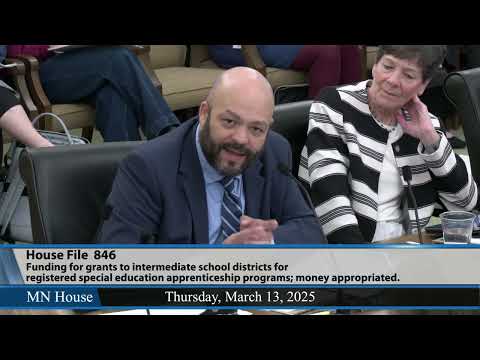
House File 846 was presented to the Minnesota House Education Finance Committee on March 13, 2025, by Representative Clardy to request expanded funding for the Intermediate Teacher Apprenticeship Collaborative (I-Track).
Representative Clardy said the program, developed by the state's four intermediate school districts, creates a two-year, on-the-job apprenticeship that allows nonlicensed support staff to earn a bachelor's degree and categorical licensure in areas such as emotional and behavioral disorders and autism spectrum disorder. “This program was designed to recruit diverse and highly qualified special ed workforce because we know that there's been a shortage in that area,” Clardy told the committee.
The bill as presented proposes additional annual funding for the program. Representative Clardy described the proposal as seeking "$3,000,000 annually to expand apprenticeship within the intermediate school districts," and asked the committee to lay the measure over for possible inclusion in a later omnibus bill.
Marcy Dowd, superintendent of Intermediate District 287, testified that the district launched the apprenticeship with support received last year and that the program places apprentices with experienced teachers while the University of Minnesota–Mankato provides related instruction. “This is a two-year immersion program,” Dowd said, adding that apprentices will graduate with two licensure areas that match the high-need, federally defined settings intermediates serve. Dowd told the committee the program expects 23 apprentices to graduate in spring 2026.
Alvin Chambers, a current apprentice at Intermediate District 287, described how the program removed financial and scheduling barriers that had kept him from finishing college. “It created opportunities for my family,” Chambers said. He said the work-and-learn model allowed him to continue supporting his daughters while completing coursework and becoming a licensed special-education teacher.
Caitlin Snyder of Education Minnesota said the union supports registered teacher apprenticeship models and noted the benefits of paid student teaching, loan relief and the potential to diversify the workforce. At the same time, she cautioned that many smaller districts “do not have the capacity to be competitive under the system design here,” and said the Department of Labor and Industry’s (DLI) budget proposal to fund statewide sponsors could build needed infrastructure and consistency.
Committee members asked detailed questions about grant administration. Representative Hudson asked why the draft bill allowed “up to $40,000” for administration in one line item and whether unspent administrative funds would revert to program use. Megan Adeola, legislative policy manager for the Minnesota Department of Education, replied that many state grants allow up to 5% of total allocation for administration and that administrative dollars are typically used to pay staff time to support grantees. Adeola said she would follow up with written details on how any difference between estimated and actual administrative costs would be handled.
Dowd told the committee the requested administrative allocation reflects work across four intermediates that collectively serve 45 member districts; the intermediates are braiding local special-education dollars and other pipeline funds to operate the apprenticeship.
Supporters in the room urged the committee to consider the program as a solution to the shortage of teachers able to serve students in federal level 4 settings. Representative Ray Rauer and Representative Bickberg both described classroom observations of apprentices working successfully with high-need students.
The chair laid over House File 846 for possible inclusion in a later omnibus bill.
The committee did not take a final funding vote on the proposal during this hearing. Testimony materials and a video the sponsors submitted were offered for follow-up by committee staff.