Get Full Government Meeting Transcripts, Videos, & Alerts Forever!
Get email alerts on the Student Loans topic
No spam. Unsubscribe anytime.
Lutheran Social Service outlines statewide student loan counseling work as lawmakers question competition and finances
Summary
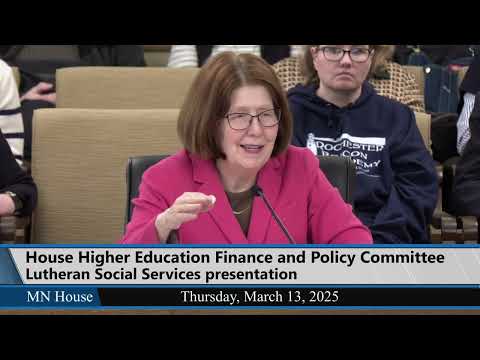
Lutheran Social Service of Minnesota told the House Higher Education Finance and Policy Committee it has statewide capacity for student loan repayment counseling under a state grant, described recent outcomes and metrics, and answered lawmakers' questions about competition, funding sources and executive pay.
Lutheran Social Service of Minnesota told the House Higher Education Finance and Policy Committee on Tuesday that it is operating a statewide student loan repayment counseling program funded in part by state grants and has continued demand for its services.
The nonprofit's senior vice president, Alexis Oberdorfer, said LSS ‘‘serves 91,000 individuals and families’’ across all 87 counties and that the agency’s financial counseling line includes certified student loan counselors. Becky Pacarinen, senior director of financial and employment services at LSS, described the program’s history, reach and outcomes and said LSS counseled 1,104 Minnesota borrowers in 2024 across 58 counties.
Committee members said the program is widely used and asked whether the statutory requirement that grantees be certified counseling agencies with physical statewide locations limits competition. ‘‘We do go through a competitive RFP process,’’ Pacarinen told the committee. ‘‘In the statute, it requires you must be a certified counseling agency and you must have physical locations throughout the state.’’ Pacarinen said she is aware of only one other agency that has physical locations but very limited capacity.
LSS described results reported from counseling: 93 percent of counseled borrowers report increased knowledge about repayment options, 95 percent avoid default for at least one year after counseling, 58 percent report payments are more affordable one year later, and 97 percent develop a realistic budget. Pacarinen said program staffing for the counseling line amounts to about 2.25 full-time equivalent positions across eight staff dedicated to student loan work and that the agency has a low overall administrative rate of about 8 percent.
Lawmakers asked about financial oversight and reliance on government funding. Representative Coulter cited LSS audited financials in the committee packet and noted that the organization reports a large share of revenue from government fees and grants; Pacarinen and Oberdorfer told members those government funds are tied to specific services and contracts and that internal and external audits and oversight are part of their regular operations.
Several members praised the counseling as both a remediation tool for borrowers in distress and a model that could be useful on the front end to help students understand borrowing. Representative Cleburne said she would like to see active efforts to provide counseling before students take on debt. Representative Robbins suggested the committee review whether the statute’s statewide-location requirement unintentionally excludes capable local organizations.
The committee adjourned the LSS presentation after a brief line of questioning and moved on to other agenda items.
Lutheran Social Service provided conference materials and audited financial statements in the committee packet, which lawmakers referenced during questioning.
Looking ahead, lawmakers signaled interest in reviewing statutory requirements that govern how the state awards and structures the student loan counseling contract to determine whether more local providers could participate without reducing statewide access.