Get Full Government Meeting Transcripts, Videos, & Alerts Forever!
Get email alerts on the Fy2026 Budget topic
No spam. Unsubscribe anytime.
Mayor Parker proposes $6.7 billion "1 Philly 2" budget, pairs tax reform with housing and public-safety investments
Summary
Mayor Sherelle L. Parker delivered the proposed fiscal 2026 operating and capital plan — a $6.7 billion "1 Philly 2" budget — that pairs a multi‑year tax reform plan and pension stabilization with major housing bonds, public‑safety spending, and investments in wellness, transit, and forensics.
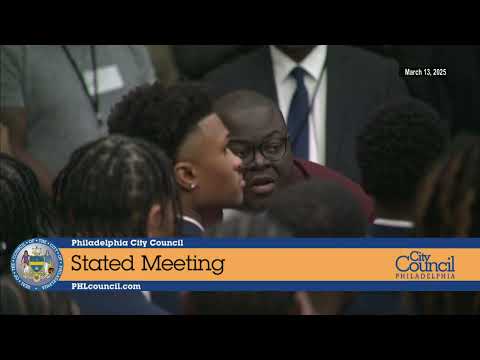
Mayor Sherelle L. Parker presented her proposed fiscal 2026 operating and capital budget to Philadelphia City Council on March 13, laying out what she called the "1 Philly 2" plan: a $6,700,000,000 budget that would build on last year’s $6,370,000,000 package while advancing tax changes, housing investment and public-safety initiatives.
The mayor said the plan relies on continued pension improvements and other revenue changes to fund multi‑year goals. “I am proud to return today as the 1 hundredth mayor of our great city of Philadelphia,” Parker said in her address.
Parker emphasized three central elements: tax reform intended to stimulate job growth, a large bond program and other direct investments to create and preserve housing, and targeted public‑safety and wellness spending. She proposed reserving $280,000,000 in a budget stabilization fund by the end of the five‑year plan and highlighted the city pension fund’s recent progress — currently at about 65% funded, the mayor said — as a driver of future fiscal room.
On housing, the administration proposed a goal of creating or preserving 30,000 housing units during Parker’s tenure and said the five‑year plan would include $800,000,000 in housing bonds, with $400,000,000 of that to be issued in fiscal 2026. Parker said additional actions on titles, zoning and streamlined permitting would follow, and she scheduled a special council session on housing for March 24 to present more details.
On tax policy, Parker proposed a multi‑year program to change the business tax structure. The administration would reduce the net‑income portion of the Business Income and Receipts Tax (BIRT/BERT) over time and eliminate the gross‑receipts portion after a transitional period — with an immediate step lowering the net‑income rate from 5.81% (FY25) to 5.5% by FY30 and an eventual target the mayor described in her remarks. The plan also restarts phased reductions to the wage tax, targeting 3.7% for residents and 3.39% for non‑residents by FY30. Parker said those tax changes — combined with pension savings and other revenue — represent roughly $212,000,000 in tax reform investments over the plan.
To help pay for targeted priorities the mayor proposed a package of discrete revenue and fee changes: a modest increase to the realty transfer tax expected to generate about $173,000,000 over five years, a Center City parking meter rate increase from $3 to $4 per hour, and a $3 increase in the portion of document‑recording fees directed to the Housing Trust Fund. Parker said the administration would also fund a new Jump‑Start business program with $30,000,000 per year and a $5,000,000 small business catalyst fund.
Public safety and violence prevention were central themes. Parker reiterated the administration’s “prevention, intervention, enforcement” (PIE) approach and proposed to expand the neighborhood wellness court pilot to five days a week and to increase Police Assisted Diversion (PAD) with a $2,800,000 pilot in FY26. The budget also includes a $67,000,000 investment for a new forensics laboratory (to be sited at 4101 Market Street, the mayor said) and funding to outfit officers with body‑worn cameras and, over time, dash cameras in patrol cars.
The mayor described a major wellness and behavioral‑health investment, noting that the Riverview Wellness Village — opened in January after emergency rehabilitation work — has a 336‑bed capacity and the five‑year plan would allocate $216,000,000 for wellness operating costs across the plan. Parker said the administration had already put $100,000,000 in capital toward wellness facilities in FY25 and planned additional beds and services at Riverview.
The mayor also recommended $716,000,000 in operating support to SEPTA over five years and a $76,000,000 capital match; Vision Zero street‑safety capital investments described in the speech totalled tens of millions across the capital program to fund speed cushions, striping and other safety measures.
Parker asked council to work with the administration on passage and implementation and announced multiple outreach and transparency steps, including a new PhillyStat360 data dashboard and the March 24 housing session. She framed the package as a balance of fiscal discipline and targeted investments to stimulate economic opportunity for Philadelphians.
Council did not vote on the mayor’s proposal at the session; the presentation begins the statutory process of council review and amendment ahead of formal budget votes in the weeks to come.