Get Full Government Meeting Transcripts, Videos, & Alerts Forever!
Get email alerts on the Committee Votes Roundup topic
No spam. Unsubscribe anytime.
Economic Matters Committee advances package of utility, consumer protection and accessibility bills
Summary
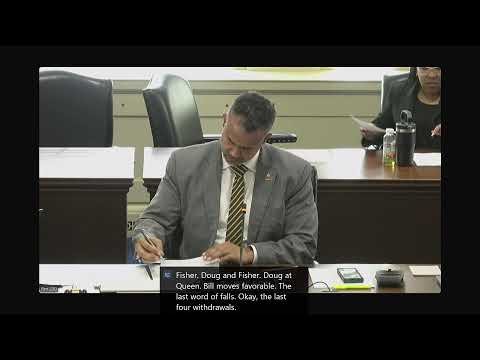
The House Economic Matters Committee voted to advance a series of bills affecting utilities, consumer protections and accessibility requirements, moving several measures favorably after brief debate and a handful of roll-call records.
The House Economic Matters Committee voted to advance a series of bills affecting utilities, consumer protections and accessibility requirements, moving several measures favorably after brief debate and a handful of roll-call records.
Among the items the committee advanced were: House Bill 1294, which subjects earned-wage-access products to the Maryland Consumer Loan Law and related provisions; House Bill 1270, which would exempt certain transmission lines from continuing designation within specified wildlands under set conditions; and House Bill 1363, which lowers the screen-count threshold for movie-captioning requirements to theaters with at least four screens and adds a reporting requirement. The committee also moved several additional bills forward by voice vote, including measures on utility reporting, carrier liability for damage to public infrastructure and a limited license for certain aesthetic services.
Why it matters: The bills touch on consumer finance protections, siting and environmental oversight for transmission infrastructure, and expanded accessibility requirements for movie theaters — each affecting businesses, state regulators and local communities in different ways.
Earned-wage-access regulation (House Bill 1294)
House Bill 1294 would bring companies that offer earned-wage-access services — sometimes called payday-on-demand or similar products — within the scope of the Maryland Consumer Loan Law and other statutes that regulate consumer credit. Committee discussion focused on how the amendments in the packet change fee treatment and clarify application of certain delivery or expedited-delivery fees.
Committee members described the bill as bringing “more regulation” and consumer protections into the market for earned-wage-access products. One member summarized the intent: “It brings more regulations into the earned wage access groups ... Regulates it, brings it into our consumer laws, creates a cap on how much you can charge on fees for when you borrow money,” and noted the amendment limits applicable tip provisions and clarifies fees.
Committee members acknowledged prior opposition to the measure. One member said the bill had opponents in earlier sessions but supported the amended version in light of recent events, saying, “we've been opposed to this in the past, but I think given the recent events, happy to support this bill for the first time in several years.” The committee moved the amendments and proceeded with a recorded vote on the bill as amended.
Transmission-line exemptions from wildland designation (House Bill 1270)
House Bill 1270 would prevent specified lands from continuing to be designated as part of the Big Savage Mountain Wildland, Bear Penned Wildland or Dans Mountain Wildland if a NextEra Energy transmission line runs parallel to an existing Potomac Edison transmission line and a certificate of public convenience and necessity (CPCN) is obtained from the Public Service Commission. The bill also includes an amendment requiring certain wildlife-mitigation guarantees to be provided to the Public Service Commission as a condition of approval.
Committee members discussed prior opposition from environmental groups. A member noted: “There was opposition, I believe that Sierra Club was against it. LCB was against it.” The Department of Natural Resources’ position was described during the hearing as “neutral.” The Farm Bureau and some others were reported to have supported the measure.
A roll-call vote was taken on the bill as amended; the committee moved it forward on that vote.
Movie-captioning threshold reduced to four screens (House Bill 1363)
House Bill 1363 extends statutory movie-captioning requirements to motion-picture houses with at least four screens; last year's law applied to theaters with eight or more screens. The bill also adds a reporting requirement, the committee was told. Members questioned whether the change would disproportionately affect small theaters in regions such as the Eastern Shore, and staff and other members said the universe of affected businesses also includes sites in Southern Maryland, Baltimore City and other jurisdictions.
One committee member raised concerns about potential cost differences for acquiring films with captions, saying, “there's a cost difference between acquiring a film that has the captions in it. It's not like your TV, smart TV where you just hit a button.” Another member said stakeholders had worked to reach agreement on the bill and that there had been no organized pushback compared with the prior year.
Other bills advanced by voice vote
- House Bill 121: Requires each electric company other than a municipal electric company to submit an annual report to the Public Service Commission by Feb. 1 containing information related to recent votes cast at meetings of a regional transmission organization. An amendment clarifies the reporting requirement for votes cast by affiliates only applies to Maryland affiliates.
- House Bill 860: Prohibits a common carrier or an employee of a common carrier from causing damage to public infrastructure that necessitates the closure of public infrastructure; creates a civil-penalty exposure (an amendment clarifies liability may include a civil penalty of $1,000 per day). The committee passed the bill as amended on a voice vote.
- House Bill 1223: Establishes a limited license for certain eyelash-extension services and expands the statutory definition of providing aesthetic services. The committee moved the bill favorable by voice vote.
The committee also recorded a number of withdrawals from the consent calendar during the meeting; several delegates requested to withdraw bills that will be returned in a future session.
Process notes and next steps
Committee members frequently moved amendments from the packet and handled a mix of voice votes and roll-call votes. The chair reminded members to remain available for upcoming subcommittee hearings. Several members reminded colleagues that some measures could be contested later on the floor.
Quotes attributed in this article are taken verbatim from the committee hearing transcript. Where speakers were not identified by name in the transcript, their remarks are attributed generically (for example, 'Committee staff' or 'a delegate') to avoid misidentification.
Ending
All bills advanced by the committee will proceed to subsequent floor or committee stages according to the legislative calendar and any additional amendments or floor debate that occurs. The committee chair asked members to be alert for subcommittee hearings and said additional consideration on some items could continue in follow-up sessions.