Get Full Government Meeting Transcripts, Videos, & Alerts Forever!
Get email alerts on the Short Term Rentals topic
No spam. Unsubscribe anytime.
South Salt Lake adopts short-term rental limits, grandfathering existing licensed hosts
Summary
The South Salt Lake City Council approved an ordinance that restricts short-term rentals in single-family neighborhoods, establishes a 30-mile residency requirement for new hosts, creates a citywide and per-block cap with a wait list, and grandfathers existing licensed short-term rentals. The measure passed in a roll-call vote on March 12.
South Salt Lake — The City Council on March 12 approved an ordinance to regulate short-term rentals (STRs), including new geographic and residency limits for future hosts, a citywide cap, and a wait list, while allowing existing licensed STRs to continue under grandfathering provisions.
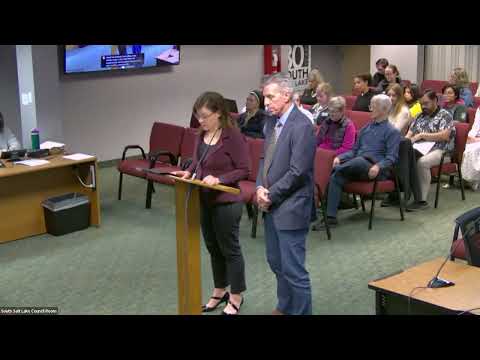
Supporters and opponents of STRs attended the meeting and several residents urged the council either to enact restrictions or to allow the market to remain open. Jonathan Weidenhammer, the city’s community and economic development director, and Eliza (deputy) presented the ordinance and the planning commission’s recommendations before the council voted.
The ordinance bars new short-term rentals in single-family (R-1) and certain residential districts unless the property is owner-occupied or owned and operated by a person who lives within 30 miles of South Salt Lake. The proposal sets a citywide cap at 200 licensed STRs, establishes per-block limits, an occupancy maximum of 10 people per rental, and on-site parking requirements. The ordinance includes a wait-list provision: completed applications received after a cap is reached are placed in order by date and reviewed annually; applicants on the waiting list are not charged renewal fees until a license is issued.
Under the ordinance, roughly 45 currently licensed STRs will be allowed to continue as nonconforming uses with existing operations preserved; those properties will not be subject to the new cap. If a grandfathered property changes ownership, the new owner must apply for a business license (business licenses are nontransferable) and bring operations into compliance with regulatory standards such as occupancy and parking, though the grandfathering exempts them from the numeric cap tied to existing use.
Public commenters described both neighborhood impacts and economic benefits. Richard Lane and Carl Wilmarth, residents on East Commonwealth Avenue, told the council they had multiple STRs on their block and urged limits to preserve neighborhood character. Brian Klinger, representing a 45-unit development at 3390 South 300 East, said developers and owners sometimes plan for STRs and asked how the ordinance would affect new townhome projects.
City staff said the ordinance already precludes STRs in the city’s townhome overlay; developers would need a council-approved change to the land-use matrix to allow STRs in such developments. Staff also noted enforcement limits: state law prevents municipalities from using internet advertising alone as the primary means of identifying unlicensed operators, so compliance actions typically rely on complaints and inspections.
Council members acknowledged competing interests. Several members said they had received many resident contacts and described the measure as an attempt to protect long-term homeownership and neighborhood stability while permitting some commercial-scale hospitality in defined commercial or mixed-use corridors.
The council voted to approve the ordinance, including the added wait-list language read into the record. After roll call, the measure passed and council members expressed appreciation for staff work and community engagement.
Votes at a glance: The ordinance was approved by roll call vote on March 12; the meeting record shows affirmative responses from the council and the mayor noting the motion passed. The ordinance amends multiple sections of the South Salt Lake Municipal Code to enact the new STR rules.
The council directed staff to return materials and code language as final ordinance text and implementation steps. Staff also said they will continue outreach about licensing and enforcement procedures.
Ending: The new rules take effect as the municipal ordinance process is completed and will apply to future STR license applicants; existing licensed hosts may continue operating under grandfathering rules but must meet operational standards upon transfer of ownership.