Get Full Government Meeting Transcripts, Videos, & Alerts Forever!
Get email alerts on the Mining Regulations topic
No spam. Unsubscribe anytime.
San Miguel County planners continue rewrite of mining regulations amid preemption, setback concerns
Summary
San Miguel County planning staff presented a revised draft of mining and natural‑resource regulations at a joint work session March 13, emphasizing impact‑based review and accepting state and federal permit materials, while commissioners and stakeholders pressed for clearer language on setbacks, monitoring and preemption.
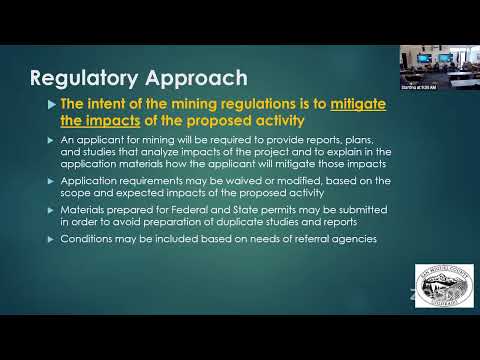
San Miguel County planning staff and a consultant presented a revised draft of mining regulations at a joint work session with the county commissioners and planning commissioners on March 13, 2025, saying the rules are intended to mitigate local impacts from exploration, reclamation and mining operations while deferring technical permitting to state and federal agencies.
The draft, which will become Article 6.3 of the land‑use code, lays out definitions, application requirements and review standards for three activity categories: exploration (minor and major), reclamation‑only projects, and full mining operations. Presenter Kaye (county planner) said the county will accept federal and state permit materials in lieu of duplicate studies and will rely on agencies such as the Colorado Division of Reclamation, Mining and Safety (DRMS) and the Bureau of Land Management (BLM) where those agencies’ work already addresses technical issues.
Why it matters: commissioners and speakers from industry and conservation groups said they want clearer rules because mining proposals affect county roads, water resources, dark‑sky standards and public safety, but industry groups warned the county not to adopt standards that conflict with state law. County staff and counsel discussed legal preemption — whether state or federal law limits local regulation — and said the proposed rules are impact‑based in order to reduce the risk of conflict with DRMS and federal permitting.
Discussion highlights
- Preemption and role of DRMS: Consultant Tory Jarvis and county counsel reviewed three types of preemption (express, implied, conflict) and told the commission the draft appears structured to avoid facial preemption. They advised caution when imposing rigid, prescriptive standards — for example, inflexible setbacks — that could conflict with DRMS permits for specific projects. Jarvis said the county can and should take DRMS and federal documents as evidence for local review, but that local mitigation and conditions addressing impacts off the DRMS permit boundary may still be imposed where legally permissible.
- Review process and scope: The draft uses two‑step review for mining operations (Planning Commission recommendation; BOCC final decision). Minor exploration and reclamation‑only projects are proposed for an expedited one‑step review; commissioners asked staff to clarify thresholds and public‑notice opportunities. Staff said many reclamation activities done by federal or state agencies will remain notice‑only, but the county will keep a one‑step review for reclamation carried out by private applicants so the county can track impacts.
- Application requirements and monitoring: The regulations would require plans and studies scaled to project impacts — for example, emergency preparedness, spill prevention, hazardous‑materials management, stormwater, and restoration plans. Staff said applicants may submit DRMS or other state/federal documents in lieu of new materials, but the county may require specific monitoring and reporting as permit conditions. Commissioners urged the draft to more clearly state whether and how the county will receive and make available monitoring data submitted to other agencies.
- Setbacks, noise and cumulative impacts: The draft includes default setbacks (e.g., a 200‑foot setback from dwellings and a quarter‑mile scenic setback in some cases) with language allowing modification based on site‑specific findings. Staff explained those defaults are starting points, not inflexible bans. Commissioners emphasized cumulative impacts (roads, traffic, water quality, noise) and asked staff to clarify how the county will evaluate cumulative effects across multiple approvals.
Public and stakeholder input
The county circulated the draft and received written comments from DRMS, BLM, Colorado Parks and Wildlife, the Colorado Mining Association, Western Small Miners Association, local conservation groups, town governments and private citizens. Speakers at the meeting urged both careful protection of wetlands, water and community resources and recognition that much technical permitting is already handled by state and federal agencies. Industry participants asked that the county avoid duplicative requirements and unnecessary costs; conservation groups urged stronger buffers and clearer monitoring.
Next steps
Staff said they will prepare a third draft incorporating clarifications discussed at the work session — including clearer language about acceptance of federal/state application materials, refinement of definitions (such as “reclamation” and “restoration”), and edits requested by DRMS — and resubmit the draft for an extended public comment period. Commissioners signaled they were ready to send a revised draft to formal referral and a public hearing, with at least 30 days of comment; staff said a May Planning Commission public hearing is likely if the next draft is ready in time.
No formal regulatory changes were adopted at the March 13 work session; the action taken was direction to staff to prepare a revised draft and to circulate it for additional comment.