Get Full Government Meeting Transcripts, Videos, & Alerts Forever!
Get email alerts on the Wastewater topic
No spam. Unsubscribe anytime.
Winter Springs advances East/West wastewater plant designs; consultants say Ironbridge route would add time and cost
Summary
City staff and consultants presented final designs, funding steps and a construction-manager-at-risk plan for two new wastewater reclamation plants. Engineers cautioned that piping wastewater and reclaimed water to the regional Ironbridge facility would require many years and higher costs, and could create new operational risks.
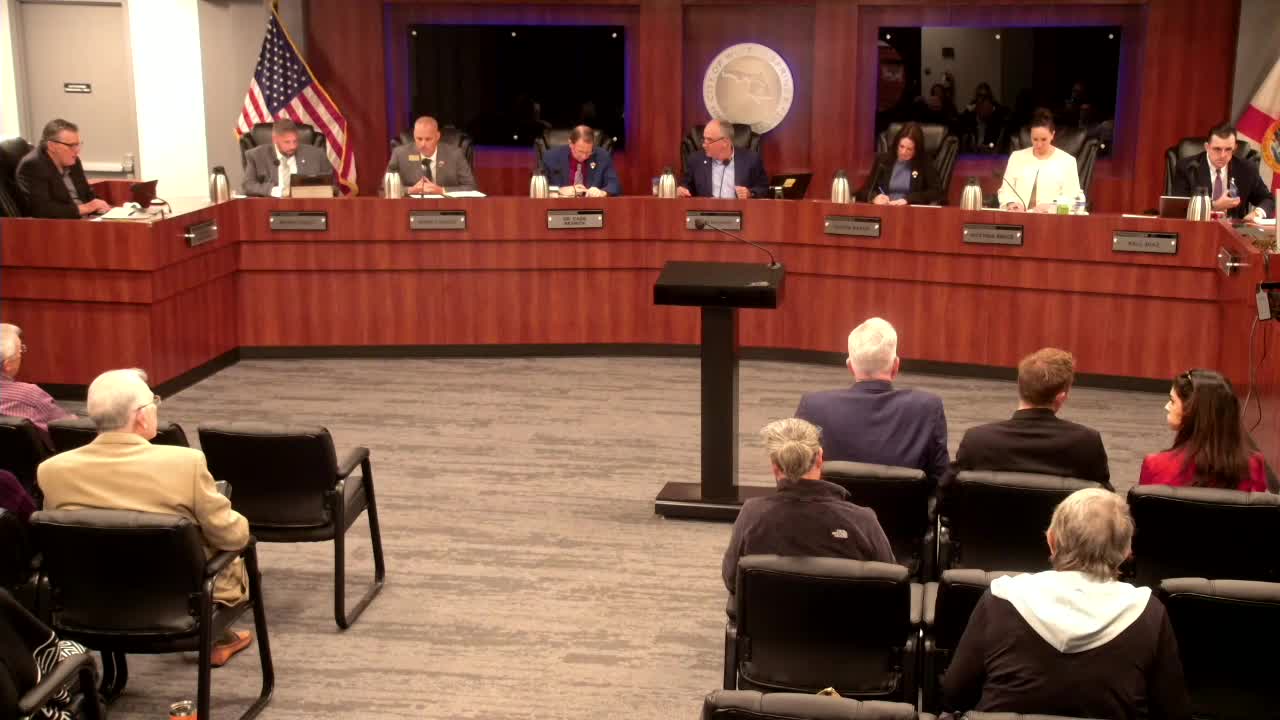
Winter Springs city staff and outside engineers on March 13 presented a plan to replace aging East and West wastewater reclamation plants and said pursuing a regional hookup at Ironbridge would add years, complexity and cost.
Utilities Director Clete Sonnier opened the City Commission workshop with an overview of the project and the condition of the existing plants. "It's my great privilege to present to you an update on the engineering design and construction phase services associated with the East and West wastewater reclamation facilities," Sonnier said, noting the plants were installed decades ago and have been kept functional by short-term repairs.
Carollo Engineers project director Scott Richards and Carollo project engineer Mira McKee described designs, funding steps and permitting. Richards said the current plants are "well beyond their useful life" and explained the new designs use multiple treatment trains and separated clarifiers to add redundancy.
Why it matters: Winter Springs operates two package-style plants that staff say are fragile when a single component fails, and the city is managing elevated regulatory and operational risk while the plants remain in service. City documents and consultants say replacing the plants—rather than routing all flow to a regional facility—keeps local reclaimed-water capacity and reduces some long-term dependencies on outside systems.
Key points from the presentation
- Existing facilities and need: Carollo and city staff told commissioners the East and West plants were installed as ringed-steel package plants several decades ago, that short-term repairs beginning in 2019 extended operations, but that the package-plant design leaves the city vulnerable when a single tank or aeration unit fails.
- Project scope and sizing: The current East-plant design is sized at about 1.6 million gallons per day (MGD); staff said present flow is roughly 1.1 MGD and the design leaves room to add capacity later. McKee said, "The East preliminary design is finalized as mentioned. We use that to apply for our DEP construction permit."
- Funding and schedule: The city secured an SRF design loan in 2022 and used ARPA funds for design work; the draft permits were submitted to the Florida Department of Environmental Protection (DEP) in early 2025. Staff said they will apply for SRF construction funding in June to be considered for an October 1 funding award. With a construction-manager-at-risk (CMAR) approach led by Wharton Smith, consultants estimated the East plant construction could finish in roughly two years after funding and procurement steps are complete (the presentation cited a mid-2028 target for the East plant under the current schedule). The West plant is planned to follow, with design work and a funding application targeted in 2027 and a possible completion around 2030, subject to funding and permitting.
- Procurement approach: The commission was briefed on the CMAR method and its benefits, including early cost estimating and constructability input. Eric Anderson of Wharton Smith said the CMAR "allows us to work on estimating during the design phase," enabling early ordering of long-lead items such as switchgear and generators and an open-book guaranteed-maximum-price (GMP) process.
- Operations contract: Sonnier said the city's current operations-and-maintenance contract ends Sept. 30; an RFQ for a contract operator was published Feb. 28 and staff will review submittals under Florida's cone-of-silence rules. Sonnier said staff intends to bring a recommended operator to the commission on May 12 for a contract start date of Oct. 1.
Ironbridge alternative: engineering tradeoffs and risks
Consultants outlined the option of sending Winter Springs' wastewater to the regional Ironbridge treatment facility instead of building two new local plants. Richards described three major technical and programmatic obstacles: hydraulics and pumping infrastructure, acquiring treatment capacity and restoring reclaimed-water delivery to Winter Springs.
- Pumping and transmission: Tying into the existing SNOC force main or building a new dedicated force main to Ironbridge would require long runs of force main—consultants referenced distances of up to roughly 12–15 miles for reclaimed-water return lines and as much as 15 miles for raw wastewater transmission in some routing scenarios—and large pump stations with higher head requirements. Richards told commissioners that sections of the SNOC force main already see velocities near engineering limits and that adding flow could worsen hydraulic performance for all existing members.
- Treatment capacity and governance: Richards said Ironbridge and its governing arrangements are controlled in part by the city of Orlando and that members' shares and capacity allocation are subject to charter and membership constraints. Consultants said Ironbridge had reported no capacity currently listed for sale and that any membership would require legal agreements and likely capital and rate commitments by Winter Springs.
- Reclaimed water return: Several presenters emphasized that the city needs reclaimed water for irrigation to meet consumptive-use and reclaimed-water planning needs. Richards warned that losing local reclaimed delivery could require a distant, costly reclaimed distribution system to return water to Winter Springs and that failing to secure reclaimed supply would create potable-water implications for the city's consumptive-use permit.
Cost and timeline comparisons
Consultants gave a high-level view that routing to Ironbridge would add schedule and cost: Richards said an Ironbridge transmission solution could take on the order of eight to ten years at a high conceptual level and would require restarting much of the planning and permitting process. He and other presenters said the pipe, pump stations and reclaimed-water return would materially increase project cost; at a conceptual level presenters said the Ironbridge piping/transmission plus treatment option appeared roughly double the capital cost of replacing the two local plants. Wharton Smith and city staff emphasized that these are high-level planning estimates and that detailed, route-specific modeling and pricing would be needed to firm up numbers.
City and county numbers cited during the meeting included a conceptual figure of roughly $75 million mentioned for additional treatment capacity at Ironbridge (presented as an approximate, capacity-only figure) and a higher, widely-cited construction-space estimate discussed by staff and commissioners when including long transmission mains and reclaimed-water return. Consultants emphasized the uncertainty in those comparative numbers and repeatedly recommended detailed engineering and cost modeling before any fundamental change of course.
Operational risks and trade-offs
Presenters highlighted trade-offs if the city abandoned local treatment: Winter Springs would shift maintenance and capital risks onto an expanded transmission network that could run through other jurisdictions, require additional rights-of-way, air-release valves and mid-line pump stations, and expose the city to other members' rate and capital decisions. Richards warned pipeline breaches and air-release-valve maintenance are routine operational realities on long force mains and would create additional maintenance tasks. By contrast, the planned local plants are designed with redundancy to reduce the risk of large single-point failures that currently plague the package plants.
Public-finance and grant implications
City Manager Kevin Sweet reminded commissioners that design funding included ARPA dollars and warned there would be federal conditions if the city chose to redirect funds to a different regional project. Staff also explained that SRF construction applications require design plans, a DEP permit and a draft GMP; those documents are being assembled now for a June SRF application.
What the commission directed or decided
No formal vote was recorded at the workshop. Staff said they will proceed with the permitting, SRF application and CMAR GMP process for the East plant while continuing planning for the West plant. Sonnier said staff will review RFQ responses for the operations-and-maintenance contract and return a recommendation to the commission on May 12.
Next steps and public information
Staff and consultants said they will pursue the SRF construction application in June, finalize the CMAR GMP and time orders for long-lead equipment if SRF funding is approved in the October funding cycle, and continue design for the West plant toward a 2027 funding application. Materials and the video of the March 13 workshop will be published on the city website. Sonnier reiterated staff's request that commissioners defer operational-operator questions while the cone of silence for the RFQ remains in effect.
Ending
City staff and consultants urged the commission to weigh local control, reclaimed-water needs and schedule risk when deciding whether to continue with local replacement or pursue a regional Ironbridge connection. Staff emphasized that the East plant is the near-term priority under current funding, permitting and schedule assumptions and that more detailed engineering and cost work would be required before any definitive route change could be recommended.