Get Full Government Meeting Transcripts, Videos, & Alerts Forever!
Get email alerts on the Public Safety Drug Enforcement topic
No spam. Unsubscribe anytime.
Mayor Lurie defends enforcement strategy as supervisors press for broader fentanyl response
Summary
Mayor Daniel Lurie told the Board of Supervisors the administration measures success by residents' experiences and defended recent interagency operations targeting street drug markets, while Supervisor Myrna Melgar Fielder and others urged a 'four pillars' approach that balances enforcement with prevention, harm reduction and treatment.
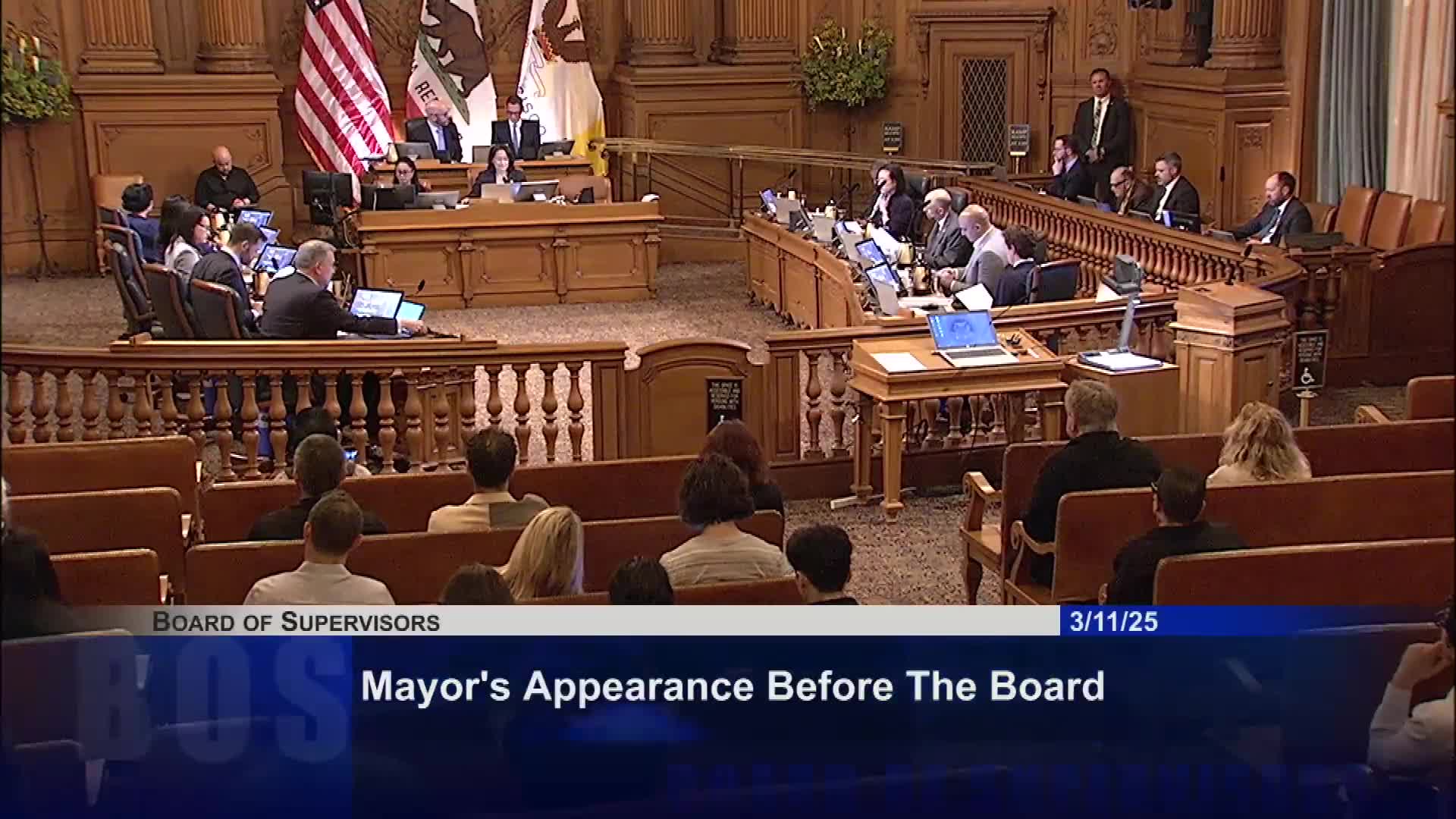
Mayor Daniel Lurie told the San Francisco Board of Supervisors on March 11 that his administration measures success in its response to open-air drug markets and fentanyl by whether residents and small-business owners feel safe on city streets.
Supervisor Myrna Melgar Fielder asked Lurie whether recent enforcement operations—cited in the meeting as targeting hot spots such as Sixth Street, Sixteenth and Mission, Jefferson Square Park and the Tenderloin—had succeeded or merely displaced people who use drugs to other neighborhoods. Fielder pressed the mayor to commit to a strategy that gives equal weight to prevention/education, harm reduction, treatment and enforcement, an approach she described as the "four pillars" model endorsed in a recent Budget and Legislative Analyst office review.
Lurie said enforcement is one component of a broader strategy that must include expanding bed capacity and treatment options. "Success is measured by the experiences our residents and visitors feel," Lurie said, naming clean sidewalks, safe alleys and viable small businesses as markers of progress. He described interagency operations that removed dealers, paraphernalia and trash and said responses in the affected communities had been "overwhelmingly positive." He also referenced the city's recently passed fentanyl state of emergency ordinance as a tool to speed procurement and open first-responder friendly treatment sites.
Fielder and several supervisors cited ongoing displacement after enforcement operations and urged measurable alternatives, including on-demand treatment, shelter capacity and recovery programs. Fielder said the city needed to avoid a pattern of moving public drug activity from block to block and pointed to Zurich as an example of a city that had combined approaches to improve street conditions. She said she had called for a hearing on the four pillars strategy and thanked supervisors Dorsey, Walton, Chen and Mahmood for cosponsoring the hearing.
Lurie said the administration is working with the newly appointed Department of Public Health director, Dan Tsai, to increase bed capacity across the continuum of care and said the state of emergency ordinance would allow faster opening of treatment sites and hiring of public health workers. He named a potential site, "22 Gary," as an example of first-responder friendly treatment capacity the ordinance could help bring online. Lurie said enforcement would continue against people dealing drugs while the city expands treatment and shelter options.
The exchange closed without a board vote; Mandelmann (presiding) announced the matter was "discussed and is now filed." The supervisors who requested further hearings and actions signaled continued oversight and follow-up discussions with the mayor's office and public health staff.
The supervisors' questions and the mayor's responses underscored a central tension in the city's response to fentanyl and public drug use: whether the current emphasis on enforcement sufficiently addresses underlying needs for treatment and shelter, and how to measure short- and long-term success.