
Cedar Park staff briefs commission on accessory dwelling unit rules; commissioners opt to await state action
Get AI-powered insights, summaries, and transcripts
Subscribe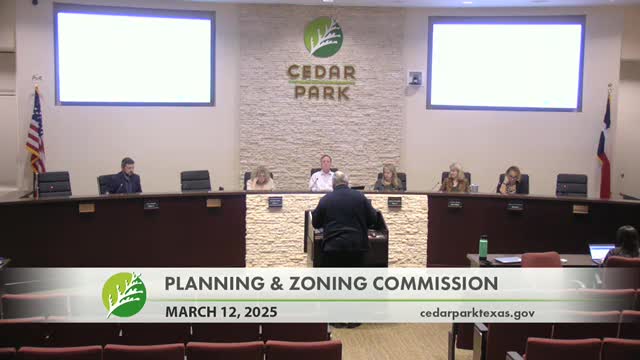
Summary
City staff summarized Cedar Park's current ADU rules, including permitted zones, size and ownership limits. A string of public comments backed more permissive ADU rules, but commissioners said they will watch pending state legislation before pursuing changes locally.
At the March 2025 Planning and Zoning Commission meeting, City of Cedar Park staff gave an overview of the municipality—s accessory dwelling unit (ADU) regulations and commissioners discussed whether to pursue local changes.
Dustin Henry, development services, told the commission that under current Cedar Park code ADUs are permitted only as a conditional use in certain residential districts (Development Reserve, Estate Reserve, Estate Residential and Suburban Residential) and are not allowed in the city—s smallest single-family district, Semi-Urban Residential. He outlined several key standards: an ADU must be on the same lot and under the same ownership as the principal dwelling; it cannot be sold or leased independently; attached ADUs are limited by size to a maximum of 200 square feet or up to one-quarter of the conditioned space of the principal dwelling (with a practical maximum shown by staff at 400 square feet), and detached ADUs may range roughly from 400 to 650 gross square feet. Henry also noted accessory buildings must comply with height, setback and other zoning standards and that all accessory buildings together may not exceed 20% of the rear-yard area.
Henry cautioned that the Texas Legislature is considering bills this session that could affect municipal ADU rules; staff said they were monitoring four bills that might change local authority.
Public comment on the item was uniformly supportive of revising local ADU rules to allow greater flexibility. Commenters said ADUs can help aging relatives remain nearby, provide housing for young adults and expand rental options. Dustin Henry and staff summarized submitted written comments: Tom Schwert, Christina LeGrand, Darren Jurashta and other residents urged revisions to remove practical barriers in the code and to permit a wider range of ADU configurations.
Commissioners asked practical questions about lot-size and setback constraints and noted that homeowners associations and deed restrictions may still prohibit ADUs regardless of city code. Several commissioners said they favored careful review but recommended waiting to see whether pending state legislation will impose new requirements before moving forward with local code changes.
No action was taken; the item was an informational staff presentation and will return for further consideration only after staff and the commission determine whether local amendments are appropriate in light of state-level developments.
Why it matters
ADU rules affect housing supply and household options for multi-generational living and affordable in-town housing. Any local change would need to balance neighborhood character, parking and infrastructure effects, and the legal limits of local authority if state law changes.
Speakers quoted in this article are drawn from the meeting record.