Get Full Government Meeting Transcripts, Videos, & Alerts Forever!
Get email alerts on the Procurement Reform topic
No spam. Unsubscribe anytime.
Committee presses procurement reforms; small‑business officials highlight payment, training and certification hurdles
Summary
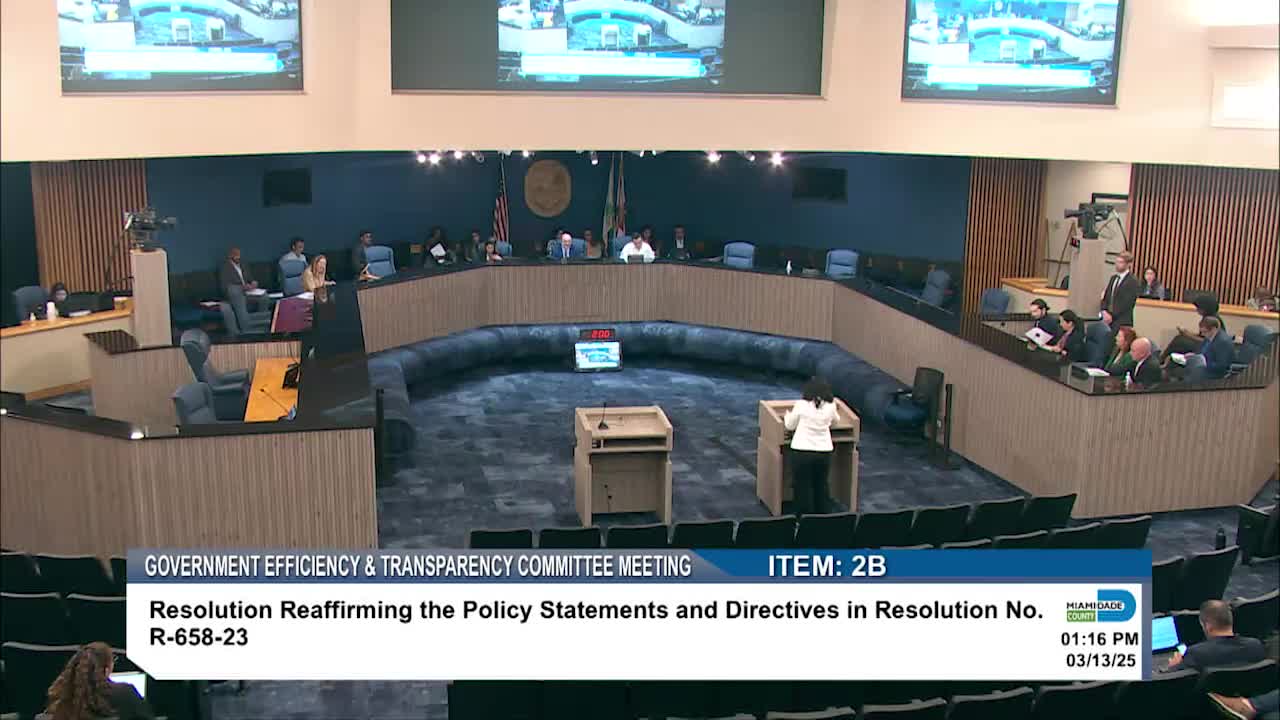
Miami‑Dade procurement and small business leaders briefed the Government Efficiency & Transparency Ad Hoc Committee on March 13 on delays in procurements, vendor registration burdens and a proposed rule change to limit post‑award contract renegotiation. Commissioners unanimously approved related amendments to procurement implementing orders.
Commissioners and procurement staff on March 13, 2025 discussed a set of administrative and legislative changes intended to shorten procurement timelines, improve notification and centralize procurement practices across Miami‑Dade County.
The conversation centered on two committee actions: an amendment to update references within Implementing Order No. 3‑38 (the county’s master procurement implementing order) and an amendment directing the county mayor to include a complete contract with RFP solicitations so that material contract terms are not renegotiated after a selection is made. Both measures were approved unanimously by the four committee members present.
Why it matters: Miami‑Dade’s procurement volume is large and complex. Namata Uppal, identified on the record as the county’s chief procurement officer, told the committee that the procurement office currently manages roughly 1,065 active contracts and 204 pool contracts with a combined portfolio value the office cited at about $12.2 billion. Uppal said the office registers roughly 12,000 vendors and that the county’s annual contract spend is about $2.9 billion.
Uppal described the county’s InForm system as the central repository for contracts and said procurement staff notify department contract managers when contracts are approaching expiration so reprocurement can begin. “For those contracts [managed by procurement], my staff is responsible to notify the department… ‘hey, your contract is gonna be up in two years,’” she said. Uppal acknowledged that many contracts still arrive at the committee after their term has expired and said the administration has initiatives underway to standardize processes across departments.
Small business concerns: Lori Johnson, who identified herself as chief of the Office of Small Business Development, described outreach and certification work focused on helping local businesses compete for county work. Johnson said the office averages about 110 certification applications monthly and currently lists about 1,700 certified firms (some firms hold multiple certifications). She highlighted the county’s mentor‑protégé program, prompt‑payment advocacy and technical assistance to help small firms prepare bids and invoices. Johnson said $265 million in expedited miscellaneous construction awards were delivered through the small‑business program in a recent period.
Commissioner debate and direction: Commissioners pressed staff on three main breakdowns they said produce late procurements: 1) notification and accountability when contracts approach expiration, 2) departments’ timely delivery of detailed scopes of work, and 3) lengthy negotiations after selection. Commissioner Regalado suggested additional checkpoints — for example, notifying committee chairs when departments have upcoming procurements — to create broader accountability beyond the procurement office. Commissioner Cohen Higgins and others argued the RFP solicitation should include the “actual contract” language so bidders must raise objections during the proposal phase rather than during post‑award negotiations. Vice Chairman Cabrera offered an amendment clarifying that no terms that materially alter the original RFP or vendor proposal shall be negotiated into the final contract; the amendment leaves a written exception for the county mayor or the mayor’s designee to justify departures for complex procurements.
Metrics and targets: Strategic Procurement presented historical RFP timing data. For procurements under $1 million, the office reported a historical median of about 251 days from proposal received date to award and proposed a target of 90–120 days, subject to internal process improvements. For procurements over $1 million, the historical median reported was 349 days; staff proposed a target of 120–150 days after internal changes. Uppal emphasized these targets are contingent on coordinating legislative changes, process standardization and more centralized use of the county’s InForm system.
Committee actions: Commissioner Cohen Higgins moved the amendment updating the implementing order references (item 2B); Commissioner Regalado seconded and the committee approved it unanimously. Vice Chairman Cabrera’s amendment to item 2C (no material post‑award alterations without justification) was moved as amended and approved unanimously.
What was not decided: Commissioners directed staff to return with more specific recommendations and implementation steps; the committee did not adopt a detailed new notification protocol or a binding penalty for late departmental responses. Staff said technology, culture change and additional training would be part of the implementation plan.
Quotes (selected):
Namata Uppal, chief procurement officer: “The way we are set up today is the contracts are in the InForm system… for those contracts, my staff is responsible to notify the department that has the allocation or the contract manager… ‘hey, your contract is gonna be up in two years.’”
Lori Johnson, chief, Office of Small Business Development: “The mayor’s commitment to the small business program is not just because we were able to spend $265,000,000 with our small business community in construction, but because each dollar spent has a multiplier effect in the small business community.”
Next steps: Procurement staff said they will continue internal process work, return to the committee with legislative recommendations to streamline checks, and collaborate with small business staff on outreach and prompt‑payment monitoring.