Get Full Government Meeting Transcripts, Videos, & Alerts Forever!
Get email alerts on the Education Device Policy topic
No spam. Unsubscribe anytime.
Senate approves one-year 'bell-to-bell' cell-phone restriction for Oklahoma public schools
Summary
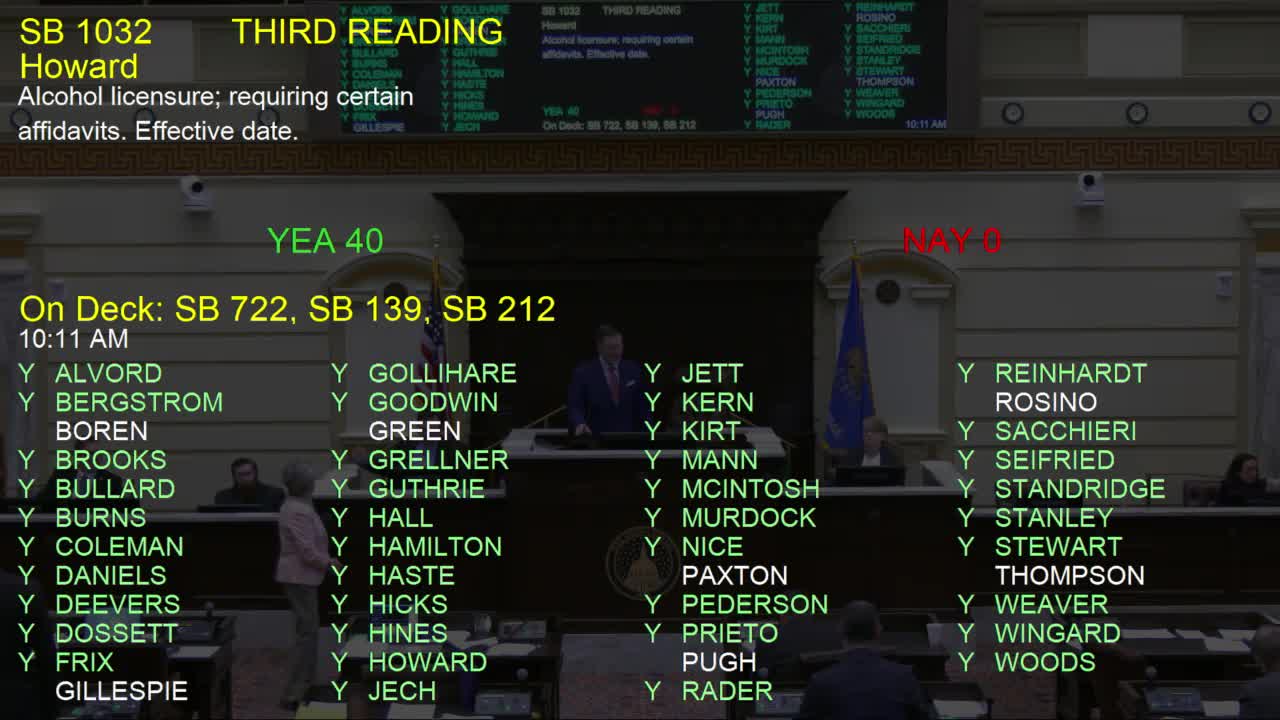
On third reading the Oklahoma Senate passed Senate Bill 139, establishing a one-year statewide bell-to-bell ban on student cellphone use during instructional time and advancing the bill as an emergency measure.
The Oklahoma Senate passed Senate Bill 139 on third reading, imposing a one-year statewide restriction on student cellphone use during instructional hours and advancing the measure as an emergency measure. The body recorded multiple roll calls: the initial passage on final reading was recorded as 30 ayes and 15 nays; the subsequent roll on emergency status recorded 36 ayes and 8 nays after changes were entered.
Senator Seifried, the bill's sponsor, told the Senate she sought a one-year, statewide standard to give school districts and communities a uniform approach to reduce distraction and harm linked to student device use. "I'm asking for 1 year," Seifried said on the floor, describing the proposal as a temporary, uniform approach to support classroom instruction and student well‑being.
Proponents, including Senator Pew and others, pointed to research and examples from districts that adopted similar policies, arguing the policy can reduce behavioral problems and improve focus. "The addiction to cell phones, to devices, to digital technology, I think, is ruining young people's academic and educational experiences," Senator Pew said in floor debate, citing research and local reports of academic and mental-health impacts.
Opponents urged deference to local control and warned the policy shifts enforcement burdens to teachers and districts. Several senators expressed concern about unfunded implementation costs for large districts and the potential for parental pushback; some members argued boards and local superintendents should continue to set policy. The floor adopted an amendment to delay mandatory district action until the 2026–27 school year for optional adoption in the 2025–26 school year.
The chamber recorded the bill as advanced as an emergency measure later in the session. The bill as adopted requires local school districts to follow a uniform bell‑to‑bell restriction during the specified period, with mechanisms for limited exemptions. The Senate's action sends the measure forward in the process required for consideration by the other legislative chamber and for any additional steps required to enact emergency provisions.