Get Full Government Meeting Transcripts, Videos, & Alerts Forever!
Get email alerts on the Agrivoltaics Solar Development topic
No spam. Unsubscribe anytime.
Senate approves bill setting standards for solar development on agricultural and Commissioners of the Land lands
Summary
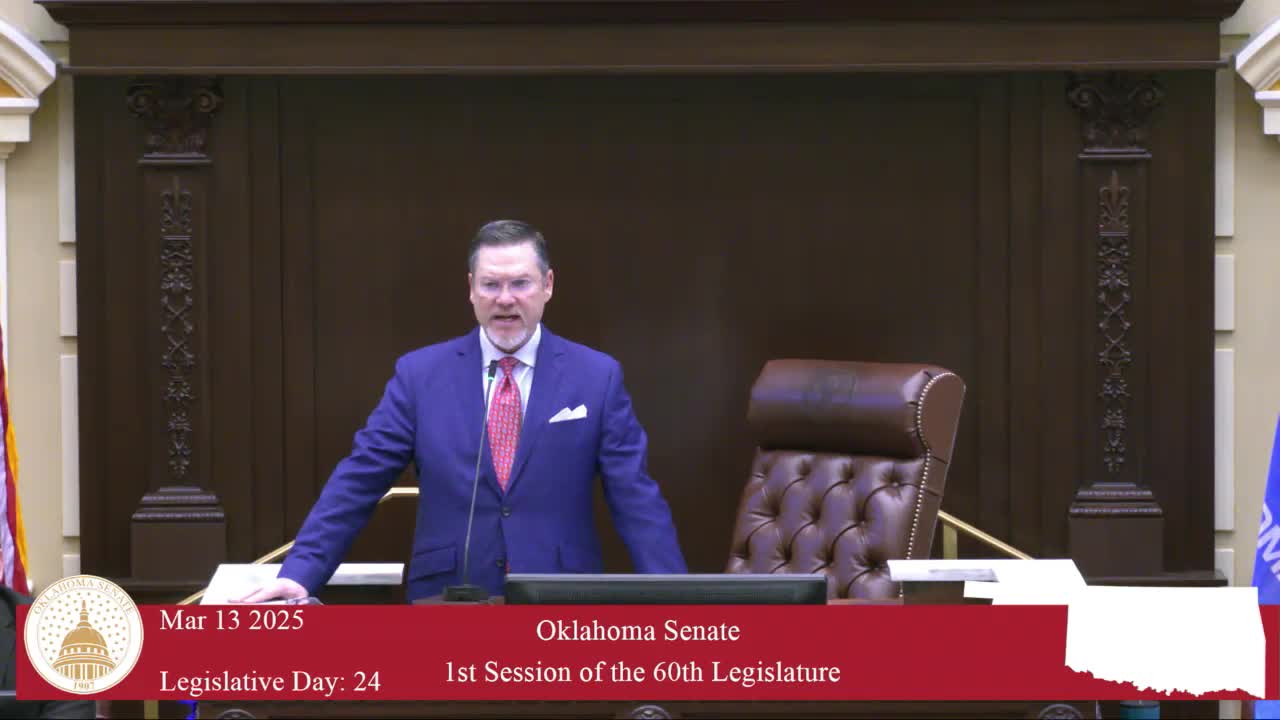
The Oklahoma Senate voted to pass Senate Bill 915, which sets state standards for commercial solar projects on agricultural and Commission-owned (CLO) lands, including minimum panel height, spacing and tax assessment rules; the bill passed on third reading.
Senators on the Oklahoma Senate advanced and passed Senate Bill 915, a measure authors said sets statewide standards for commercial solar development on agricultural land and land managed by the Commissioners of the Land (CLO). The bill passed on third reading with a recorded roll showing 43 ayes and 3 nays.
Supporters said the bill aims to preserve agricultural uses while giving landowners options to lease land for solar. "65,000, that's how many acres is in the queue for solar in Oklahoma," Senate Greene said during explanation of the bill, citing acreage the author said is proposed for solar development. Greene told colleagues the measure would allow ranchers to retain grazing while receiving lease revenue and would require certain construction and reclamation responsibilities by developers.
The bill includes minimum heights for ground-mounted panels, spacing requirements between panel rows, and a requirement that CLO lessees pay a payment in lieu of ad valorem taxes to counties where commercial facilities are installed. During questioning, the author pointed to language in the bill that sets a 6-foot minimum height above ground, explaining: "At 6 foot, it would keep cattle from rubbing on those panels." Senators pressed the author on whether the 6-foot standard had been tested against heights for other animals such as horses or bison; the author said the height was informed by examples in other states and his experience raising cattle, and that some adjustments could be negotiated between landowners and developers.
Opponents and questioners raised concerns about definitions and implementation. Senators asked whether the bill defines commercial facility size thresholds by kilowatts; the author replied that the bill uses the commercial/"distributed generation" definitions found elsewhere in state statute. Committee members and senators during debate urged clearer language around agrivoltaics — the practice of combining agriculture and solar on the same footprint — and urged the legislature to protect productive farmland. "I wish the bill had a definition of agrivoltaic," Senator Bourne said in floor debate, arguing that the industry could negotiate contracts that place panels at ground level and preclude agricultural uses unless the statute requires otherwise.
The bill also directs that CLO make payments in lieu of ad valorem taxes for commercial facilities and includes language that companies would be liable for site restoration for the life of the project. Senators asked about lease lengths and the expected project lifetime; the author and questioners referenced typical lease terms of 10 years and said more detailed bonding and cleanup language was being coordinated with House counterparts. The bill was advanced and passed on third reading; the author also asked that the vote be considered the vote on the emergency status, and the clerk recorded the bill as passed on final reading.
The measure now moves to the next steps in the legislative process as required by law.